
How can I make my paid ads profitable again?
If your paid ads look fine in dashboards, but the pipeline isn’t growing, you’re not alone.
Ad costs are rising. Buyers are harder to influence. And metrics that used to signal success like clicks, leads, low CPL, don’t mean what they used to.
In a webinar we hosted, Devin Littlefield (CEO of Market Vantage) explained why the traditional paid ads playbook no longer works and how B2B teams are cutting wasted ad spend without sacrificing pipeline. This article covers the main ideas Devin presented during the webinar.
You can watch the webinar here.
TL;DR
- Paid ads aren’t broken, but the old way of measuring them is
- Rising costs expose weak targeting and weak qualification faster
- Clicks, leads, and low CPL no longer reflect real performance
- The best teams measure paid ads by pipeline and sales acceptance
- Integrated, multi-channel campaigns outperform standalone paid ads
- Clear ICPs and sales alignment reduce wasted spend
- Experimentation only works when learnings change future decisions
- Cutting underperforming programs is necessary to improve results
Why the Paid Ads Playbook Has Changed
B2B teams often assume paid ads stopped working because ad platforms changed. In reality, the problem runs deeper than platform updates or new ad formats. Paid advertising has become harder because several structural shifts are happening at the same time.
Google Ads CPCs are up roughly 13% year over year, while LinkedIn CPCs jumped as much as 147% between 2024 and 2025. At the same time, buyers increasingly educate themselves before engaging with sales. In fact, 94% of B2B buyers now use AI tools during the buying process, which means many prospects form opinions long before clicking an ad or filling out a form.
Despite these challenges, paid media still accounts for around 30% of total marketing spend. When a large share of the budget goes to paid ads, teams can no longer afford campaigns that look good on the surface, but fail to produce a real pipeline.
That pressure is only increasing. Our recent research shows that GTM teams are actively shifting more budget into paid media, with nearly half doing so specifically to offset declines in organic and inbound channels.
The outcome of the “old approach” is predictable: higher spend, lower returns, and declining lead quality. Paid ads now demand far greater precision. Teams that cannot clearly connect ad spend to pipeline and revenue are under more scrutiny and are often the first to face cuts when budgets tighten.
Integrated, Multi-Channel Campaigns Perform Better
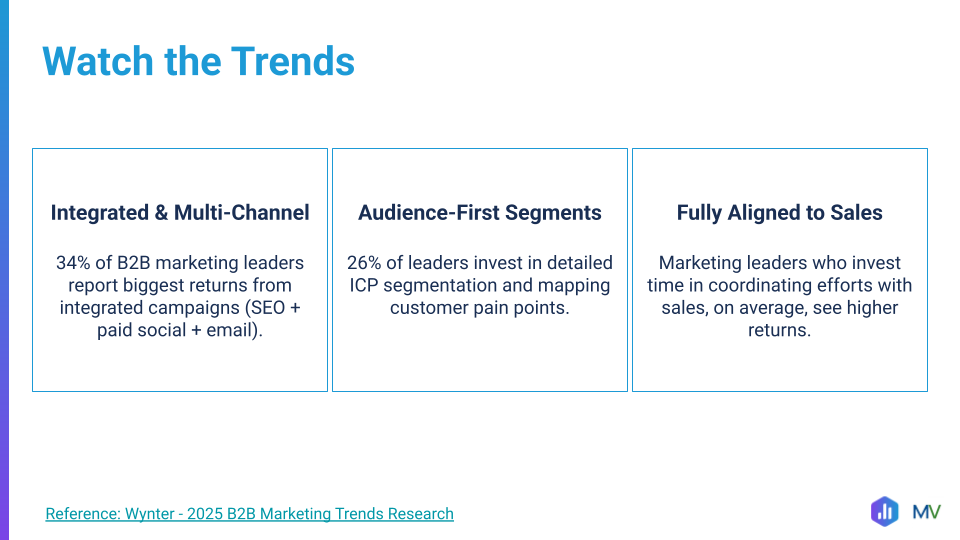
Paid ads perform best when they work together with other channels, like SEO, email, and sales outreach. In these setups, paid ads reinforce messages prospects already see in other places. This consistency helps build familiarity, reduces friction when sales reaches out, and shortens the time it takes for buyers to move forward. As a result, paid ads become more efficient, even when costs are higher.
By contrast, running paid ads as a standalone growth lever is becoming increasingly inefficient, as they struggle to create meaningful momentum on their own.
Audience-First Segmentation Beats Keyword-First Targeting
One of the most overlooked opportunities in B2B paid advertising is proper ICP definition. Many teams jump straight into tactics, bidding on high-intent keywords, launching broad LinkedIn campaigns, or testing ad copy, without first being clear on who they are trying to reach.
Teams that consistently outperform define their ideal customer profile, map buying committees, and align messaging to specific customer pain points. While it may seem foundational, a strong understanding of the audience influences which keywords you target, how you structure campaigns, and how you evaluate lead quality. Without that foundation, optimization efforts tend to focus on surface-level improvements that don’t translate into better pipeline.
Sales Alignment Is a Must
Optimizing paid ads for sales-accepted leads instead of raw lead volume helps reduce waste and makes paid spend easier to justify internally.
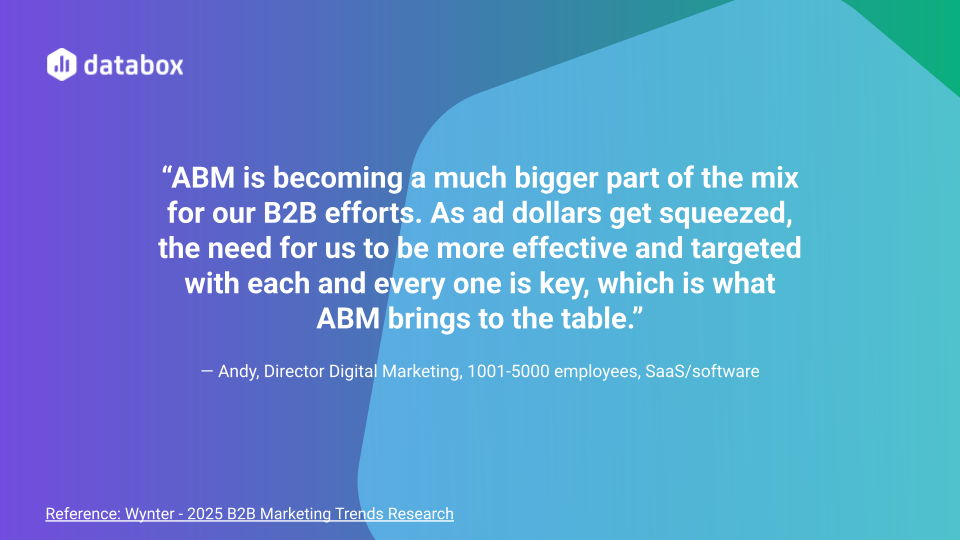
Account-based marketing (ABM) performs well in B2B because it forces marketing and sales to align on target accounts, qualification criteria, and success metrics. It replaces volume with intent, so paid ads are aimed at accounts sales wants to win, not at everyone who might click, generating fewer, but better, leads.
ABM is not a shortcut. It only works when account lists are well-defined, sales is involved, and paid performance is evaluated beyond lead volume.
The Metrics That Actually Matter in 2026
Companies often fall into designing paid ads dashboards to be reassuring rather than revealing, featuring metrics like click-through rate, cost per click, and cost per lead. These metrics do not show whether paid ads are driving business growth.
- The metrics that matter most today focus on outcomes, not activity. These include:
- Number and value of deals influenced by paid ads.
- Customer acquisition cost (CAC),
- Cost per lifecycle stage (such as sales-accepted leads and opportunities),
- Lifetime value (LTV),
- Return on ad spend (ROAS),
- Payback period, and
- Number and value of deals influenced by paid ads.
If paid spend cannot be tied to pipeline or sales conversations, optimization becomes guesswork. Teams may still see leads coming in, but they lack the insight needed to decide what to scale, what to cut, and where to invest next.
That’s why teams like Market Vantage blend paid ad data with HubSpot lifecycle and CRM outcomes in Databox. By combining Google Ads, LinkedIn Ads, HubSpot Marketing, and HubSpot CRM data into a single scorecard, they can track paid performance from first click all the way through revenue.
The Framework That Wins: Reach Your P.E.A.K.
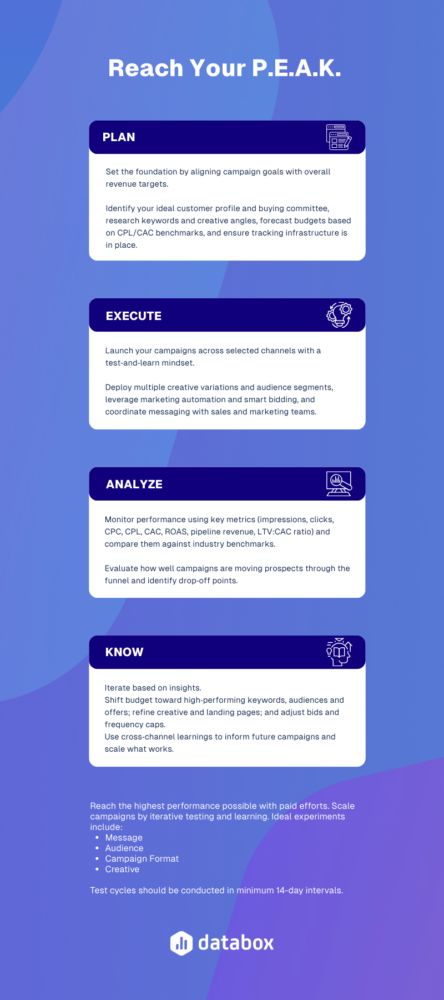
To make experimentation repeatable instead of chaotic, Devin introduced the P.E.A.K. framework – a simple way to test, evaluate, and scale paid ads based on real outcomes.
Plan starts with clarity. Teams define their ideal customer profile and buying committees, align paid goals to revenue targets, forecast budgets using realistic CAC and LTV assumptions, and ensure CRM and ad platforms are properly connected.
Execute is where testing happens. Campaigns are launched with multiple variants, including different audiences, messages, formats, and creative. Messaging stays aligned with sales and lifecycle stages to ensure consistency.
Analyze goes beyond lead counts. Performance is evaluated based on sales acceptance, pipeline influence, and where prospects drop out of the funnel.
Know is the step many teams skip. Learnings are applied decisively—underperforming campaigns are cut, successful approaches are scaled, and insights are carried across channels.
The key idea is simple: experimentation only matters if it changes future decisions.
Cutting Paid Ad Waste Requires Tough Decisions
One theme that came up during the webinar was the need to cut underperforming programs without hesitation.
B2B teams often keep campaigns running because they look “okay” in dashboards, they worked in the past, or because no one feels confident enough to turn them off. Over time, this creates a drag on performance and makes it harder to see what’s actually working.
However, cutting ruthlessly doesn’t mean cutting blindly. It means being clear about which metrics matter, evaluating campaigns against those outcomes, and being willing to shut down programs that don’t contribute to pipeline, even if they generate clicks or leads.
In the webinar, Devin shared how teams use pipeline signals, deal velocity, and sales acceptance to decide what to scale, what to pause, and what to kill entirely.
Want to See How Teams Make These Decisions?
In the webinar, Devin walks through real examples of how B2B teams:
- identify wasted spend
- decide when a campaign has run long enough
- cut programs without hurting pipeline
- and reallocate budget with confidence
If you’re struggling to decide what to scale, pause, or shut down, the full session is worth watching.
Frequently Asked Questions
Why do paid ads look successful but pipeline isn’t growing?
Because many teams still optimize for clicks and leads instead of sales outcomes. These metrics don’t reflect lead quality or pipeline contribution.
Are paid ads still effective for B2B companies?
Yes, but only when they are measured against pipeline and revenue. Paid ads that can’t be tied to sales conversations create false confidence.
What’s the biggest source of wasted paid ad spend?
Broad targeting and early-stage metrics. When campaigns are judged before sales impact is visible, waste is easy to miss
Why does ICP definition matter so much for paid ads?
Because it affects everything: targeting, messaging, keyword selection, and lead quality. Without a clear ICP, optimization focuses on surface-level improvements.
Is account-based marketing required for paid ads to work?
No, but alignment with sales is. ABM works when account lists are well-defined, sales is involved, and success is measured beyond lead volume.
Which paid ads metrics matter most today?
Customer acquisition cost (CAC), sales-accepted leads, opportunities, deal value, and payback period matter more than clicks or cost per lead.
How do teams know when to cut a paid campaign?
That depends on deal velocity and pipeline signals. In the webinar, Devin shares how teams use sales acceptance and pipeline data to make these decisions.