Stop looking for an AI Analytics tool. Start looking for an analytics protocol.
That advice sounds counterintuitive. Everyone’s searching for “the best AI analytics platform” or “which BI tool has the best AI.” But that framing misses what’s actually happening in the market, and why most AI analytics implementations fail to deliver on their promise.
Here’s the uncomfortable truth: if you buy a tool with built-in AI today, you’re betting that its AI will still be competitive in 18 months. Given how fast this space moves, that’s a risky bet. GPT-5 launches, Claude gets smarter, Gemini adds new capabilities, and you’re stuck with whatever model your vendor decided to hardcode into their platform last year.
The companies getting AI analytics right aren’t shopping for a single tool. They’re building a stack where any AI can talk to their data.
The Real Problem with Analytics Today
Before we get into what AI analytics is, let’s be honest about what’s broken.
The Waiting Game. You need an answer now, but your analyst is swamped with three other requests. By the time you get the data, the moment has passed. The campaign you could have paused kept spending. The opportunity you could have seized went to a competitor.
The Wrong Question. The dashboard answers the question it was built for. But you have a follow-up. Or the context changed. And suddenly that beautiful visualization is useless. You’re back to exporting CSVs and trying to find someone who knows SQL.
Data Silos Everywhere. Your marketing data lives in HubSpot. Finance is in Xero. Sales is in your CRM. Advertising is split across Google, Meta, and LinkedIn. You can’t see how they connect without wrestling with spreadsheets or begging your data team for a custom report.
These problems aren’t new. What’s new is that AI can actually solve them now—if you set things up correctly.
What AI Analytics Actually Means
AI analytics is the application of artificial intelligence—machine learning, natural language processing, pattern recognition—to process, analyze, and interpret business data.
But that definition undersells the shift. The real change is about who can ask questions and how fast they get answers.
Traditional analytics requires someone to build the report before you can read it. Someone has to anticipate your question, design a dashboard for it, and keep that dashboard updated. If your question doesn’t fit an existing report, you wait.
AI analytics flips this model. You ask a question in plain language. The AI figures out where the data lives, how to query it, and how to present the answer. No SQL. No dashboard building. No waiting.
What this means in practice: Instead of asking your data team, “Can you pull last month’s CAC by channel?”, you ask the AI directly. It queries your ad platforms, calculates the numbers, and gives you an answer in seconds. Then you can ask follow-ups: “How does that compare to Q3?” “Which channel had the biggest change?” “What’s driving the increase in paid social?”
The conversation continues until you have what you need. No tickets. No queue. No context lost between back-and-forth emails.
Why “Big Data” AI Strategies Fail for Most Businesses
Here’s where most AI analytics content goes wrong.
Read IBM’s take on AI analytics. Look at Gartner’s recommendations. Scan through enterprise BI vendor materials. They all assume the same thing: you have a data warehouse. Your data lives in Snowflake, BigQuery, or Redshift. You have data engineers maintaining pipelines. You have a semantic layer mapping business terms to database tables.
That describes maybe 10% of businesses.
The other 90%, like agencies, SMBs, and growing SaaS companies, have “small, scattered data.” Not small in importance. Small in the sense that it doesn’t live in a centralized warehouse. It’s distributed across 30 or 50 SaaS tools, each with its own API, its own data model, its own quirks.
When these businesses try to implement “enterprise AI analytics,” they hit a wall. The AI needs clean, structured, centralized data. They have fragments spread across HubSpot, Stripe, Google Analytics, QuickBooks, and a dozen other platforms.
The solution is simpler than you think. You don’t need a six-month data warehouse project before AI can help you.
The solution is federated AI analytics. AI that can query your SaaS tools directly through their APIs, without requiring you to build a data lake first. Lightweight AI that reads from your existing dashboards and connected platforms, rather than heavy AI that demands a SQL database.
This matters because the future of AI analytics will be split into two paths:
- Heavy AI: Requires data engineering, warehouses, semantic layers, and significant infrastructure investment. Works beautifully if you have the resources.
- Lightweight AI: Connects to your existing tools via APIs, pulls data on demand, and gives you answers without the infrastructure overhead.
Most content about AI analytics assumes Heavy AI. But Lightweight AI is what actually works for the majority of businesses today.
The Hierarchy of Autonomy: From Dashboards to Agents
Traditional explanations of AI analytics list four types: descriptive, diagnostic, predictive, and prescriptive. That framework is accurate but misleading; it presents them as equal categories you pick from, like choosing a flavor of ice cream.
In reality, they’re levels. A ladder of increasing autonomy. And understanding this ladder reveals where AI analytics is actually heading.
Level 1: Reporting (The Dashboard Era)
This is where most companies still operate. Dashboards show what happened. Someone builds a report, data refreshes on a schedule, and users log in to check the numbers.
The AI enhancement at this level is mostly cosmetic. Maybe there’s a chat interface to “ask questions about your dashboard.” Maybe the system highlights anomalies automatically. But the core model is unchanged: humans observe, then humans decide, then humans act.
The limitation: Dashboards answer the questions they were designed for. When the situation changes or you have a follow-up, you’re stuck.
Level 2: Conversational (The Chatbot Era)
This is where most “AI analytics” products live today. You type a question in natural language. The AI translates it into a query, runs it, and returns an answer.
It’s genuinely useful. Someone who doesn’t know SQL can now explore data independently. The time from question to answer drops from days to minutes.
But there’s a ceiling. Conversational AI is still passive. It waits for you to ask. It answers, then stops. The gap between insight and action remains—you still need to interpret the answer, decide what to do, and execute manually.
The limitation: Chatting with data is valuable, but it’s still observation. The AI tells you what happened. You have to figure out what to do about it.
Level 3: Agentic (The Action Era)
This is where things get interesting, and where the real shift is happening.
Agentic analytics means AI that doesn’t just answer questions but takes action. Agents that monitor data continuously, detect issues before you notice them, diagnose root causes automatically, and execute responses within boundaries you define.
The difference between conversational and agentic is the difference between a research assistant and an operations manager. The research assistant finds information when you ask. The operations manager notices problems, investigates them, and handles routine responses without being asked.
What this looks like in practice:
Consider a marketing agency managing ad spend across multiple clients. Today, someone checks dashboards every morning, looking for campaigns that overspent or underperformed. When they find one, they investigate, then manually adjust budgets or pause ads.
With agentic analytics:
- An agent monitors all campaigns continuously
- When CPA spikes 30% above target, the agent detects it immediately
- The agent segments data to identify the cause: mobile traffic from one specific ad creative is converting at half the normal rate
- The agent pauses the underperforming creative and reallocates budget to better-performing variants
- The agent logs the action and notifies the account manager with a summary
The human doesn’t discover the problem. The human reviews what the agent already solved.
Gartner’s 2025 Data & Analytics trends identify agentic analytics as a top priority, predicting that by 2027, autonomous analytics platforms will fully manage and execute 20% of business processes. The shift from passive observation to active participation is already underway.
Why Protocol Beats Platform
Here’s where most people make a strategic mistake.
They see the power of AI analytics and go shopping for a platform that has it built in. “I need a BI tool with AI.” “Which analytics platform has the best chatbot?” “Who has agentic features?”
This makes sense, until you think about what you’re actually buying.
When you buy a platform with built-in AI, you’re buying their AI. Their choice of model. Their implementation. Their update schedule. If they built on GPT-4 and GPT-5 is 10x better, you wait for them to upgrade. If they chose Claude and you prefer Gemini, too bad. If a new model launches that’s perfect for your use case, you can’t use it.
You’ve outsourced one of the most important technology decisions of the next decade to your BI vendor.
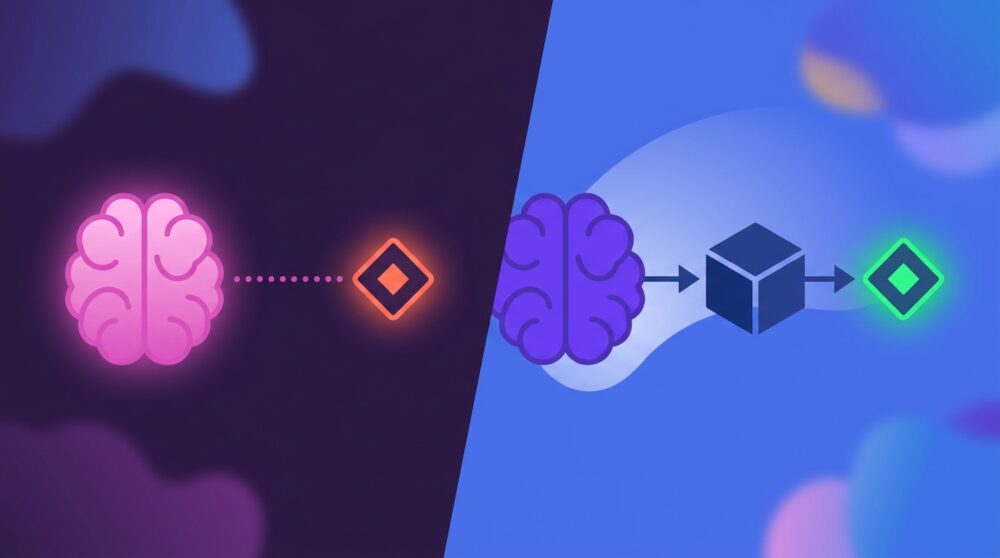
The alternative is the BYOB approach: Bring Your Own Brain.
Instead of buying a tool with embedded AI, you separate the data layer from the intelligence layer. Your analytics platform handles the data: connecting sources, maintaining quality, and providing access. The AI handles the thinking: answering questions, finding patterns, and taking actions.
When a better AI comes along, you swap it in. When your needs change, you switch models. You’re not locked into anyone’s roadmap.
The role of the analytics platform in this model changes. It’s no longer trying to be the brain. It’s the nervous system—the infrastructure that feeds clean, reliable data to whatever AI you choose.
This is where the Model Context Protocol (MCP) becomes relevant.
How AI Actually Connects to Your Data
MCP is an open standard that defines how AI systems connect to external data sources and tools. Instead of every AI building custom integrations with every platform, MCP provides a universal interface.
Think of it like USB for AI. Before USB, every device needed its own proprietary connector. After USB, you could plug anything into anything. MCP does the same thing for AI-to-data connections.
Why this matters for analytics:
Before MCP, if you wanted Claude to access your business data, you needed custom development. If you wanted ChatGPT to query your dashboards, more custom development. If a new AI came out, you’d start from scratch.
With MCP, a platform exposes one interface. Any MCP-compatible AI can connect immediately. Claude, ChatGPT, Gemini, whatever comes next—they all speak the same protocol.
What this means in practice: Your analytics platform builds one MCP server. Suddenly, it works with every major AI. You’re free to use whichever model fits your needs today, and switch to a better one tomorrow.
However, most business users won’t interact with MCP directly. The more common experience is app-style integrations—connecting your BI platform to Claude through OAuth, similar to connecting any other SaaS tool. The technical complexity happens behind the scenes.
The point here is practical, not technical. The protocol enables flexibility. When you choose a platform that supports open standards like MCP, you’re not betting on a single AI. You’re betting on all of them.
A Tale of Two Disruptions
Let’s make this concrete with a single scenario: your e-commerce business sees a sudden drop in conversion rate.
The Old Way (Dashboard Era):
- Tuesday morning: You notice the dashboard shows conversion dropped 15% yesterday
- You email your analyst asking for a breakdown by traffic source and device
- Wednesday afternoon: The analyst sends back a report showing that mobile traffic from paid social is the problem
- You ask for a comparison to the previous period
- Thursday morning: The analyst shows that mobile paid social conversions started dropping after a checkout page update last Friday
- You schedule a meeting with the dev team to discuss a fix
- Friday: The meeting happens. You decide to roll back the change
- Monday: The rollback goes live. You’ve lost a week of conversions
The New Way (Agentic Era):
- Tuesday 2:00 AM: An agent detects a drop in conversion rate in real-time
- Tuesday 2:01 AM: The agent automatically segments by traffic source, device, and time period
- Tuesday 2:02 AM: The agent identifies that mobile paid social conversions dropped starting Friday at 3:47 PM
- Tuesday 2:03 AM: The agent cross-references this with deployment logs and finds a checkout page update at 3:45 PM Friday
- Tuesday 2:05 AM: The agent creates an incident report, links the likely cause, and notifies the on-call engineer
- Tuesday 6:00 AM: You wake up to a summary: “Conversion issue detected, likely caused by Friday’s checkout update. Engineering notified. Estimated revenue impact: $12,400. Rollback recommended.”
- Tuesday 9:00 AM: Rollback complete. Total time from problem to solution: 7 hours instead of 7 days
Same underlying analytics capabilities: identifying what happened, diagnosing why, and predicting impact. But the difference in how quickly insights become action determines whether you lose $12,000 or $84,000.
Getting Started (Without a Data Warehouse)
If you’re sold on AI analytics but don’t have enterprise data infrastructure, here’s the practical path forward:
1. Start with connected data, not centralized data. You don’t need everything in a warehouse. You need your SaaS tools talking to a platform that can query them all. Most modern analytics platforms offer dozens or hundreds of native integrations. Start there.
2. Pick a platform that plays well with external AI. Look for MCP support or similar open protocols. Ask vendors: “Can I connect my own AI models, or am I stuck with yours?” The answer tells you whether you’re buying flexibility or lock-in.
3. Begin with conversational, graduate to agentic. Don’t try to automate everything immediately. Start by giving your team the ability to ask questions in natural language. Once they’re comfortable and you understand the patterns, identify repetitive decisions that agents could handle.
4. Define boundaries before you automate. Agentic analytics requires trust, and trust requires clear boundaries. What can the agent do without approval? What requires human sign-off? What’s completely off-limits? Set these guardrails before you give AI any authority to act.
5. Measure time-to-action, not time-to-insight. The traditional analytics metric is “how fast can I see a dashboard?” The AI analytics metric should be “how fast does an insight become an action?” That’s where the real value lives.
The Bottom Line
AI analytics is often presented as a single capability: “Ask questions in natural language!” But that’s like describing a smartphone as “a device that makes phone calls.” True, but missing the point.
The real shift is from passive observation to active participation. From dashboards you check to agents that act. From locked-in platforms to interoperable protocols. From enterprise-only infrastructure to lightweight AI that works with the scattered SaaS data most businesses actually have.
The companies that figure this out will make faster decisions, catch problems earlier, and execute responses while competitors are still scheduling meetings to discuss the dashboard.
The ones that don’t will keep waiting for reports.
Stop reading about the future of data and start experiencing it. Try Databox for free for true AI-powered business analytics. Connect your sources in seconds and use our analytics MCP to chat with, monitor, and act on your data directly inside Claude, n8n, and your favorite AI tools.
Frequently Asked Questions
Do I need a data warehouse for AI analytics?
No. While enterprise AI solutions often assume centralized data infrastructure, federated approaches can query your SaaS tools directly through APIs. This “lightweight AI” model works well for agencies and SMBs with data spread across multiple platforms.
What’s the difference between conversational and agentic analytics?
Conversational AI waits for questions and provides answers. Agentic AI monitors data continuously, identifies issues proactively, and can take action automatically within defined boundaries. The difference is passive vs. active—observation vs. participation.
Should I buy an analytics platform with built-in AI?
Consider whether you want to be locked into that vendor’s AI choices. Platforms that support open protocols like MCP give you flexibility to use different AI models as the technology evolves. Built-in AI can work, but you’re betting on that vendor’s AI roadmap.
How do I know if my business is ready for agentic analytics?
Start with conversational. If your team is asking repetitive questions and making routine decisions based on the same patterns, those are candidates for automation. Agentic analytics works best when you can clearly define the boundaries of what the agent should handle.
What’s MCP and do I need to understand it?
MCP (Model Context Protocol) is an open standard for connecting AI systems to data sources. You don’t need to understand the technical details—it works behind the scenes. What matters is choosing platforms that support open standards, so you’re not locked into a single AI vendor.