
How can I measure AI search traffic effectively?
AI answer engines are becoming a default step in B2B discovery. Instead of scanning ten blue links, buyers now ask one complex question in ChatGPT, Gemini, Perplexity, or Google AI Overviews — and get a single synthesized recommendation.
If your brand isn’t part of those answers, you risk disappearing at the exact moment buyers decide.
Databox’s latest research shows this shift is already happening. In our survey of 90+ SEO pros and digital marketers, about one-third said generative AI is changing audience search habits and pulling attention away from traditional search, leading to reduced website traffic.
At the same time, respondents were clear that SEO still drives most traffic and conversions today. So this isn’t an “SEO is dead” story. It’s an “SEO is splitting into new surfaces” story — and AI visibility is now one of them.
Even with AI chats pulling attention, traditional SEO is still doing the heavy lifting today. In our survey, respondents estimated that about 84% of their overall site traffic still comes from classic SEO, compared to AI-driven answer engines.

To help marketers adapt, we hosted a webinar with Rick Kranz (Founder, AI Marketing Automation Lab) on the new rules of AI visibility. Watch it on demand here: https://databox.com/ai-seo-new-rules-get-found-chatgpt-ai-search
However, it’s important to note here that everyone defines ‘virality’ differently. For the purpose of surveying our respondents for this piece, we defined viral videos as “videos that got millions of views in a few weeks.” However, when we asked companies to share their videos, only a couple met these criteria — telling us virality means different things to different people.
TL;DR
To show up in ChatGPT results consistently, and to optimize for AI answer engines like Gemini, Perplexity, Copilot, and AI Overviews, you need content that adds proprietary information, answers specific long-tail prompts directly in the first 45 words, uses clean structure and FAQ schema so AI can parse it, and includes best-fit comparisons so the model knows when to recommend you.
If you’re wondering how to show up in ChatGPT results, this framework is the shortest path from “invisible” to “citation-ready.” Brands that do this consistently often start seeing AI mentions within weeks, depending on how quickly their pages are crawled and picked up.
This article is actually structured according to this framework, making it easy for both humans and AI to understand!
What’s Changing in Search Right Now
AI search isn’t a “maybe someday” behavior — it’s already influencing how people discover products and solutions.
Databox research confirms a real behavioral shift: in our survey, about a third report that audiences are spending more time in AI chats/direct answers, which is starting to affect organic traffic patterns.

So what’s driving that shift?
Rick Kranz’s framing from the webinar explains why users are moving this way:
“Google was an answer engine. AI is an action engine.”
In Google, users typically get a list of options and do the work of comparing them. In AI answer engines, users get a synthesized, decision-ready response in one step. That compressed journey is exactly what makes AI chats feel faster and “good enough” for search — and it’s why more people are using them in the first place.
What AI Engines Actually Reward
Rick’s golden rule from the webinar is blunt:
Originality or invisibility.
AI engines don’t need another generic remix of what already ranks. If your content is commodity text, the model already knows it — so it won’t cite you.
AI does reward content that is:
- Proprietary (original data, internal benchmarks, lived experience)
- Specific (long-tail, conversational prompts)
- Structured (clear hierarchy, skimmable chunks)
- Best-fit oriented (comparisons that explain differences)
Rick Kranz’s 5 Pillars of AI Visibility
AI visibility can feel fuzzy because there isn’t one “AI algorithm” you can game the way people used to game Google. People often describe the goal as trying to rank in ChatGPT, but what you’re really doing is making your content retrieval-worthy across multiple systems. Different answer engines (ChatGPT, Gemini, Perplexity, AI Overviews) are built differently, but they share a common behavior: they pull from sources they trust, and they prefer sources that are easy to parse and clearly relevant to the prompt.
Rick Kranz’s 5 pillars are a practical AI SEO framework for earning that trust and relevance. Think of them as the minimum set of conditions your content needs to meet to get found in ChatGPT and other AI answers. They don’t replace traditional SEO – they sit on top of it and help your existing content surface inside AI recommendations.
- Pillar 1 — Proprietary Knowledge Strategy
- Pillar 2 — Direct Answer Strategy (First 45 Words)
- Pillar 3 — Structure for Machines
- Pillar 4 — Best-Fit Comparisons + Tables
- Pillar 5 — JSON FAQ Schema (Non-Negotiable)
Pillar 1 — Proprietary Knowledge Strategy
AI cites what teaches it something new. So don’t write from SERP consensus.
Write from your own “truth bank”:
- original research
- product facts
- real customer outcomes
- defendable POVs
Pillar 2 — Direct Answer Strategy (First 45 Words)
AI doesn’t want a long intro. It wants the answer now.
Rule:
- First paragraph = direct answer to the query.
- Immediately follow with TL;DR bullets.
Pillar 3 — Structure for Machines
AI agents don’t read pages like humans. They parse HTML hierarchy first — headers, nesting, and structured chunks. If your structure is messy, your meaning gets lost.
Checklist:
- One clear H1
- H2s that match real buyer prompts
- Short paragraphs
- Bullets for steps/criteria
Pillar 4 — Best-Fit Comparisons + Tables
AI agents love comparison tables because they’re easiest to parse. And if you don’t list competitors or alternatives, AI will define the comparison for you.
Mark the key nuance: comparisons shouldn’t be a fight. They should be a best-fit guide.
Example best-fit table (diplomatic):
| Option | Best for | Not best for |
| Databox AI Traffic Dashboard | Teams who want AI referrals + signups tracked in one place | Teams only tracking mentions |
| Prompt/rank tools | Checking if brand appears in AI output | Proving ROI from AI traffic |
| Manual GA4 filtering | Analysts who want custom work | Busy marketers needing a template |
Pillar 5 — JSON FAQ Schema (Non-Negotiable)
Rick calls schema a “nutrition label for content.” It tells AI exactly what your page says.
Two rules:
- Your visible HTML FAQ must match your JSON FAQ exactly.
- Generate the FAQPage JSON-LD quickly with AI and paste it in.
How to Scale AI Visibility Without Burning Out Your Team
AI search creates a long-tail demand explosion. You can’t cover it with a handful of giant pillars.
The scalable play is:
- publish many high-specificity answers
- each structured cleanly
- each anchored in proprietary truth
- each aimed at a narrow prompt
That’s “quality over quantity” in practice: fewer generic posts, more specific answers that compound.
How to Measure AI Search Traffic
As AI answers grow, AI search traffic becomes a real pipeline variable you need to track, not a vague brand metric. You need to track:
- which AI engines send sessions
- which pages earn AI visibility
- and whether those sessions convert
If you want to see exactly how much traffic ChatGPT, Gemini, Perplexity, Copilot, and Google AI Overviews are sending — and which pages are earning that visibility — start with this free template: Track AI Search Engine Traffic with this Databox Dashboard Template.
It shows:
- Sessions AI Traffic per Session Source
- Total Sessions AI Traffic
- Signups from AI Source
- Sessions from AI by Landing Page
- Bounce Rate from AI by Landing Page
- Avg Session Duration from AI by Landing Page
- Signups from AI Source by Landing Page
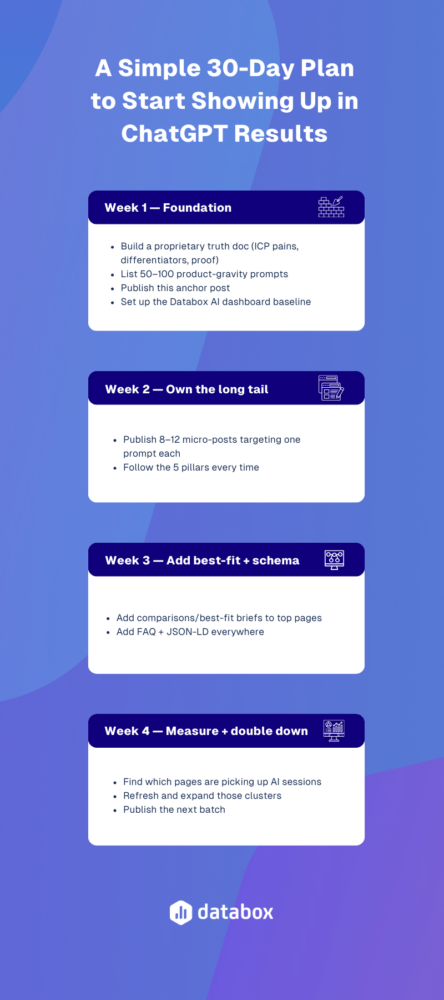
A Simple 30-Day Plan to Start Showing Up in ChatGPT Results
Week 1 — Foundation
- Build a proprietary truth doc (ICP pains, differentiators, proof)
- List 50–100 product-gravity prompts
- Publish this anchor post
- Set up the Databox AI dashboard baseline
Week 2 — Own the long tail
- Publish 8–12 micro-posts targeting one prompt each
- Follow the 5 pillars every time
Week 3 — Add best-fit + schema
- Add comparisons/best-fit briefs to top pages
Add FAQ + JSON-LD everywhere
Week 4 — Measure + double down
- Find which pages are picking up AI sessions
- Refresh and expand those clusters
- Publish the next batch
Final Takeaway
AI answer engines are still a blue-ocean opportunity. The brands that publish proprietary, machine-readable, best-fit content now will become the default citations later. If your team wants a repeatable system for how to show up in ChatGPT results (not guesswork), grab the on-demand webinar and start with the 5 pillars above, then measure the lift with the Databox AI Search Traffic dashboard template so you can double down on what’s actually earning mentions.
Frequently Asked Questions
How do AI answer engines differ from traditional search engines?
Traditional search engines provide a list of links to choose from, whereas AI answer engines offer a synthesized response, delivering a decision-ready answer in one comprehensive step.
What kind of content do AI engines prefer?
AI engines prefer content that is original and proprietary, specific to long-tail prompts, well-structured, and comparative in ways that provide a best-fit guide.
What are Rick Kranz's 5 pillars of AI visibility?
The 5 pillars include using proprietary knowledge, providing direct answers, structuring content for machines, creating best-fit comparisons, and implementing a thorough FAQ schema using JSON-LD.
How can I measure AI search traffic effectively?
To measure AI search traffic, track different metrics, such as sessions AI engines send, which pages gain visibility, and whether these sessions convert, using tools like the Databox Dashboard Template.
What is a simple strategy to start appearing in ChatGPT results within 30 days?
Begin by building foundational content with proprietary insights. Focus on tailoring micro-posts to specific prompts, and ensure content follows Rick Kranz’s 5 pillars. Scale visibility by measuring and enhancing content based on performance.