The dashboard was supposed to set your data free. Instead, it became a beautiful prison.
You built the perfect visualization. Metrics aligned, charts polished, filters configured. Then someone asked a follow-up question, and suddenly you were back in the queue, waiting for an analyst to build another report.
Dashboards are like printed maps in the age of GPS. They show you where things are at a specific moment. But they can’t reroute when conditions change. They can’t answer “why?” They can’t have a conversation.
That’s starting to shift. A new approach to analytics is emerging—one where you express what you want to know, and the system figures out how to answer. Some are calling it “vibe analytics,” borrowing from the “vibe coding” movement that’s lowering barriers to software development.
The technology enabling this shift? The Model Context Protocol, or MCP.
The Dashboard’s Limitations
Let’s be clear: dashboards aren’t going away. They’re useful for monitoring known metrics and sharing standardized views across teams. But they have structural limitations that no amount of polish can fix.
Dashboards answer pre-defined questions. Someone has to anticipate what you’ll want to know, then build a visualization for it. If your question doesn’t fit an existing report, you wait.
Dashboards require specialists. Building a good dashboard means understanding data models, setting up the data, choosing the right chart types, and maintaining everything as sources change. That expertise is expensive and scarce.
Dashboards can’t follow up. You see that conversion dropped 15%. You want to know why. The dashboard stares back at you, mute. You’re back to emailing an analyst or exporting to a spreadsheet.
The Shift to Vibe Analytics
The term “vibe coding” emerged to describe a new way of building software: instead of writing precise code, you describe what you want and let AI figure out the implementation. You express intent, observe results, and refine through conversation.
Vibe analytics applies the same principle to data.
Instead of learning SQL or navigating dashboard builders, you describe what you’re trying to understand. The AI interprets your intent, queries the relevant data sources, and returns an answer. If the answer raises new questions, you keep the conversation going.
The shift looks like this:
| Traditional BI | Vibe Analytics |
|---|---|
| Define the question precisely | Express intent naturally |
| Structure query in SQL or UI | AI interprets and queries |
| Execute and wait | Get results in seconds |
| Visualize in a fixed format | Receive contextual explanation |
| Interpret manually | Ask follow-ups conversationally |
| Start over for new questions | Evolve understanding through dialogue |
The barrier to analytics is dropping. Just as vibe coding means you don’t need to be a developer to build software, vibe analytics means you don’t need to be an analyst to explore data.
This doesn’t make analysts obsolete. It shifts what they spend time on. More on that shortly.
The Engine Behind Vibe Analytics: MCP
Vibe analytics sounds appealing in theory. But how does an AI actually connect to your business data?
That’s where the Model Context Protocol comes in.
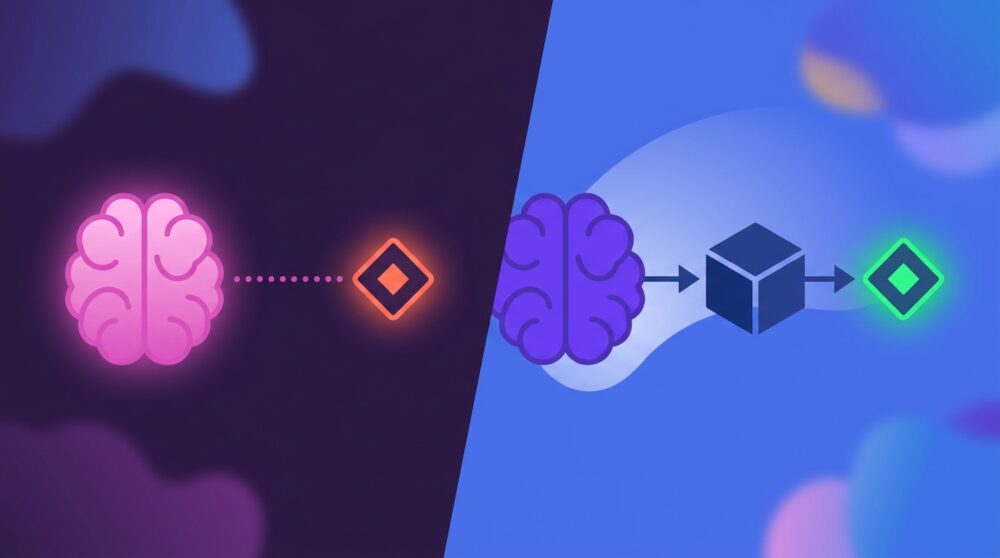
MCP is an open standard that defines how AI systems connect to external data sources and tools. Think of it as USB-C for AI. Before USB-C, every device needed its own proprietary cable. After USB-C, one connector works with everything.
MCP does the same thing for AI-to-data connections. Instead of every AI building custom integrations with every platform, MCP provides a universal interface. If a platform has an MCP server, any MCP-compatible AI can connect to it.
MCP is what enables the “just ask” experience of vibe analytics. Without it, connecting AI to scattered business data would require custom development for every source. With it, the plumbing is standardized.
The New Analytics Companion
Here’s where things get interesting for teams.
Traditional analytics required a human intermediary. You had a question, you asked an analyst, they built a report, and you got an answer days later. The analyst was the gatekeeper between you and your data.
With MCP and vibe analytics, that intermediary role shifts. The AI becomes your analytics companion—available in Claude, ChatGPT, or whatever AI tool you prefer, pulling data for anyone who needs it in real-time.
This changes the analyst’s role in two important ways:
From report builder to strategist. When anyone can ask basic questions directly, analysts stop spending time on routine data pulls. They become embedded advisors to business teams, applying their investigative mindset to complex problems that require judgment and context.
From data modeler to infrastructure engineer. The focus shifts from building dashboards to ensuring data quality and accessibility. If the AI can query your data, but the data is garbage, you get garbage answers. Clean, well-structured, accessible data becomes the priority.
Your analyst used to spend Monday mornings building the weekly performance report. Now, your analyst spends Monday mornings in a strategy session with the marketing team, helping them understand why certain segments are underperforming and what to do about it.
Analytics becomes invisible infrastructure like plumbing or electricity. You don’t think about how the water gets to your faucet. You just turn the handle, and it’s there.
How Databox Enables Vibe Analytics
We built Databox to work in this new world.
Most analytics platforms treat AI as an add-on: bolt a chatbot onto a dashboard and call it AI-powered. That approach inherits all the limitations of the dashboard underneath. The AI can only see what the dashboard sees.
Databox takes a different approach. We built MCP into the core of the platform, exposing your connected data (100+ integrations worth) directly to AI agents.
The read/write advantage matters here. Most MCP servers are read-only. The AI can query data, but can’t act on it. Databox MCP supports both reading and writing. An AI agent can pull your metrics, analyze them, and push results back into Databox for tracking and automation.
This enables workflows that read-only systems can’t touch:
- An agent monitors your ad performance continuously
- When CPA exceeds your threshold, the agent investigates automatically
- The agent logs the anomaly, identifies likely causes, and records its findings in Databox
- You wake up to a summary: “CPA spiked 40% on mobile yesterday. Likely cause: the new landing page has a slow load time on iOS. Recommendation: revert to the previous version.”
That’s the closed loop: observe, analyze, act, record. Traditional BI stops at observation.
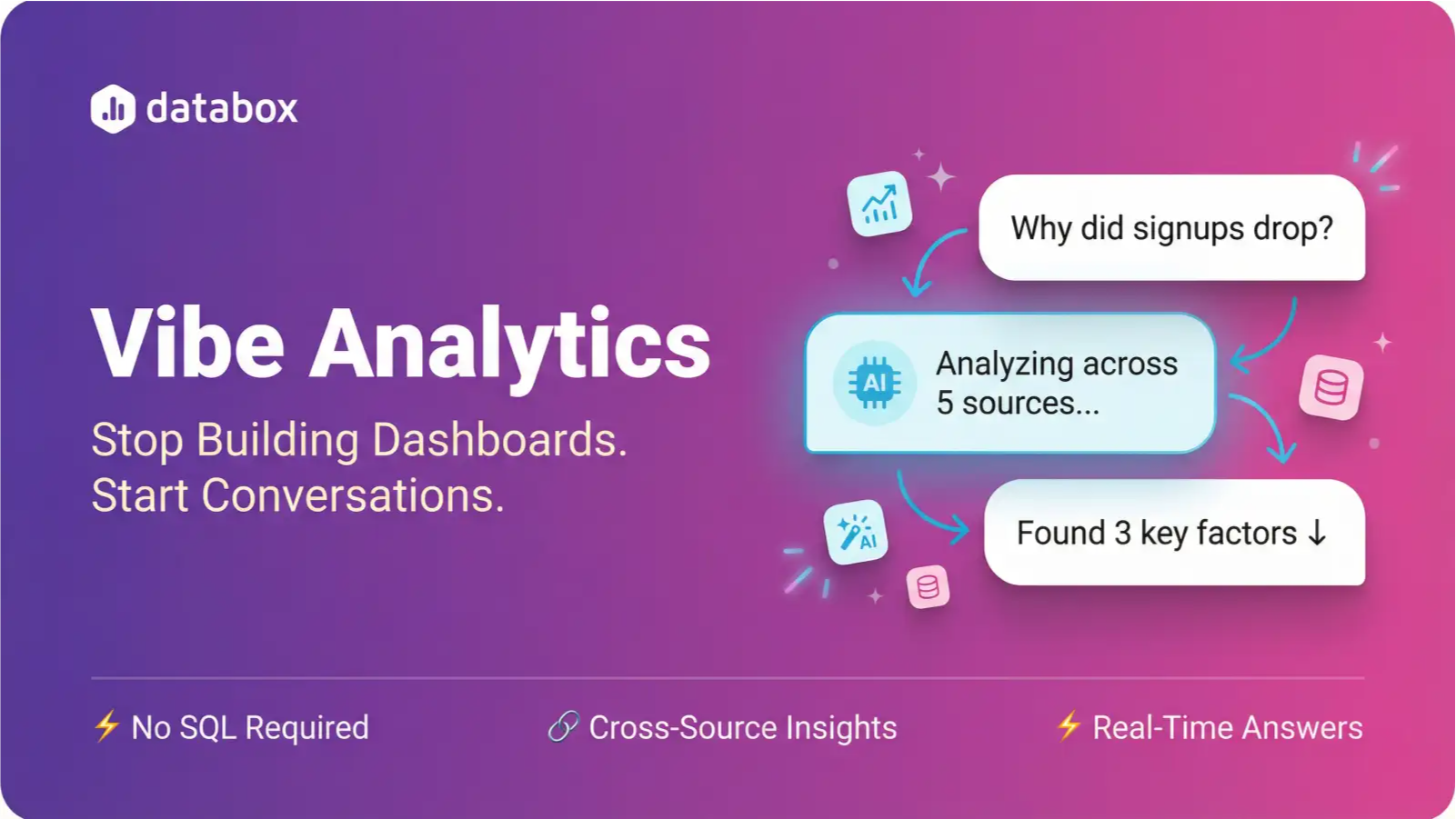
Genie, our AI analyst, brings vibe analytics inside the platform. Ask “Why did signups drop last week?” and Genie queries across your connected sources, identifies patterns, and explains what’s happening. No SQL, no dashboard building, no waiting.
With Databox, you get both: Genie for quick answers inside the product, and MCP for connecting your data to the broader AI ecosystem. Convenience and flexibility.
The Bottom Line
The dashboard era isn’t ending; it’s expanding. Dashboards become one interface among many, useful for certain tasks but no longer the only way to interact with your data.
Vibe analytics represents the next layer: conversational, intent-driven, accessible to anyone who can describe what they want to know. MCP is the infrastructure that makes it possible, connecting AI to data without custom development for every source.
For teams frustrated by the gap between having data and actually using it, this shift matters. The barrier between question and answer is collapsing. The specialist bottleneck is clearing.
Stop building dashboards for every question. Start having conversations with your data.
Ready to move beyond static dashboards and start chatting with your data? Try Databox for free to experience AI-powered business analytics. Connect your sources in seconds and use our read/write analytics MCP to ask questions, run diagnostics, and trigger actions directly inside Claude, n8n, and more.
Frequently Asked Questions
What is vibe analytics?
Vibe analytics is an approach to data analysis where you express intent in natural language rather than writing queries or building reports. AI interprets your question, queries the relevant data, and returns an answer conversationally. The term borrows from “vibe coding,” which describes building software by describing what you want rather than writing precise code.
How is MCP different from traditional data integrations?
Traditional integrations require custom development for each AI-to-data connection. MCP is an open standard that provides a universal interface—any MCP-compatible AI can connect to any MCP-enabled data source. This means you’re not locked into one vendor’s AI, and new models can access your data immediately.
Does vibe analytics replace analysts?
No. It shifts what analysts spend time on. When routine questions can be answered directly by AI, analysts focus on complex problems requiring judgment, context, and strategic thinking. The role evolves from report builder to embedded strategist.
What’s the difference between read-only and read/write MCP?
Read-only MCP servers let AI query data but not act on it. Read/write servers like Databox MCP allow AI agents to both retrieve information and push data back into the system—enabling automated workflows, logging, and closed-loop analytics.
Can I use vibe analytics without a data warehouse?
Yes. Platforms like Databox connect directly to your SaaS tools via APIs, so AI can query your scattered data without requiring centralized infrastructure. This “lightweight AI” approach works for teams that don’t have data engineering resources.
Ready to move beyond dashboards? Connect your data to Databox MCP and start asking questions. Get started →