
TL;DR
- AI-driven insights shift decision-making from reactive to proactive by answering not just “what happened” but “why it happened” and “what’s likely to happen next,” closing the structural gap between data access and confident action.
- The six specific improvements are speed, accuracy, predictive power, data unification, insight democratization, and bias reduction, each mapping to a failure mode in traditional analytics that costs businesses time, money, and competitive position.
- Industry research on AI-driven predictive analytics points to 20–30% gains in forecasting accuracy, but those gains depend on data quality, governance, and human oversight. Deploying AI on a weak foundation produces confidently wrong answers.
- Conversational BI and agentic AI are compressing the timeline from insight to action. Gartner’s 2024 CDAO Agenda Survey found 50% of organizations have either deployed decision intelligence platforms or committed to deploying within six months, making the infrastructure gap between early adopters and laggards wider every quarter.
- You don’t need a data science team to start. Modern platforms like Databox AI let any team member ask a business question in plain language and get an answer backed by all their connected data sources.
Eighty-five percent of business leaders have suffered from decision distress — regretting, feeling guilty about, or questioning a decision they made in the past year, according to Oracle’s Decision Dilemma study of 14,000+ leaders and employees across 17 countries. The same study found 72% admit the sheer volume of data and their lack of trust in it has stopped them from making any decision at all, and 77% say the dashboards and charts they get don’t always relate to the decisions they actually need to make.
It’s a structural failure in how data gets converted into decisions. Most organizations have more information than ever and slower, less confident calls to show for it, because the architecture between “data exists” and “someone acts on it” is fundamentally broken.
AI-driven insights are the structural fix for that gap. Where traditional analytics answers “what happened”, usually days or weeks after the fact, AI-driven insights go further: they explain why it happened, predict what’s likely to happen next, and surface those answers in plain language before the decision window closes. A VP of Marketing who needs to know why conversion rate dropped 18% this week shouldn’t have to wait until Thursday’s analyst report. AI-driven insights combine machine learning, natural language processing, and anomaly detection to turn raw data from every connected source into specific, timely recommendations — without a data team as the intermediary.
AI-driven insights don’t just speed up analysis; they shift the entire decision-making process from reactive to proactive.
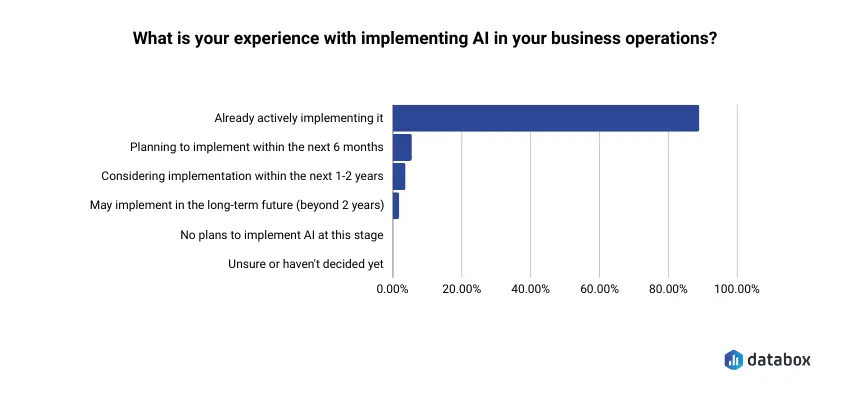
That shift matters now because adoption is accelerating fast. According to Databox’s AI Adoption in SMBs survey, 87.16% of respondents are currently using generative AI. The capability is no longer experimental. But the gap between “using AI” and “making better decisions with AI” is enormous, defined by whether organizations understand what AI-driven insights actually change, where they create measurable impact, what risks they introduce, and how quickly the competitive window is closing.
This article covers all four: the structural failures AI-driven insights fix, the specific mechanisms that make them work, the real risks worth managing, and the trends that are about to reshape what’s possible.
Leaders Have More Data Than Ever and Still Make Worse Decisions Than They Should
The instinct is to blame decision quality on a lack of information. The reality is the opposite. 70% of leaders have given up on deciding because the data was overwhelming, and 86% say the sheer volume of data is making their decisions more complicated, not clearer. Adding more dashboards to that environment doesn’t fix the problem. It compounds it.
McKinsey’s Global Survey on decision-making found that only 20% of organizations believe they excel at decision-making. Gartner puts a number on the underlying data problem: organizations lose an average of $12.9 million per year to poor data quality, the upstream issue that degrades every decision built on it.
The failure modes are structural, not personal:
- Information overload. When a marketing leader has access to Google Analytics, HubSpot, six ad platforms, and a CRM, the problem isn’t missing data. No human can synthesize signals across all those sources fast enough to act before the window closes.
- Siloed data. Sales works from CRM numbers. Finance works from ERP data. Marketing works from ad platform dashboards. Each team makes locally rational decisions that are globally incoherent because nobody has a unified view.
- Backward-looking reports that miss the decision. Traditional BI answers “what happened last month.” By the time the report reaches the leadership meeting, the conditions it describes have already changed. 77% of business leaders say the dashboards and charts they actually receive don’t relate directly to the decisions they need to make — a structural mismatch no amount of additional reporting will fix.
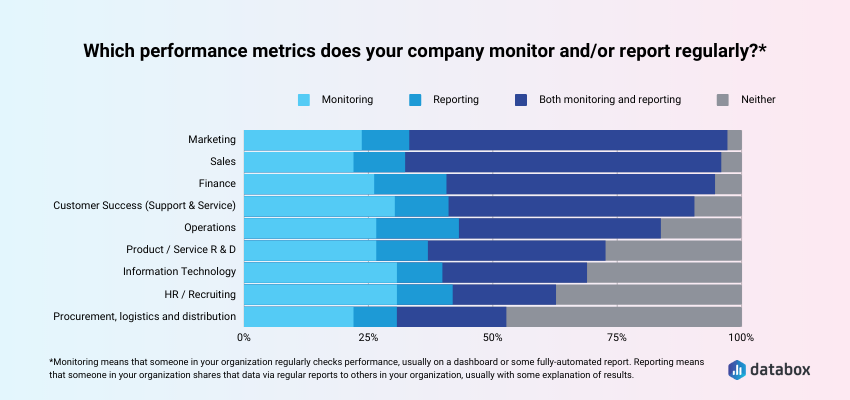
- Analyst bottlenecks. Every ad-hoc question — “why did churn spike?” or “which campaign drove the pipeline shift?” — goes into a queue. Databox’s State of Business Reporting found that 65.75% of respondents both monitor and report sales metrics regularly. They’re tracking the numbers. But tracking and acting are separated by days of analyst turnaround, formatting, and context-building.
- Cognitive bias dressed up as analysis. Anchoring, recency bias, and groupthink shape which data leaders notice and how they interpret it — even when the data itself is accurate. 78% of business leaders concede that people often make decisions first and look for the data to justify them afterward, and 74% of employees believe businesses put the highest-paid person’s opinion ahead of data. The dashboards aren’t the bottleneck. The decision process around them is.
None of these failures are solved by adding more dashboards. They require changing what the data does before it reaches a decision-maker.
AI-Driven Insights Fix the Six Structural Failures That Make Good Decisions Hard
Each improvement below maps directly to a failure mode from the previous section. AI-driven insights don’t deliver abstract value — they resolve specific, named problems in how organizations convert data into action.
Speed: From Days to Minutes
When data pipelines feed AI systems continuously, the lag between “something changed” and “someone knows about it” collapses. Real-time analytics doesn’t just compress timelines — it changes which decisions are even possible. Reallocation decisions, campaign pauses, and escalation calls that require fresh data simply cannot happen on a weekly reporting cadence.
Accuracy: Fewer Blind Spots
Pattern recognition at scale catches what humans structurally cannot, especially in high-volume, multi-variable datasets where the interaction effects between channels, segments, and timeframes are invisible to manual review. Anomaly detection flags outliers before they compound into crises.
Industry research on AI-driven forecasting — including Deloitte’s algorithmic forecasting work — points to 20–30% accuracy gains over traditional methods. Accuracy gains compound as models learn from new data, meaning the gap between AI-augmented and unaugmented forecasting widens every quarter.
Predictive Power: Stop Reacting, Start Anticipating
Predictive analytics uses historical patterns to forecast future outcomes — demand shifts, churn risk, revenue trajectories, conversion rate trends. The reframe is fundamental: instead of asking “what happened to our conversion rate last quarter,” teams can ask “what’s our conversion rate likely to look like next quarter, and what’s driving it?”
That question shift, from retrospective to prospective, is where the reactive-to-proactive transformation actually lives. A sales leader who knows pipeline coverage is trending toward 1.2x next month can act on it now. One who discovers it after the quarter closes is writing a post-mortem.
Breaking Data Silos: A Single Source of Truth
Naming the silo problem is easy; solving it with another integration project is where most attempts stall. Even when data is technically connected across systems, it still lives in separate dashboards that nobody opens side by side, so the cross-functional patterns stay invisible.
AI-driven analytics platforms close that gap by querying across sources in a single pass and surfacing relationships that only become visible when the signals are joined and not just stored together. The point isn’t unifying the warehouse. It’s unifying the question. When a VP of Operations can see that rising customer acquisition costs are colliding with declining average order values across the same cohort, the conversation changes from “each team’s numbers look fine” to “we have a margin problem that three dashboards were hiding.”
Democratizing Insight: No Data Team Required
Natural language querying is the most underreported shift in business intelligence right now. Any team member can ask a question in plain English — “which campaigns drove the most pipeline last month?” or “why did churn increase in Q2?” — and get an answer backed by all their connected data, in seconds, without writing SQL or waiting in an analyst queue. When every team self-serves insight rather than queuing for analyst time, decision cycles shrink from days to minutes. A marketing manager who gets an instant answer on campaign pipeline contribution can reallocate budget the same afternoon rather than waiting a week for a custom report.
Adoption of AI-powered analytics is no longer a competitive luxury. The capability is moving from enterprise-only to expected standard, and the implications are structural: when any team member can self-serve insight, the analyst bottleneck that gated decision speed disappears entirely.
Having an AI analyst that can just tell you why a metric has dropped and what’s likely driving it — that’s a game-changer. Genie feels like having a smart teammate who’s always watching the data.”
A RevOps lead using Databox AI analyst Genie, for example, can ask “what’s driving the pipeline gap this month?” and get a cross-source answer pulling from multiple connected sources simultaneously — without leaving the platform or requesting a custom report.
Reducing Human Bias in Decision-Making
AI surfaces data-backed patterns rather than conclusions filtered through individual intuition. When a leadership team evaluates campaign performance through an AI system that weights all historical data equally, anchoring bias — the tendency to over-index on the first number presented — loses its grip. Recency bias and groupthink are similarly reduced when the analysis isn’t shaped by who spoke loudest in the last meeting.
Intellectual honesty matters here, though. AI models can introduce their own biases if training data is unrepresentative, incomplete, or reflects historical inequities. A churn prediction model trained primarily on enterprise accounts will produce misleading risk scores for SMB customers. The fix isn’t avoiding AI — it’s auditing the data AI learns from, which connects directly to the limitations section that follows.
Want to see AI-driven insights in action? Explore Databox AI
The Impact Shows Up in Specific Metrics, Not Abstract Improvements
The improvement vectors above are real, but they only matter if they produce measurable outcomes at the function level. Three use cases ground the theory.
Marketing and Campaign Optimization
AI-driven insights let marketing teams identify which audience segments are converting, which spend is underperforming, and how customer behavior is shifting — in real time, not in a post-campaign retrospective. Dynamic spend reallocation based on live performance data is fundamentally different from reviewing last month’s numbers and adjusting next month’s plan.
The specific metrics where AI-driven insights create the clearest signal for marketing teams: customer acquisition cost, conversion rate by segment, campaign ROI, and attribution accuracy across channels.
Sales and Revenue Forecasting
AI analyzes pipeline health, historical close rates, deal velocity, and engagement signals to forecast revenue with greater confidence and flag at-risk deals before they go cold. A Head of Sales who can see that deals with engagement scores below a certain threshold have a 70% probability of stalling can intervene with targeted outreach or executive sponsorship, weeks before the deal drops out of the pipeline entirely.
Two high-value applications stand out: churn prediction (identifying which accounts show early warning signals of disengagement) and deal prioritization (ranking pipeline by probability-weighted value so reps focus on the highest-impact opportunities). The specific metrics: forecast accuracy, pipeline coverage ratio, churn rate, and average deal velocity.
Operations and Financial Planning
Cost anomaly detection, inventory optimization, and cash flow forecasting are three operational decisions where AI-driven insights produce measurable ROI. An operations leader whose AI system flags an unexpected 12% spike in logistics costs on a Tuesday can investigate the root cause and adjust before the variance compounds through the rest of the quarter. One who discovers the spike in the monthly close report is writing an explanation for the CFO rather than solving the problem.
The specific metrics: operating cost variance, inventory turnover, days sales outstanding, and days cash on hand. Each benefits from the speed, accuracy, and cross-source unification described above, and each degrades rapidly when decisions depend on stale or siloed data.
AI-Driven Insights Still Fail When the Foundation Is Wrong
None of the gains above materialize automatically. AI-driven insights deployed on a weak foundation produce confidently wrong answers, which may be worse than no answers at all, because they carry the appearance of data-backed authority. Three failure modes require active management.
Data Quality: Garbage In, Garbage Out
Machine learning models are only as accurate as the data they learn from. Inconsistent naming conventions, incomplete records, outdated CRM entries, and unreconciled data across platforms don’t just reduce accuracy — they create systematic errors that compound as the model trains on progressively distorted inputs.
Original data is an irreplaceable infrastructure. Organizations building proprietary data assets — original research, first-party behavioral data, customer signals no competitor has — hold an advantage AI cannot replicate from publicly available information. Primary data creates the foundation that makes AI-driven insights trustworthy. Without it, models are pattern-matching on the same generic datasets everyone else feeds them.
Data governance, source hygiene, and regular model auditing must be in place before deploying AI-driven analytics at any scale. No shortcut exists for this prerequisite.
Algorithmic Bias
If training data over-represents certain time periods, geographies, customer segments, or deal types, the model’s outputs will carry those skews. A revenue forecast trained heavily on Q4 data will systematically over-predict Q1 performance. A customer segmentation model trained on North American behavioral patterns will produce misleading recommendations for European or APAC markets.
The mitigation is straightforward but requires discipline: diverse training data, regular model audits, and human review of high-impact outputs. No AI system should make resource allocation decisions without a person evaluating whether the recommendation makes sense given context the model may not have.
Black-Box Opacity and Over-Reliance
Complex models can produce accurate predictions without transparent reasoning, making it hard for leaders to know why the AI recommended a specific course of action. When a model says “this deal will close” but cannot explain the signals driving that confidence, trust erodes. And when the model is wrong, course-correcting becomes guesswork.
The resolution is framing, not avoidance. AI should augment human judgment, not replace it. The goal is AI as a trusted adviser, improving speed, scale, and quality of decisions while keeping humans responsible for the final call. Organizations that treat AI outputs as unquestionable inputs will eventually be burned by one of the three failure modes above.
The Shift from Insight to Autonomous Action Is Already Underway
AI-driven insights today answer questions. The next generation will take action on the answers.
Agentic AI: From Insights to Action
Agentic AI represents the next evolution: systems that don’t just surface insights but set goals, plan tasks, execute steps, and adapt based on feedback without continuous human oversight. The practical implication for a Head of Revenue: an AI agent that doesn’t just flag a churn-risk account but automatically triggers a retention workflow, adjusting the sequence, the offer, and the timing based on the account’s specific engagement history.
Gartner projects that by 2028, 33% of enterprise software applications will incorporate agentic AI, up from less than 1% in 2024. A jump from near-zero to one-third of enterprise software in four years signals a shift that organizations cannot afford to prepare for after it arrives.
Conversational BI and Natural Language Querying
The interface for business intelligence is shifting from dashboards to dialogue. Instead of navigating a complex report, a user asks a question. Instead of waiting for an analyst to build a custom view, they get an instant, contextual answer drawn from all their connected data.
Conversational BI is the practical fulfillment of the democratization argument from the previous section: when every team member can query their data in natural language, the analyst bottleneck that slowed decisions ceases to exist. The question shifts from “can our team access the data?” to “can our team ask the right questions?”
The Adoption Window Is Narrowing
Gartner’s 2024 CDAO Agenda Survey found 33% of organizations had already deployed decision intelligence platforms by 2024, with another 17% committed to deploying within six months and 19% considering deployment in 6–12 months. That puts more than half of organizations in production or in motion within a year, and the competitive pressure is already reaching mid-market and SMB organizations, where competitors adopt AI-driven analytics and begin compounding their speed and accuracy advantages quarter over quarter.
A VP of Marketing at a mid-market SaaS company faces this concretely. She opens her Monday pipeline review to find organic-sourced MQLs down 34% month over month. With Genie inside Databox, she types: “What’s driving the MQL decline this month?” The answer comes back in seconds, pulling from Google Analytics, HubSpot, and Google Ads data simultaneously, and shows that a specific blog category lost 60% of its search traffic after a Google algorithm update two weeks ago. She doesn’t file an analyst request. She doesn’t wait for the weekly report. She redirects paid spend to bridge the gap that morning and briefs her content lead on a recovery plan before lunch.
That workflow — ask a question in plain language, get a cross-source answer in seconds, act before the business impact compounds — is what Databox AI and Genie make possible today. No SQL. No analyst queue. No waiting until the monthly review to discover what went wrong three weeks ago.
Organizations that delay building data infrastructure, governance practices, and tool fluency to support AI-driven insights face a compounding disadvantage across four dimensions: decision speed, forecast accuracy, team autonomy, and the ability to act on signals before competitors do. Every quarter, an organization operates on stale, siloed, analyst-gated data while competitors operate on real-time, unified, self-serve insight, which widens the decision-quality gap, and decision quality is the upstream variable that determines everything else.
The Leaders Who Benefit Most Will Be the Ones Who Use AI to Sharpen Their Judgment, Not Replace It
AI-driven insights don’t make human judgment obsolete. They remove the structural obstacles that make good judgment hard: slow data, siloed systems, cognitive overload, and backward-looking reports. The leaders who extract the most value from this shift will be the ones who treat AI as a tool for sharpening decisions rather than a mechanism for outsourcing them, and who build the data foundation, governance practices, and tool fluency now, while the compounding advantage of early adoption still exists.
The question is no longer whether AI will reshape how your organization makes decisions. It’s whether you’ll be driving that shift or spending the next two years catching up to it.
Frequently Asked Questions
What is the difference between AI-driven insights and traditional business analytics?
Traditional business analytics reports on what already happened — it answers historical questions after the fact, usually through static dashboards that require analyst interpretation. AI-driven insights go further by explaining why something happened and predicting what is likely to happen next. That shift from descriptive to predictive and prescriptive analysis is what makes AI-driven insights a decision-making tool, not just a reporting tool.
How do AI-driven insights reduce decision-making bias?
AI surfaces objective, data-backed patterns rather than conclusions filtered through human intuition, which reduces common cognitive biases like anchoring, recency bias, and groupthink. The analysis weights all historical data rather than over-indexing on the most recent or most visible signals. AI models can still introduce their own bias if trained on unrepresentative data, which is why human oversight and regular model audits remain essential complements to any AI-driven decision process.
Do I need a data science team to benefit from AI-driven insights?
No. Modern AI analytics platforms, including Databox AI, use natural language querying, which means any team member can ask a business question in plain English and receive an answer backed by all their connected data sources. The bottleneck shifts from “who can build the query” to “who can ask the right question.” No SQL, no analyst queue, no technical background required.
What are the biggest risks of relying on AI for business decisions?
The three primary risks are poor data quality, algorithmic bias, and black-box opacity. Poor data quality means models trained on inconsistent or outdated data produce confidently wrong predictions. Algorithmic bias means unrepresentative training data skews outputs toward certain segments or time periods. Black-box opacity means complex models may not be able to explain their reasoning to the humans who must act on their outputs. All three are manageable with proper data governance, diverse training datasets, and a human-in-the-loop framework that treats AI as an adviser rather than an authority.
How quickly can businesses see results from AI-driven analytics?
Results vary by implementation maturity and data readiness. Industry research on AI-driven predictive analytics points to 20–30% gains in forecasting accuracy. Real-time monitoring tools can surface actionable alerts within hours of deployment, meaning speed-of-decision benefits appear almost immediately. Forecasting accuracy improvements build over time as models learn from new data — the compounding effect means organizations that start earlier accumulate a progressively larger advantage.