

86% pick generative AI before any BI tool for analytical work. Trust ranks fourth in their reasons. Speed and convenience rank first.
TL;DR
- 86% of business users reach for ChatGPT, Claude, Gemini, or Copilot before any BI tool for analytical work. 39% fully trust it for the analysis they share with leadership, board, or clients. Users know the tool they picked is less trustworthy. They picked it anyway.
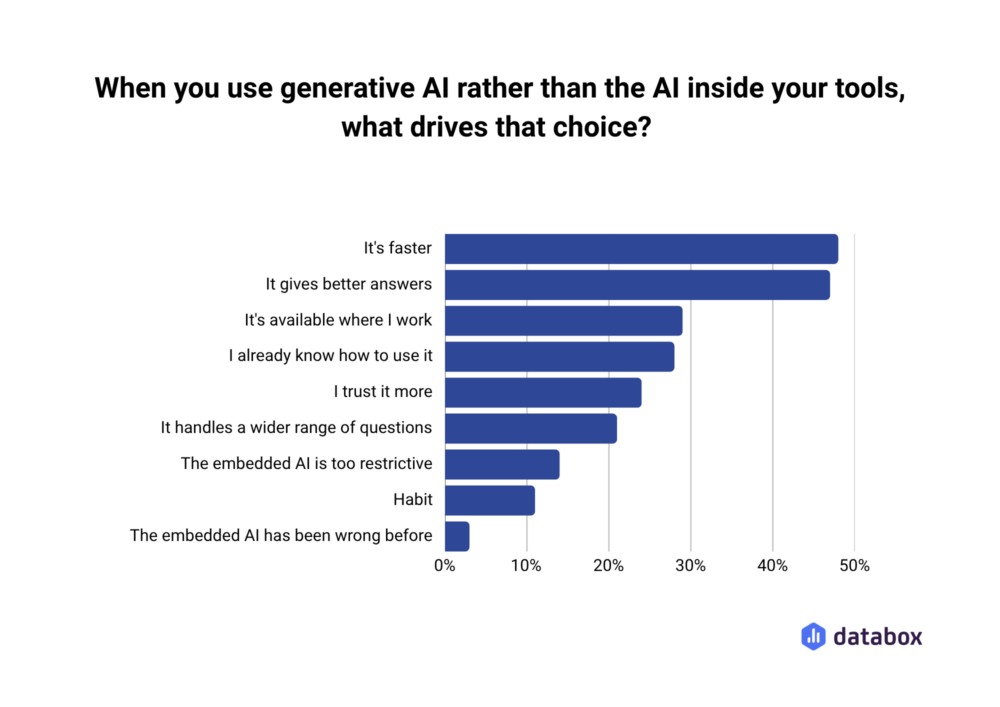
- Trust ranks fourth (24%) among reasons users pick generative AI over the AI inside their BI tools, behind speed (48%), better answers (47%), and familiarity (28%). BI has the trust. Gen AI has the speed. Speed won.
- The heaviest users have the highest error rate (91% lifetime, 66% in 30 days) and the least data infrastructure (80% have no unified data layer). Being burned repeatedly has not sent them back to the more-trusted tool.
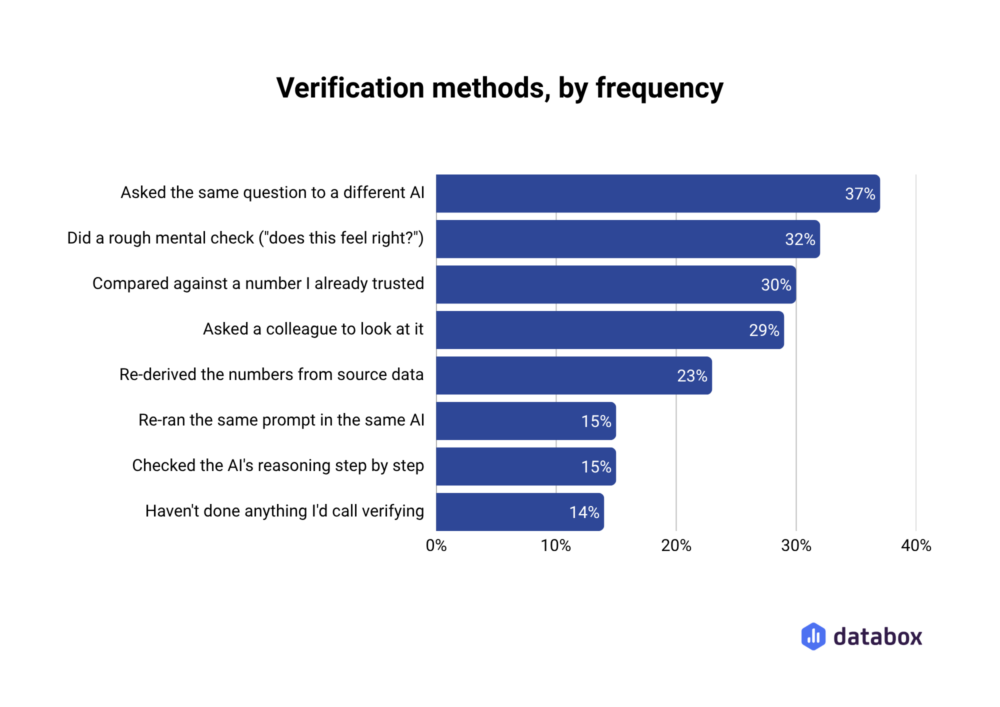
- Verification behavior climbs with usage. Errors climb faster. What most users call “verifying” is asking a second AI, which is a second hallucination from a different model with the same training corpus.
- The lever isn’t earning more trust. BI already has that. The lever is making trusted data as fast as pasted data, and reaching it from the tool users already chose. Databox’s four pieces do exactly that: verified metrics with owners, a semantic layer AI can read, MCP that brings governed data into Claude and ChatGPT, and a Skills Marketplace where the finished report already exists.
BI has the trust. Gen AI has the speed. Speed won.
According to our research on using AI in analytics, 86% of business users reach for ChatGPT, Claude, Gemini, or Copilot before any BI tool for analytical work. 39% fully trust it for the analysis they share with leadership, board, or clients. Both numbers come from the same survey of the same people.
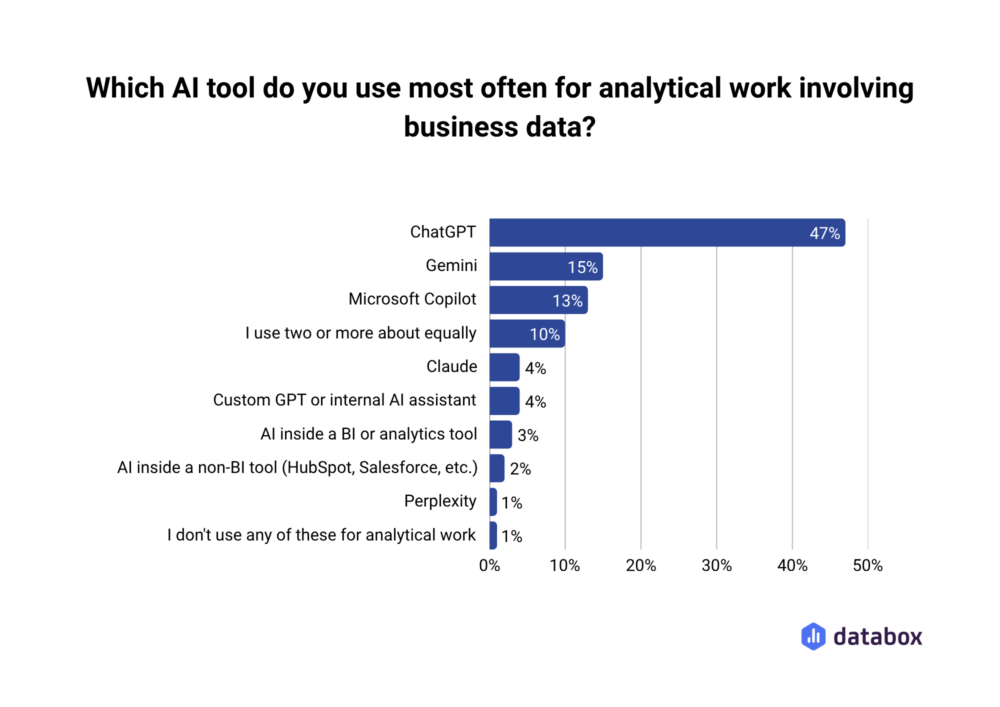
That gap is not a trust problem for BI. Users trust BI. When the survey asked why generative AI could replace BI tools, respondents themselves named the properties that make BI more trustworthy: governed metric definitions, audit trails, accuracy of the underlying data, the fact that general AI cannot be trusted with critical numbers. Users named those. They picked the tool without any of them.
Of 17 respondents who explicitly say they do not trust generative AI for forecasting, 15 used it for forecasting in the last 30 days. Distrust does not prevent use. It coexists with it. If the story were that trust decides the choice, you would expect roughly zero of those seventeen to be forecasting with AI. The number is fifteen. Trust is real, but it is just not the deciding factor.
They didn’t pick it for the reasons the category thinks they did.
When users explain why they reach for generative AI over the AI inside their BI tools, trust arrives fourth. Speed (48%) and better answers (47%) lead. Availability (28%) and familiarity (28%) tie for third. Trust arrives at 24%. Users themselves are telling vendors: the axis you have been optimizing is not the one we are choosing on.
Speed and familiarity are what users say. The structural reason underneath is what the rest of the survey shows. 66% of business users feed AI by paste, upload, or one-tool-at-a-time connections. 63% spend the majority of their AI analytical time on data prep, not on the analysis itself. 9% have a unified data layer their AI can query. The alternative to generative AI, in most business users’ actual workflow, is not a more-trustworthy AI. It is asking the analyst. The analyst has a queue.
The reach is the structural reason underneath the speed. Real analytical questions cross tools. What is actually driving churn this quarter? That question lives in Salesforce, the product analytics database, and Stripe. The AI inside any one of them can only answer inside its own data model. A generative AI, given the pieces pasted in, can span them. Badly, but span them. And span them in a chat window, in three seconds, at 4 PM when the analyst is heads-down on next week’s board deck.
Mony Raanan, founder of Voice Crafters, described exactly this pattern in the survey. “Our organic traffic looked like it was sliding in GA4, and our first instinct was to treat it as a ranking problem and start rewriting pages. Instead, I had Claude pull the GA4 and Search Console data apart side by side. Most of the ‘decline’ turned out to be bot traffic falling off. Real human organic search was flat. So we didn’t burn weeks rebuilding pages that were fine.”
No single dashboard held Mony’s question. Generative AI held it, badly enough to be useful. That is why speed matters, why familiarity matters, and why “our AI is more accurate” is the wrong pitch. Users are not choosing on accuracy of the underlying math. They are choosing on reach, speed, and the quality of the surface answer. The BI tool that pitches trust to a market choosing on those three has been optimizing the wrong variable.
The heaviest users are the most burned. They have not left.
74% of business users have shipped a decision, report, or shared output based on a generative AI number that turned out to be wrong. 39% in the last 30 days alone. Among daily gen AI users, the lifetime rate is 91% and the 30-day rate is 66%.
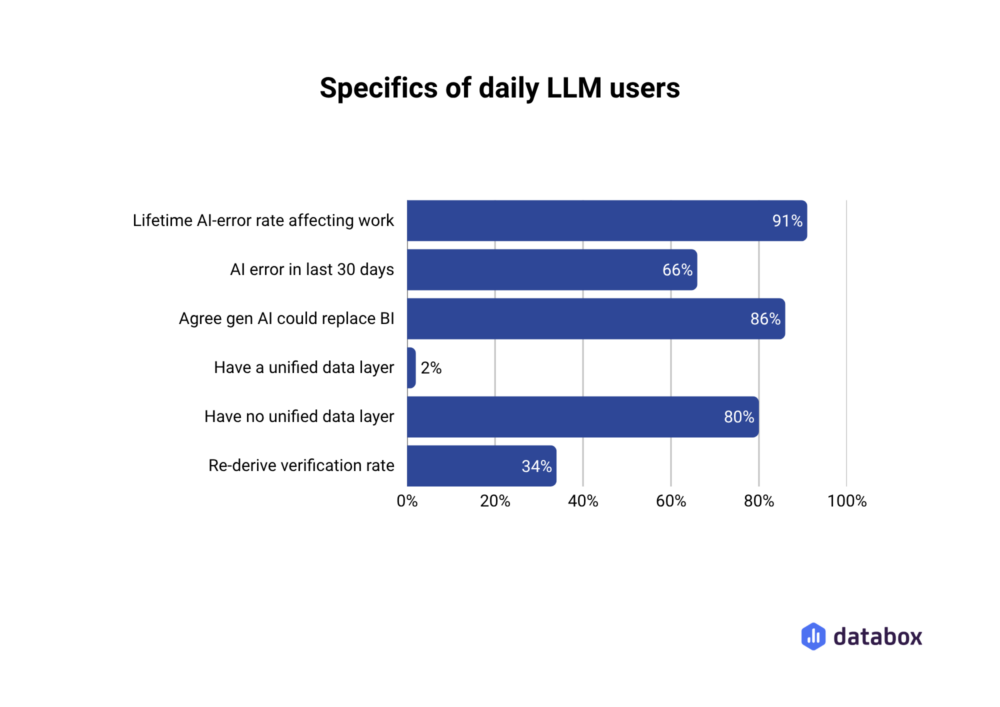
The users hurt most are the users most invested. Daily users verify at the highest rate in the sample: 34% re-derive from source versus 23% across all respondents. They believe in gen AI’s replacement potential at the highest rate: 86% agree ChatGPT or Claude could replace the BI tools their company uses. They have the least data infrastructure underneath them: 80% have no unified data layer. They have been burned repeatedly. They have not gone back to the BI tool they said they trust more. If the story were that users learn to prefer the more-trusted tool after being burned, daily users would show the pattern first. What the survey shows is the opposite. Usage climbs, verification climbs, and error rate climbs faster.
Andy Rouse, co-founder of Haystack Land Company, described the mechanism that catches them: “It will rarely tell you it doesn’t know. Instead it acts like an overconfident intern that has great presentation skills. It won’t tell you your sample’s too small to believe it.”
An overconfident intern with great presentation skills is exactly what users have been picking over the BI tool with the audit trail. Not because they don’t see the audit trail. Because the intern is faster and answers the question the way it was asked. Behavior change is not the lever the category has been assuming it is. The trust argument does not win the trust user’s actual choice.
What most business users call verifying is asking one hallucination to check on another.
86% of business users selected at least one action they describe as verifying gen AI output in the last 30 days. 23% re-derive the numbers from source data. The most common method, at 37%, is asking a different AI. It is not verification. It is a second hallucination from a different model with the same training corpus. A second guess is not a check.
The confidence gap is what compounds the error. Immediately after a planted-error test in the survey, 21% of respondents said they were “very confident” they had caught everything wrong. 5% actually caught all three planted errors. 28% flagged a distractor problem that was not actually wrong with the summary. 14% specifically invented an MRR error that did not exist. Users who feel confident about their verification are not, in aggregate, more accurate than users who don’t.
Tommy P. Landry, founder of Return On Now, described what this feels like in the moment. “The AI treated the monthly numbers like a clean trend, when I knew the reality was messier. One month might look stronger because a client paid late. Another might look weaker because I prepaid software, paid a contractor, delayed an invoice. The AI could see the numbers, but it did not understand enough of the timing and context behind them. That made the answer feel too confident.”
Feel too confident. Not “be too confident”. The distance between feeling confident and being correct is where verification has to happen, and the tools users have chosen to verify with are the same tools that produced the answer they are checking. That is not a discipline problem. It is a structural one. Verification has to become a property of the data, not a discipline imposed on the user. That is the lever every previous section has been pointing at.
The lever is making trusted data as fast as pasted data.
Databox already has the trust. Users acknowledge that in the survey. What users do not have is a way to reach the trusted data from the tool they actually opened, at the speed a chat window sets as the new baseline. The Databox architecture is four pieces built around exactly that.
Governance puts a verified badge on the metrics, dashboards, reports, and datasets your team has agreed are canonical. A semantic layer maps the vocabulary. When marketing calls something an MQL and finance calls the same thing a qualified lead, both terms resolve to the same definition. Every metric has a named owner accountable for accuracy. Roles and permissions decide who can verify or edit each asset. The activity log records every governance action. All of it lives in the same workspace as the dashboards and the AI, so the people accountable for the metrics can govern them where the work happens. No separate semantic-layer stack. No data engineer prerequisite. The 9% of business users in the sample who do have a unified data layer have been waiting for governance that does not require dbt, LookML, or a data engineering team. This is it.
Genie is the AI analyst that computes from those governed definitions. The LLM does not do the math. The data layer does. Every Genie answer is grounded in the same verified asset your dashboards read from, which means a wrong answer can be traced back to a specific metric, owner, and definition. Genie is where BI’s trust meets gen AI’s speed, inside Databox. Available on every plan.
MCP is the piece that meets users where they already are. 86% of business users picked a general gen AI tool before Databox got into the room. MCP makes that choice survivable. Connect Claude, ChatGPT, Cursor, or n8n to Databox MCP, and your AI reads the same verified, defined, owned metrics Genie reads. The metric definitions your team agreed on become what those external tools use. The audit trail stays attached. The user keeps the tool they have already learned. What changes is what the tool sees. This is the piece that carries BI’s trust into the tool users chose for speed.
Abhishek Joshi, director at Dog with Blog, described the pattern MCP is built for. “The surprising wins live between tools. The disappointments live inside them.” Point governed data at the tool users already picked, and the wins that used to live between tools become the default.
The Skills Marketplace is what makes governed AI usable by a business user who does not want to be a prompt engineer. Most people will not write MCP prompts. They want a finished GA4 weekly report on Monday morning, a paid-ads cross-channel report at month-end, a Stripe revenue report when finance asks. The Skills Marketplace ships free downloadable skills and workflows that produce exactly those outputs, running inside Claude or n8n through Databox MCP. Each one reads your live governed data and writes a structured report. For the 47% of survey respondents who said they “started verifying every time” after catching an AI error, the marketplace is the upgrade. Skills written to compute from verified data, so the verification step is already done before the report exists.
Conclusion
Users trust BI. They still reach for ChatGPT. The BI industry has been trying to earn a trust it already has while ignoring the axis on which it was losing. Speed. Convenience. Reach. The tool that gets used is the one that shows up in the browser tab already open at 4 PM.
The lever the survey points at is not more trust. It is trusted data delivered at the speed users have started expecting, inside the tools they already chose. Databox already had the trust. Now it has the pieces to carry that trust into the tool users picked (MCP) and to make the trusted data as fast as pasted data (Genie, Skills Marketplace). Speed and trust are the same product now.
Change what the tool sees.
Research report is available at databox.com/research-reports.
Want the full picture? Download the full report!
By submitting the completed form, you agree to our Terms of Service and Privacy Policy
Frequently Asked Questions
Why do 86% of business users reach for ChatGPT or Claude before any BI tool for analytical work when they say they trust BI more?
Trust is real but it is not the axis of the choice. Users pick gen AI on speed (48%), better answers (47%), availability (28%), and familiarity (28%). Trust arrives fourth at 24%. Underneath those stated reasons is a structural one: 66% of users feed AI by paste, upload, or one-tool-at-a-time connections. The alternative to generative AI in most workflows is not a more-trustworthy AI. It is asking the analyst, who has a queue.
Does the survey show users trust generative AI more than BI tools?
No. Users named the properties that make BI more trustworthy (governed metric definitions, audit trails, accuracy of the underlying data) themselves in the survey. They still picked the tool without those. 15 of 17 respondents who explicitly said they do not trust gen AI for forecasting used it for forecasting in the last 30 days. Distrust does not prevent use. Trust does not force the choice back to the trusted tool.
Does asking a different AI count as verifying an AI's output?
Asking a different AI produces a second number, not a check. The second AI has the same class of training-corpus limits as the first and produces the same class of hallucination. In the survey, 37% of respondents named “ask a different AI” as their verification method. 23% actually re-derive the numbers from source data. Respondents who reported source re-derivation caught about three times more real errors in a planted-error test than respondents who reported only cross-AI verification.
How is Databox MCP different from the AI inside a BI tool?
The AI inside a BI tool sees only that tool’s data model. Databox MCP lets an external AI tool (Claude, ChatGPT, Cursor, n8n) read Databox’s governed metric layer, so the tool the user has already picked returns answers computed from verified, defined, owned metrics with an audit trail attached. The user keeps the tool. What changes is what the tool sees.
What does the Databox Skills Marketplace actually do for a business user who does not want to write prompts?
The Skills Marketplace ships free downloadable skills and workflows that read your live governed Databox data and produce finished reports (GA4 weekly, paid-ads cross-channel, Stripe revenue, and so on) inside Claude or n8n through Databox MCP. The verification step is done before the report exists, because the computation happens on governed data with named owners and an activity log, not on paste-in numbers.