Benchmarking is an essential tool that allows businesses to measure their performance. It involves comparing key business metrics against relevant industry standards and competitors (or internally against previous performance) to determine how well a company is doing and identify any potential areas of improvement.
There’s a reason benchmarks are the go-to solution for improving business performance, but you can’t simply decide to “benchmark” something without giving it due consideration. Everything you do, including benchmarking, is an opportunity cost. It takes time, it takes resources, and it takes effort. All of which could have been spent elsewhere.
So you need to know which type of benchmarking to use in order to get the best results.
Two main types of benchmarking are internal benchmarking and external benchmarking. However, the story doesn’t end there. There are broader categories for more and different benchmarking types, but they can all be described as internal or external (some can be both).
Each benchmarking type serves a distinct purpose, comparing different data sets to reach the desired outcome.
Here, we’ve covered a total of twelve types of benchmarking with examples, relevant methods, and other important information.
12 Types of Benchmarking:
- External Benchmarking is used to compare the performance against other similar companies.
- Internal Benchmarking is used to compare performance within an organization.
- Process Benchmarking focuses on the processes and systems a company uses to achieve its goals.
- Performance Benchmarking is used to compare an organization’s performance metrics with its competitors to identify areas for improvement.
- Strategic Benchmarking focuses on comparing an organization’s overall strategy with best-in-class organizations in order to learn from their success.
- Financial Benchmarking compares an organization’s financial performance against its peers, industry standards, or historical data.
- Benchmarking from an Investor Perspective involves measuring a company’s financial performance relative to a predetermined standard.
- Benchmarking in the Public Sector measures the performance of public services and programs relative to a specific standard.
- Product Benchmarking compares your products with your competitors to determine where your product ranks in consumer preference, usability, or features.
- Functional Benchmarking compares internal functions and processes with those of external best practices or industry standards.
- Best-in-Class Benchmarking involves studying the leading competitor or the company that best carries out specific functions.
- Energy Benchmarking is used to gather, analyze, and evaluate energy performance data of comparable activities with the purpose of assessing and comparing performance between or within entities.
- Free Benchmark Groups to Join
- Unlock the Power of Data-Driven Decision-Making with Databox Benchmark Groups
External Benchmarking
When it comes to external benchmarking, you’re setting your reference point outside of your organization. External benchmarks are used to compare the performance against other companies that are similar to yours in some way. They’re usually competitors or peers but could have other factors in common.
For example, a retail company could compare its customer-service metrics, such as response time, customer satisfaction levels, and resolution rate, to those of its competitors in order to identify areas for improvement in its own service.
What you need: For external benchmarking, you need one or more organizations to share the metrics you want to benchmark. Alternatively, you may rely on purchasing business reports or examining public financial filings. Or you can skip manual search altogether and use Databox Benchmark Groups, a tool that allows you to instantly benchmark your company’s performance against others just like yours.
Why it’s important: External benchmarking provides you with an objective understanding of the current state of your organization. This allows you to set baselines and goals for improvement.
Internal Benchmarking
Internal benchmarking is used to compare performance between different groups, teams, or processes within an organization. It includes internal monitoring of metrics and key performance indicators within an organization to identify areas for improvement and drive operational efficiency.
For example, a manufacturing company could analyze the time taken to complete a certain task in different departments to identify which is the most efficient and cost-effective.
What you need: For internal benchmarking, you need at least two groups within the organization that have shared metrics and/or practices that can be compared. If you track performance via Databox dashboards, you just need to plug in your data source, choose your metrics and the dashboard will populate automatically. From there, you will be able to track historical performance (for any department) and spot opportunities at a glance. Here is an example of a sales rep drilldown dashboard you could create to track your sales rep’s productivity and performance side-by-side.
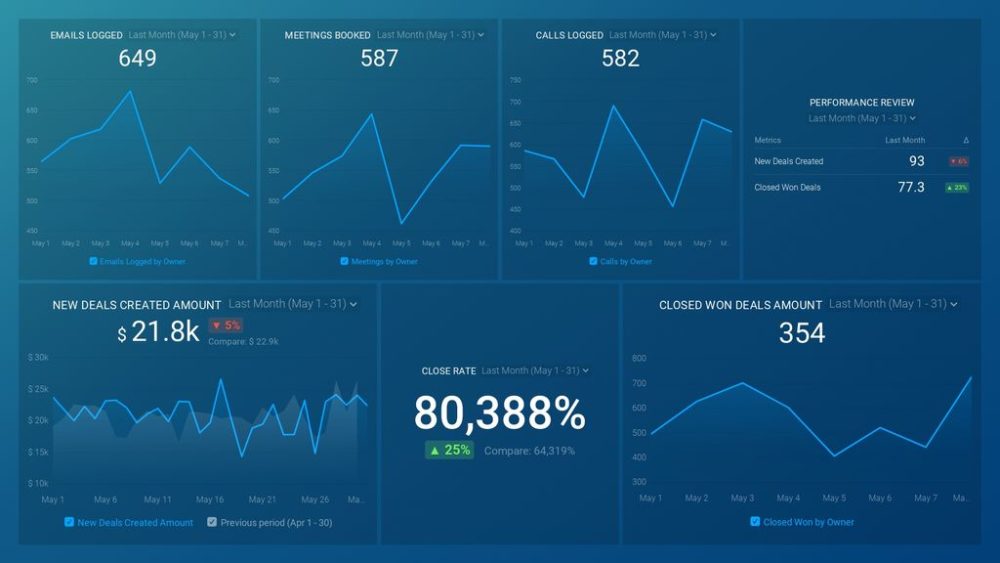
Why it’s important: This type of benchmarking can help a company identify areas where it is outperforming or underperforming and make changes to ensure that all teams are working towards the same goals.
Process Benchmarking
Process benchmarking can be both internal and external, and it focuses on the processes and systems used by a company to achieve its goals. It involves analyzing the processes used to complete tasks and comparing them to other companies or industry best practices to determine which processes are most effective.
For example, a technology company could compare its manufacturing processes, such as the supply chain, production methods, and quality control procedures, between its own factories to identify which one is performing better and why.
What you need: To perform process benchmarking, you need to have access to industry best practices or similar processes in other organizations and data to compare the performance of the evaluated process against those best practices.
PRO TIP: If you are looking for industry best practices on internal business reporting processes, check our latest 2023 State of Business Reporting in which we surveyed 314 companies globally to discover the most important trends in business reporting. We talked about tools, metrics, KPIs, best practices, and more.
Why it’s important: This type of benchmarking can be used to identify processes that are underperforming and track changes in performance over time. It also provides its own benchmark for measuring progress over time.
Performance Benchmarking
Performance (or competitive) benchmarking, is probably the most common type of benchmarking out there. It’s the systematic comparison of an organization’s performance metrics with those of its competitors or best-in-class organizations to identify areas for improvement.
For example, an insurance company could assess the performance of its sales teams using a single metric, customer satisfaction level, in order to assess the results of its recent efforts to improve it.
What you need: To perform performance benchmarking, you need to have access to performance data for your organization and the organizations you are comparing to. This data may include financial performance metrics, customer satisfaction scores, employee engagement metrics, or other relevant indicators. As we mentioned in the beginning, this data is avalilable to you for free via Databox Benchmark Groups.
Why it’s important: Performance benchmarking provides organizations with an understanding of how they compare to their competitors or best-in-class organizations. This helps organizations identify problem areas, prioritize initiatives, and measure progress over time.
Strategic Benchmarking
Strategic benchmarking is the comparison of an organization’s overall strategy with that of best-in-class organizations in order to learn from their success. You want to understand how they got to top positions in the industry and how they developed over time.
For example, an IT company could be looking at the resources and capabilities of its competitors, like their research and development goals, and use this information to identify operations it could improve.
What you need: To perform strategic benchmarking, you need to examine high-performing companies’ business models and understand how they differ from yours. This will allow you to identify elements you can implement in your structure.
Why it’s important: Strategic benchmarking can lead to better decision-making, improved strategic alignment, and increased competitiveness due to a better understanding of competitor processes.
Financial Benchmarking
Financial benchmarking involves running financial analyses in order to compare an organization’s financial performance against its peers, industry standards, or historical data. This type of benchmarking focuses on financial metrics such as revenue, profit margins, return on investment, and debt-to-equity ratios.
For example, an automotive company could examine the financial metrics of its competitors in order to better understand their spending habits and optimize its cost structure and increase profit margins
What you need: To perform financial benchmarking, you need access to financial data for your organization and the organizations you are comparing to. This may include financial ratios, return on investment, and other financial metrics.
Why it’s important: Financial benchmarking allows you to identify areas where you can improve your cash flows, minimize costs, and optimize your ROI. As such, it’s essential for businesses that need to prioritize their spending.
Benchmarking from an Investor Perspective
Benchmarking from an investor perspective involves measuring a company’s financial performance relative to a predetermined standard. This standard could be an index such as the S&P 500 or peer groups that can be considered alternative investment opportunities.
For example, an investor could be comparing the performance of different investment opportunities so they could make an informed decision for themselves or their clients.
What you need: In order to perform this type of benchmarking, you need your company’s investment data, benchmark index data, and/or peer company financial data to compare your investment potential against, and tools for analysis.
Why it’s important: It gives you data that informs investment decisions. Financial benchmarking from an investor’s perspective provides valuable information that helps investors assess the relative performance of their investments, determine investment risk, and make informed investment decisions.
Related: Reporting to Investors: 6 Best Practices to Help Increase Funding
Benchmarking in the Public Sector
Benchmarking in the public sector is a process used to measure the performance of public services and programs relative to a specific standard. It functions as a tool for improvement and innovation in public administration, where state organizations attempt to improve the quality, efficiency, and effectiveness of the services they provide.
For example, the Department of Health and Human Services could compare the efficiency of different municipal health departments against standardized benchmarks in order to determine which one will need additional resources.
What you need: In order to perform benchmarking in the public sector, organizations need to identify a benchmark that is an appropriate proxy for their services and programs. This could be a benchmark that is developed based on best practices or a peer group of similar public services or programs. Organizations then use the performance of the benchmark to measure the relative performance of their services and programs.
Why it’s important: The data you get informs policymaking. It helps government agencies, as well as the public, to assess the efficiency and effectiveness of public programs and services by comparing them to best practices and peer organizations. This helps identify areas for improvement, allocate resources more effectively, and ultimately provide better services to the public.
Product Benchmarking
Product benchmarking is the process of testing your products against those of your competitors in order to find out where your product ranks in terms of consumer preference, usability, or features. Alternatively, you can perform internal product benchmarking against old product versions in order to ensure the new ones are performing according to your expectations.
For example, a software company could compare the features and prices of its products against direct competitors in order to determine what, if anything, it should change in its approach.
What you need: In order to perform product benchmarking, you need to track metrics like product activation, feature adoption, product stickiness, and user retention.
Why it’s important: You get data that informs product design and development. You’ll get an overview of the market and trends, better understand product performance, and be able to make data-backed decisions.
Functional Benchmarking
Functional benchmarking compares internal functions and processes with those of external best practices or industry standards. It works regardless of the industry and is invaluable for identifying performance gaps.
For example, a telecommunications company could examine the performance of different functional areas like operations and maintenance and data management to make informed decisions on investments in technology and resources.
What you need: For this type of benchmarking, you need clearly defined processes and functions, relevant data within your company, and information from peer organizations you’re benchmarking against.
Why it’s important: Functional benchmarking allows for qualitative comparisons and provides industry trend information that can be used for the improvement of internal functions and processes.
Best-in-Class Benchmarking
Best-in-class benchmarking involves studying the leading competitor or the company that best carries out specific functions.
For example, an oil and gas company could compare its operations and maintenance costs, energy efficiency measures, and the effectiveness of its green initiatives against that of the industry leaders to identify areas where it’s lagging and gain insight in how to improve them.
What you need: You need to gather process and function information from the best-in-class competitors and a benchmarking methodology that will allow you to compare them against your performance.
Why it’s important: Information about how other organizations approach similar challenges and the ability to identify opportunities for improvement.
Energy Benchmarking
Energy benchmarking is the continuous process of gathering, analyzing, and evaluating energy performance data of comparable activities with the purpose of assessing and comparing performance between or within entities. Entities that can be benchmarked include processes, buildings, equipment, or companies.
For example, an industrial company could try to assess the efficiency of its energy usage compared to that of the competitor with a similar number of facilities in order to identify potential cost savings.
What you need: This type of benchmarking requires energy consumption data, baseline and normalization factors to account for variations in energy consumption due to various factors, and comparable data sources to be used as reference points.
Why it’s important: The goal of energy benchmarking is to identify areas where energy is being wasted and set energy efficiency goals, leading to increased sustainability and cost savings.