Most SaaS companies follow the same growth script: hire sales reps, run ads, build a demand gen engine, and hope the pipeline holds.
Instead, Clay built an ecosystem. Certifications, community chapters, live workshops, a talent marketplace, and a university. And for years, it wasn’t obvious it was working.
Today, Clay is one of the fastest-growing GTM platforms in the world with nearly 370 people, 84 community chapters across the globe, and a brand that has bled well beyond the SaaS bubble.
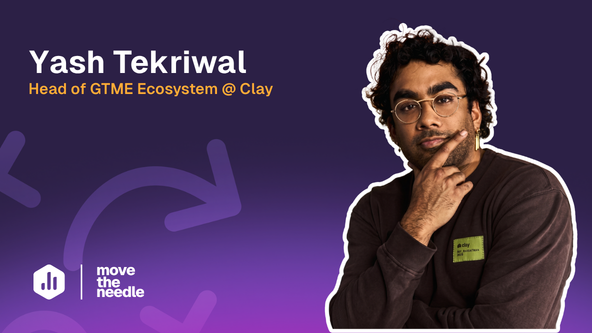
In a recent episode of Move the Needle, Yash Tekriwal, Head of Ecosystem Growth at Clay, broke down exactly how they built this: the six subgroups of their ecosystem, the certification program that looks nothing like any credentialing process you’ve seen, and why Clay tracks two types of data: hard financial metrics and “the feeling.”
This is that playbook.
If you want to track the metrics that actually matter to your ecosystem motion — pipeline influenced, retention by champion presence, expansion by cohort — Databox makes it easy to build that visibility without waiting on an analyst. Try it free.
Why Most Companies Never Build an Ecosystem
The reason most SaaS companies skip ecosystem-led growth is most likely a lack of conviction.
Ecosystems are slow to start, hard to attribute, and nearly impossible to defend in a board meeting when pipeline is the only language being spoken.
Yash was refreshingly honest about this tension at Clay.
“Almost everything that we do is both incredibly important to the financial metrics and also indirectly unimportant. Attribution is just hard, especially from a marketing standpoint.”
But Clay leaned in anyway — and the compounding effect is now undeniable.
The Six Subgroups of Clay’s Ecosystem
Clay’s ecosystem isn’t a single program. It’s a platform of six interconnected subgroups, each with its own metrics, its own growth targets, and its own role in the broader flywheel.
1. Innovation
Startup programs and campus programs designed to get Clay into the hands of the next generation of GTM engineers before they’ve built their stack preferences.
2. Community
The Clay Club — 84 chapters in cities across the world, from New York and London to Barcelona and beyond. A digital Slack community runs alongside it. The goal is simple: get Clay users in the same room, IRL and online, so they can learn from each other and pull each other deeper into the product.
3. Live Trainings
Digital and in-person cohorts, workshops, and learning programs. These are not webinars. They are structured, hands-on sessions designed to get participants to a meaningful skill threshold — fast.
4. Async Content — Clay University
A self-serve learning hub at university.clay.com where anyone can go to learn the product, explore use cases, and build skills at their own pace. This is the top of the ecosystem funnel.
5. Certification and Badging
A skills-based credentialing program that proves GTM engineering competency through real project work — not multiple choice questions. More on this below.
6. Talent Marketplace
A job placement layer on top of the certification program that connects certified Clay users with companies actively hiring for GTM engineering roles.
The Certification Program Nobody Else Would Build
Of all six subgroups, the certification program is the most intentional — and the most different from anything else in the market.
Yash didn’t mince words about why.
“I have never seen a badging or a certification process that I have liked as a learner or an educator. Are you really gonna get a good sense of that from a couple of multiple choice questions and a proctored assessment? Probably not.”
So Clay built something different. Instead of testing knowledge, they test competency. Instead of a proctored exam, they evaluate real project work. The goal is not to give someone a badge — it’s to create a signal that employers can actually trust.
The financial logic behind this is more sophisticated than it looks. Clay’s data shows that companies without a strong internal Clay champion are 60–80% more likely to churn at renewal. By certifying GTM engineers and placing them inside customer accounts, Clay is directly influencing its own retention metrics without it showing up as a traditional sales or customer success motion.
IRL Workshops: The Unattributable Growth Engine
Alongside the certification program, Clay runs in-person workshops for 20 target customers or prospects at a time. No slides. No pitch. Just hands-on time with the product in a room full of people who are trying to solve the same problems.
The attribution on these events is, by Yash’s own admission, nearly impossible to measure cleanly.
“We don’t have this yet, but we will try and plan it — as we add more Clay users or GTM engineers to companies that have more use cases they want to be expanding with us into, do we see a correlation between time of hire and time of expansion?”
But the anecdotal evidence is strong. Deal velocity increases. Contract sizes grow. Champions who were conceptually sold on Clay become emotionally invested in making it work. And occasionally, someone walks out of a workshop and publishes a LinkedIn post mapping all 16 of their Clay touchpoints before they finally bought.
That post becomes its own growth engine.
The Two Types of Data Clay Tracks
Does Clay have a culture where not everything needs to be tracked? Yash’s answer reframed the question entirely.
“I would even go so far as to reframe that into, we almost do track everything, but there are two types of data that we will take in. One is what everyone is used to. It’s the financial metrics, the tracking, the planning, the spreadsheet. And then the other is just the feeling. Are you feeling the pull of the market? Are you feeling the pull of customers?”
This is exactly the gap that tools like Databox are designed to close. When your hard metrics live in one place — standardized, verified, and accessible to everyone on the team — it becomes much easier to have honest conversations about what the data is saying versus what you feel is happening. Databox’s AI Summaries and verified metrics give GTM leaders the foundation they need to defend the unattributable — not by eliminating gut instinct, but by making sure the hard data underneath it is trustworthy enough to stand on its own.
What This Means for Your GTM Strategy
You don’t need 84 community chapters to apply this playbook. But there are principles here that translate to any mid-size SaaS company building for durable growth.
Start with education, not sales. Clay University existed before the talent marketplace. The async content existed before the live cohorts. Build the education layer first — it creates pull that a sales motion can’t manufacture.
Design your certification to actually prove something. If your certification program wouldn’t impress a hiring manager, it won’t build the kind of trust that drives retention and expansion. Make it hard. Make it real.
Defend the unattributable. The workshops, the community chapters, the IRL events — these are hard to defend in a pipeline review. Build the language to defend them anyway. Yash’s “two types of data” framework is a good starting point.
Let the flywheel compound. None of this works in a quarter. Clay slogged through five years of slow, churn-heavy growth before the ecosystem motion started to hum. The companies that win with this model are the ones that build the foundation before it’s obviously working.
The Bottom Line
Clay’s ecosystem is a growth engine with everything else is built around it. The certifications create champions. The champions reduce churn. The workshops accelerate deals. The community generates word of mouth. And all of it compounds in ways that a traditional sales team simply cannot replicate at the same cost or the same scale.
The question isn’t whether ecosystem-led growth works. Clay is proof that it does.
Listen to the full episode with Yash Tekriwal on the Move the Needle podcast. Available on YouTube, Spotify, and Apple Podcasts.