
TL;DR
- Across a Databox research on using AI in analytics, involving 100+ business users running generative AI daily for analytical work, operators independently converged on the same six-part shape of what they refuse to hand off. Finance, sales, marketing, product research, land acquisition. Different domains, same shape.
- The six patterns: AI can’t see the business context behind the numbers; AI can’t read people; AI is too confident in its recommendations; AI can’t be accountable for a decision; some data doesn’t go to AI at all; AI can’t sound like you.
- What is being delegated has one shape: repeatable operations on specific data, producing outputs a human then reviews. What is being kept has the opposite shape: judgment on outputs whose value depends on knowing something the data doesn’t show. Delegate the measuring. Keep the meaning.
- The AI-analytics category keeps optimizing for a wider delegation surface. Executives running AI daily are optimizing for something else: whether the mechanical outputs their AI tools produce are reliable enough for the judgment layer above them to act on with less friction.
- The substrate this line calls for is not the AI product on top. It is the intelligence layer beneath every tool the judgment layer reads from: verified metrics, semantic layer, named ownership, activity log. Governance in the workspace, not next to it.
The AI-analytics category has one operating assumption: AI’s job is to do more of what humans currently do. Adoption is measured by delegation surface. Success is when AI takes the whole task.
Ask the executives running AI daily what they refuse to delegate, and you get a different story. Actually, you get the same story, from operators who do not know each other, running different companies, across different functions.
In Databox research that involved more than 100 business users, operators independently converged on the same six-part shape of what stays with them. Finance, sales, marketing, product research, land acquisition. Same shape, different domains. They are not asking their vendors to let AI do less. They are quietly deciding, task by task, what to keep. Here is the map, in the order the reader is likeliest to recognize it.
The market keeps expanding AI’s scope. The users running it daily are drawing the opposite line.
The pitch decks all point one direction: AI does more. Autonomy is the endgame. The category is optimizing for a wider delegation surface. The executives who use AI daily are optimizing for something else: which classes of work are safe to hand over, and which are not. What follows is what they told us, in their own words. Six categories. Every category answers the same underlying question: what class of judgment does not move to the tool.
The six patterns.
1. AI can’t always see the full context behind the numbers.
Tommy Landry, founder of Return On Now, asked an AI to interpret monthly income and expense data. The answer was polished: it flagged revenue changes, expense pattern shifts, profitability movement. It was mathematically defensible on every count. Tommy scrapped the conclusion. “The AI treated the monthly numbers like a clean trend, when I knew the reality was messier,” he told us. A client had paid late one month. Another month, Tommy had prepaid software, paid a contractor, and delayed an invoice. The AI could see the numbers. It could not see the timing. “That made the answer feel too confident.”
Illia Termeno at FillEdge described the same problem in a different domain. An AI-driven user-behavior analysis “was completely missing the psychological perspective and pains that drove user behavior in these situations.” The math was fine. The pattern-recognition was fine. What was missing was the context that lives outside the data.
What stays with the executive: reading the numbers against the context the data doesn’t hold. Clearer metric definitions and business notes attached to the data can narrow this gap. They can’t close it.
2. AI can’t read people.
Andy Rouse is co-founder of Haystack Land Company. The business buys land from owners who want an easy, safe exit. Andy lets AI sort and route leads. He does not let it decide who gets an offer.
“A lot of the people who sell to us come in sounding rough,” he told us. “They’re grieving heirs, older folks, people typing with voice-to-text while they drive, so the first message can read as garbled or all over the place. An AI takes one look at that and files it under spam or low quality. Trouble is, those are often the people most likely to sell to us.” The training data does not include the tell that separates a grieving heir from a scammer. Andy has that tell. AI does not. Get it wrong and you lose tens of thousands of dollars you may never know you lost.
What stays: reading the person on the other side. There is no substrate fix for this. The tell isn’t in the training data, and no product roadmap is going to put it there.
3. AI is too confident in its recommendations.
Chris Todd at CTM will use AI-generated recommendations, but not the ones he cannot fully defend. “I would never use an AI recommendation I couldn’t explain fully or provide assumptions being used, and limitations in the data being sampled.” An AI answer that sounds equally confident whether it is right or fabricated is not a recommendation. It is a claim without evidence.
Farah Ahmed at ZillionDesigns applies the same standard to research: “I depend on my research for anything and am able to trust that better than if I simply ask GPT or Claude.” Chris and Farah are not skeptical of AI outputs. They are skeptical of AI outputs they cannot check.
What stays: knowing how the answer was reached, not just what the answer said. This one the substrate can close. When every AI answer traces back to a specific query, a specific dataset, and a specific set of assumptions, Chris does not have to work it out himself. He can look it up.
4. AI can’t be accountable for a decision.
Jonathan Aufray, founder of Growth Hackers, uses AI for market analysis, competitive research, options-generation, and first drafts of anything. He will not use it for hiring decisions, major investments, or significant shifts in business direction. His reasoning is not that AI is more often wrong on the strategic calls. It is that when AI is wrong on the strategic calls, the cost does not come back. “The most important business decisions require judgment, experience, and accountability.” A model cannot be held accountable for a decision whose downside is a business that no longer exists.
What stays: the calls whose downside doesn’t reverse. Accountability isn’t a feature you install. No product roadmap resolves this pattern, and none should. Where AI is wrong reversibly, the delegation is cheap. Where AI is wrong permanently, there is nothing to buy.
5. Some data doesn’t go to AI at all.
Phil Lancaster at Delivio does not feed AI anything of a highly personal or sensitive nature without masking it. Joan Malata at Syntactics does not allow AI access to client or financial data at all. Nayanaba Gohil at Meetanshi refuses to share client revenue data with generative AI, even where the model has earned trust, because the residual risk is not one she owns.
This pattern is upstream of the other five. The data never enters the delegation loop in the first place. Where the input carries risk the business owns (breach, exposure, competitive leakage, loss of client confidence), the input stays out of AI’s context window.
What stays: the input itself. A workspace where you control what AI can read and who inside the company can grant that access shifts part of this. It doesn’t change the calculus about client financials or personal information that were never meant to enter the loop.
For the data the business is willing to expose to AI in a controlled environment, Databox sits at that layer. SOC 2 Type 1 certified, GDPR compliant, hosted on AWS, with role-based permissions on every metric, dashboard, and dataset, and AES-256 encryption at rest and TLS in transit. When AI reads the workspace through Genie, Databox AI analyst or MCP, the query runs in real time and business data is not persistently stored by the AI provider. Sensitive assets stay inside the compliance perimeter your team already signed off on.
6. AI can’t sound like you.
Mony Raanan, founder of Voice Crafters, ran an AI-drafted outreach campaign for backlinks. The targeting analysis was solid. The emails were not. “I read the first batch the way the recipient would,” Mony told us, “and they sounded automated. Polished and obviously machine-made.” Mony scrapped the batch and rewrote the voice himself. “I run an agency whose entire argument is that human work reads differently from generated work, and there I was about to send generated work to the exact people I wanted to take me seriously.”
Mony’s product is his craft. AI-drafted craft with Mony’s name attached undermines the argument the business is making about itself.
What stays: the output whose value depends on being yours. No substrate fixes this. The whole argument of the pattern is that this class of work can’t be delegated.
The pattern behind the patterns: delegate the mechanics, keep the meaning.
If you take another look at what every executive above is actually delegating, you’ll see that every delegated task shares one shape: repeatable operations on specific data, producing outputs a human then reviews.
Now, take a look at what every executive is keeping: Timing, Tell, Reasoning, Stakes, Privacy, Voice. And, referenced but not quoted here, dosage. Abhishek Joshi at Dog with Blog put the frame most simply in his own answer to the survey. Quantity is what the model gives you. Dosage is the judgment you give back. Every kept operation lives in the same class. Judgment applied to outputs whose value depends on knowing something the data doesn’t show.
Delegate the measuring. Keep the meaning.
This is an operational discipline. The operators above are not the AI-skeptics the category has been arguing against for two years. They use AI daily and believe in it. They just decided, task by task and case by case, where in their workflow AI is competent and where it is not. AI, in their operating model, is the intelligence layer beneath the tools. Judgment is the layer above. This is what happens when experienced users scope their tools around that division.
What this changes about how executives should scope AI adoption.
If your team is already drawing this line in practice, the operating question is not “how do we expand AI’s delegation surface.” The question is whether the mechanical work below the judgment layer is producing outputs your judgment layer can trust. Whether Tommy’s context-check, Chris’s reasoning-check, Andy’s people-read still have coherent inputs to check.
Your team is applying judgment. The bottleneck is on what the judgment layer is receiving. When the AI tool below has no verified definition of “qualified lead,” what marketing calls a qualified lead and what finance calls a qualified lead show up as the same number in the same answer, and the executive above has to arbitrate a semantic collision the tool should have resolved. When the metrics have no named owner, tracing the reasoning behind an answer becomes a memory exercise. When there is no activity log, the reasoning Chris Todd requires has to be reconstructed rather than looked up. The judgment layer works. What it is working on does not.
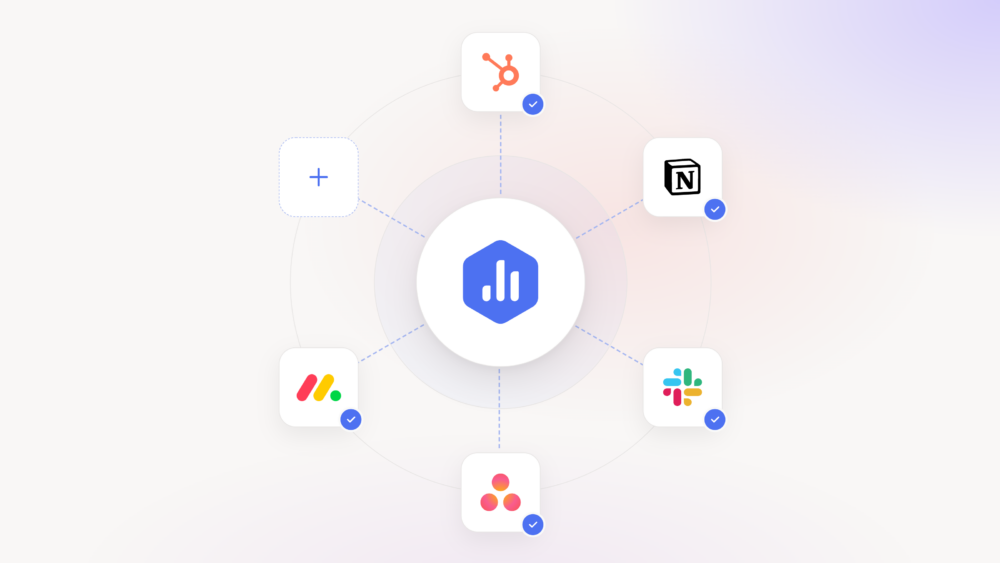
Governance in the workspace is the data infrastructure this line calls for. Verified metrics mark which version of a number is official, so the mechanical outputs the judgment layer receives arrive labeled, not blended. The semantic layer maps “MQL” and “qualified lead” to the same definition regardless of which team asks, which closes the business-context gap Tommy ran into. Named ownership makes every metric, dashboard, and dataset accountable to a specific person, so the reasoning behind an answer is a workspace fact rather than a memory exercise. The activity log records every change to a metric or dashboard, so the reasoning Chris wants is something he can look up rather than reconstruct. Roles and permissions decide who can verify, edit, or view each asset, which is the piece Phil, Joan, and Nayanaba rely on.
This is not the AI product on top. It is the intelligence layer for business data beneath every tool the executive judgment layer reads from: properly authenticated, fully auditable and built for the line your team is already enforcing.
Want the full picture? Download the full report!
By submitting the completed form, you agree to our Terms of Service and Privacy Policy
Frequently Asked Questions
When should businesses not use AI for analytics?
Business users who run AI daily consistently refuse to delegate six kinds of analytical work: (1) interpreting numbers against context the data doesn’t hold, such as the timing of financial events; (2) reading people and their motivations, especially where the tell isn’t in the training data; (3) using AI recommendations whose reasoning cannot be traced back to a specific query and dataset; (4) making strategic decisions whose downside is unrecoverable; (5) sharing sensitive or client data with consumer AI tools; and (6) producing output whose value depends on being human-made, like founder-voiced outreach. The underlying rule these operators apply: delegate the mechanics, keep the meaning.
What analytical tasks can be delegated to AI, and which have to stay with a human?
Business users delegate the mechanical layer of analytical work to AI: measuring, pulling data, formatting, categorizing, summarizing, drafting first passes, and sorting or routing inputs. They keep the judgment layer: interpreting numbers against business context, reading people, verifying how AI reached a recommendation, taking accountability for consequential decisions, controlling what data enters the AI in the first place, and producing outputs whose value depends on being human-made. The dividing line runs between mechanical operations on defined inputs and judgment applied to outputs whose value depends on knowing something the data doesn’t show.
How can companies safely use AI with sensitive business data?
The safety of using AI with sensitive data depends on where the data lives, not which AI queries it. Data kept inside a SOC 2 certified and GDPR compliant workspace, with role-based permissions and encryption at rest and in transit, can be read by AI through governed access tools like Databox Genie or Databox MCP. In that setup, the query runs in real time and the business data is not persistently stored by the AI provider. Data that carries risk the company doesn’t own, such as client financials or personal information not covered by a data processing agreement, should stay out of AI’s context window entirely regardless of the tool.