Mentoring is often seen as an informal, “nice-to-have” initiative when in reality, it can be an important part of your growth strategy.
We’ve learned that when mentoring is structured, intentional, and supported, it can become an extremely effective tool that strengthens people’s skills, builds trust, accelerates development, and prepares people for bigger roles.
Even our CEO mentors.
When leadership models learning and teaching, it motivates people to grow.
A well-structured mentoring program can help you:
- Grow internal talent faster
- Strengthen cross-functional collaboration
- Transfer knowledge across different teams of divisions
- Prepare high-potential hires for roles with more responsibility
How Mentorship Helps Fast-Growing Teams
We didn’t build this program just to support the development of our people, but also because it has a positive impact on the business.
When a company grows, work becomes interconnected, dynamic, and structured. You need a system that helps people:
- Improve technical and commercial skills
- Gain confidence and independence
- Solve problems with better context
- Collaborate across teams and departments
- Navigate complex workflows and decisions
- Prepare for responsibilities that naturally evolve as we scale
Mentoring is a great structure that can tie all of this together.
What Mentoring Looks Like at Databox
Our program runs for six months and focuses on real, practical growth, whether that’s building new skills, preparing for a new role, onboarding faster, or sharing knowledge across teams.
Each mentoring relationship is structured around clear goals, regular sessions, and measurable progress. But at the same time, it leaves enough room for flexibility so each pair can adapt the experience to what’s most useful.
This isn’t theoretical learning. It’s tied directly to the work people are already doing.
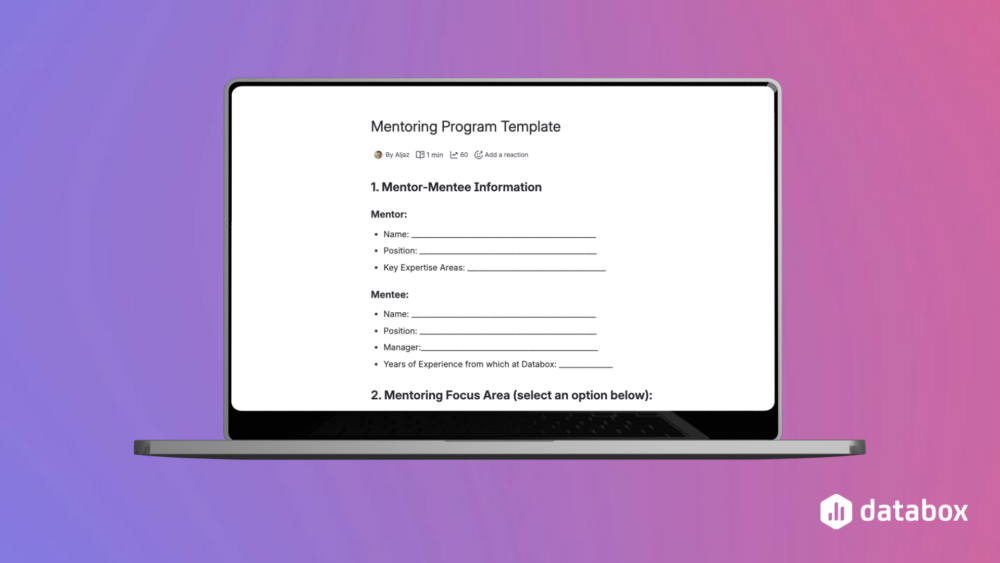
To keep the program consistent and transparent, the entire mentoring process—including roles, expectations, and templates—is documented and easily accessible to everyone involved.
Progress is tracked through a structured template aligned with individual goals, giving both mentees and their managers clear visibility into development over time. This allows managers to stay closely connected to the process and use regular 1:1s for meaningful check-ins.
At the same time, the People & Culture team monitors progress to ensure consistency, accountability, and that each mentoring relationship stays on track.
How the Program Works
Before introducing our Databox Mentoring Program, we noticed we needed an initiative that is structured and will support people to be better in their roles.
We decided to create our own mentoring program to close that gap.
Here’s how we structured it.
1. Picking the right people
Twice per year, leadership identifies high-potential individual contributors who show readiness (or near readiness) for bigger responsibilities.
Only up to 10% of team members can join each cycle, which keeps it focused and impactful.
2. Matching mentors and mentees thoughtfully
The pairings should never be random. They should be intentional and consider:
- Skill gaps
- Future role trajectories
- Personality and working style
- Areas of technical or commercial expertise
3. Meeting over a longer period
In order for the program to have an impact, it should be something that lasts more than a few weeks. At Databox, mentoring pairs meet biweekly for 6 months, and the topics they discuss are guided by:
- Defined development goals
- A shared mentoring plan
- Regular feedback loops
- Support from managers and the People and Culture team
4. Orienting everything around goals
Mentoring works best when there’s a clear direction. Each mentee defines specific goals upfront—aligned with their manager, career path and the needs of the business.
This keeps sessions focused and ensures that mentoring isn’t just a chat but is intended to accelerate learning and prepare people for the next phase of our growth or the next step in their career.
5. Tracking progress along the way
Progress isn’t left to chance. Throughout the program, mentors and mentees review and document what’s working, what’s improving, and where adjustments are needed once per month.
This creates accountability, keeps momentum high, and makes sure the mentoring relationship delivers real, measurable outcomes—not just good intentions.
Why Mentoring Prepares People for Bigger Roles
In a company that grows, talent gaps don’t show up as empty desks. They are visible when people take on bigger responsibilities and lack the support they need to be successful.
When people move into bigger roles, they typically need three things:
- Clarity
What’s expected? What does success look like? - Confidence and knowledge
Am I ready to make decisions, lead initiatives, or support customers independently? - Context
Why does this work matter, and how does it connect across teams?
Mentorship accelerates all three.
Many mentees are picked because there is an expectation that they will transition into a bigger role, either into product, leadership, sales, senior IC roles, or cross-functional work.
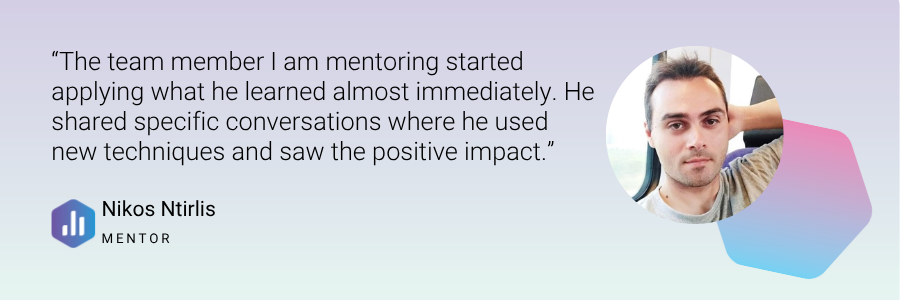
Importantly, managers of mentees are also involved in this process and track their progress closely. They are able to quickly see the progress their team members are making.

Structured guidance has the power to create a safe, focused space for development. It basically means someone experienced is helping you see what you can’t see yet.
How Mentoring Benefits the Entire Company
How will you know it’s working?
People will ask to be mentored.
At Databox, people have proactively reached out wanting to join the next cycle, which means our program is not only needed but valued.
However, having a mentoring program does not just help the mentees, but has company-wide benefits you will start seeing soon after implementing it.
For mentees
Mentees are obviously the ones who see the most direct impact of this initiative. They experience faster growth, they gain clarity in their career path, perform better in their role and are generally more confident at work.
This gives them a sense of ownership over their tasks and empowers them to feel ready to handle what’s coming their way in the future.
For mentors
While mentors are focused on growing their mentees, they are also the ones who benefit during this period. Being a mentor taught them how to coach others and allowed them to reflect on their own habits and thought processes. They gain visibility into other teams and are forced to articulate knowledge they’ve never had to verbalize before.
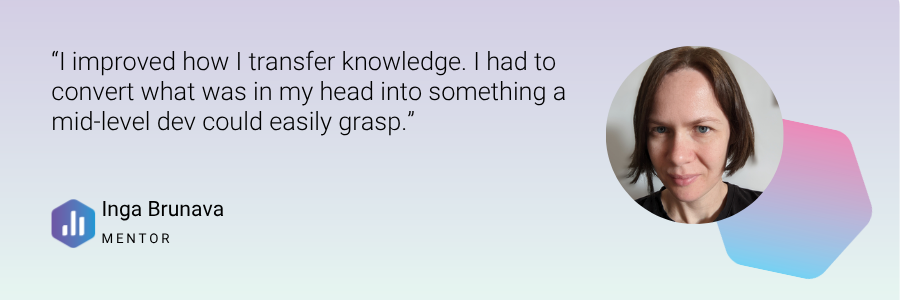
There are people on our team who initially felt like they didn’t have anything to mentor about, but quickly learned that they did, which is amazing to see and makes this process just as valuable for mentors.
Leadership sets the tone
One thing we’re especially proud of: mentoring isn’t limited to a specific level.
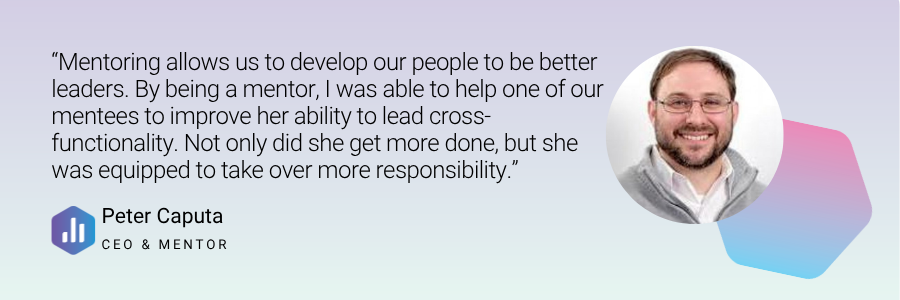
Our CEO has also taken on the role of a mentor.
That matters.
It shows that learning and development aren’t something we delegate. They’re part of how we operate as a company.
When leadership is involved, it reinforces a simple idea: everyone has something to teach, and everyone has something to learn.
Why mentoring is worth considering (for any company)
Most companies run into the same challenges as they grow:
- Knowledge gets siloed
- Onboarding takes too long
- Career paths feel unclear
- Teams become disconnected
Mentoring is one of the simplest ways to address all of these.
It creates a structured way to share knowledge, develop people, and build stronger connections across the company.
And in remote or hybrid environments, it becomes even more valuable.

You don’t need a complex system to start. But you do need intention.
How to Structure the Program for Maximum Efficiency and Transparency
A mentoring program only works if it’s structured enough to create progress, but flexible enough to allow real conversations, problem-solving, and connection.
If you are thinking of implementing it, consider creating a framework that keeps mentors, mentees, and managers aligned from day one.
Here’s how we built it.
1. Clear focus areas to guide the relationship
Every mentee enters the program with a defined purpose. There is no “general growth” approach. Each mentee has a primary focus area. In our case, those are:
- Professional Development: building or strengthening specific skills
- Career Advancement: preparing for expanded responsibilities
- Onboarding & Integration: building role-specific knowledge quickly
- Knowledge Transfer: sharing domain expertise or institutional knowledge
This focus area shapes everything that happens during the six-month cycle.
2. Kick-off call
Before the mentoring cycle begins, mentors, mentees, and mentee managers join a kickoff session with the People & Culture team.
During this session, P&C walks everyone through the program structure, clarifies roles and responsibilities, and sets clear expectations to ensure everyone starts aligned and ready to get the most out of the experience.
3. Defined goals, set together with the mentee’s manager
Before the first mentoring session, mentors receive clarity around:
- The mentee’s long-term goals
- The skills they’re developing
- The competencies they need to operate more confidently
- What “progress” should actually look like
This ensures mentoring supports both the individual and the team and is aligned with what our business needs are at the moment.
3. A planned schedule that keeps momentum high
When we start a new mentoring cycle, we host a kick-off meeting to build rapport, set expectations, and outline the plan. Then, mentors and mentees meet at least bi-weekly for six months, with mentees taking full ownership of:
- Scheduling sessions
- Preparing topics
- Bringing challenges
- Following up on the agreed next steps
Intentionally putting mentees in the driver’s seat motivates them to grow and reinforces the ownership they need to step up in their roles.
4. Meaningful activities that support growth
Depending on their goals, mentees work through a mix of:
- Shadow sessions
- Practice conversations
- Project work
- Reading assignments
- Tools or frameworks
- Internal knowledge-sharing
- Applied exercises directly tied to their role
5. Monthly progress reviews to track development
One of the most important parts of the program is how we track progress. Every month, mentees reflect on:
- Key achievements
- Challenges faced
- Skills strengthened
- Areas still unclear
- Confidence changes
- What they want to focus on next
Mentors add their perspective, helping mentees see blind spots and recognize growth they may overlook. After 3 months, pairs have a structured review conversation that resets goals if needed and ensures both sides stay aligned.
6. A final evaluation that captures impact
At the end of the six-month cycle, every mentee completes a reflection that covers:
- Skills they improved
- Goals they achieved
- Confidence gained
- Knowledge applied
- Impact on their day-to-day work
- Career development progress (if applicable)
Mentors also share feedback on areas of growth, opportunities for the future, and next steps for development. The final step is essential and turns this process into something meaningful and tangible.
7. Recognition and celebration
It is important to show recognition and celebrate both mentees and mentors for their efforts. This can be done using certificates, company-wide shoutouts during meetings, or with more opportunities to contribute or expand their influence.
Mentoring in a Nutshell
If you are thinking about implementing this in your team, here are the takeaways:
1. Make it a system
Structure, consistency, and accountability are what make mentoring impactful.
2. Pair people intentionally
Skill gaps, future roles, and personality fit matter.
3. Support mentors just as much as mentees
Training, guidance, and reflection sessions make a big difference.
4. Create a triangle of support
Mentor + Manager + P&C = shared accountability.
5. Measure the program’s impact
Track progress, collect feedback, and adapt every cycle.
When you invest in people intentionally, you build an organization that can grow intentionally, too.