

TL;DR
- Marketing planning and forecasting is cross-tool work: spend lives in the ad platforms, pipeline in the CRM, revenue in billing, and history in whatever someone remembered to save. Today most teams reconcile it by hand, into a spreadsheet nobody trusts.
- AI can compress that cycle from weeks to minutes, but only if it computes on governed, consistent data across the whole stack. Pointed at one tool or a hand-built spreadsheet, AI does not fix the guesswork. It automates it.
- An AI-built forecast fails on three axes: definitions the model guessed, tools the model cannot see, and history the model does not have.
- The fix is structural: an intelligence layer for business data beneath the planning process, with shared metric definitions, cross-tool joins, and kept history. The LLM never touches your calculations.
- What changes in practice: targets live next to the data, pacing against plan is visible continuously, and the quarterly planning cycle stops being an archaeology project.
Ask a Marketing Lead how the quarterly plan actually gets built. Not the strategy, the mechanics. The answer, in most teams, is a spreadsheet: spend pulled from five ad platforms with five different backends, pipeline exported from the CRM, last quarter’s numbers copied from a deck, targets negotiated in a separate thread. One customer described their version of it to us in a sentence that needs no editing:
“(I wanted) to keep track of budget and campaigns, social media reporting. Each individual platform has its own analytics backend. So basically I’ve created this master Excel spreadsheet, and I hate it. I hate it.”
– A marketer describing their planning workflow, in a conversation with Databox
Now AI arrives, and the promise is obvious: hand the planning and forecasting work to a model. Ask it what next quarter’s pipeline contribution should be, which channels deserve more budget, whether the current pace hits the annual number. The 86% of professionals who already reach for ChatGPT, Claude, Gemini, or Copilot before any other analytical tool (per Databox’s How Businesses Actually Use AI for Analytics survey) are already asking exactly these questions.
Here is the thesis: AI really can compress marketing planning from weeks of assembly into minutes of questioning, but the model is the cheap part. A forecast is only as good as the data it can see and the definitions it computes on. Point AI at one tool, or at the hated spreadsheet, and it does not fix the guesswork that made planning painful. It automates the guesswork and returns it with confidence.
AI pointed at fragmented data does not plan faster: it guesses faster.
The reason marketing forecasting has always been hard is not mathematical. Marketing’s inputs are scattered by design: every ad platform reports its own spend and its own conversions, the CRM holds pipeline under sales’ definitions, revenue reality lives in billing, and organic and AI-sourced channels resist attribution entirely. The weekly version of this problem is annoying. The planning version is structural, because a plan needs all of it at once, reconciled, over time.
Databox’s own research puts a number on the assembly cost: 64% of data leaders say it takes one to three days just to gather the data needed to answer a business question. A quarterly plan is fifty of those questions stacked.
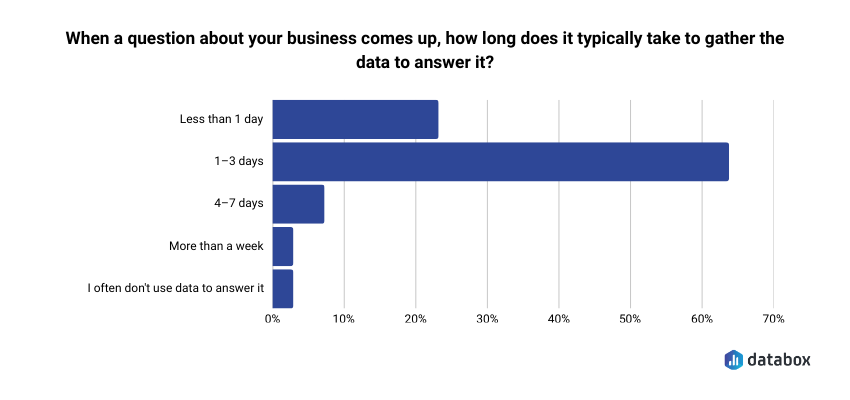
So teams hand the stack to AI, and the failure arrives on three axes.
Definitions the model guessed. Ask an AI for CAC by channel, and it must decide what counts as a customer, which spend is included, and over what window, none of which is written anywhere it can read. Marketing and sales do not even agree between themselves; the model resolves in silence what the team argues about in planning meetings, and it resolves it differently depending on how you phrase the question.
Tools the model cannot see. Planned versus actual spend is the simplest planning metric that exists, and it still defeats single-tool AI, because “planned” lives in a budget file and “actual” is spread across every platform’s backend. Practitioners have been naming this for years:
“Marketing spend was the one that got out of control, because it’s something that kept changing and wasn’t easy to track, because it’s so manual. You have to plan and budget and change, and then get the amount you planned to spend versus what you actually spent. Even now that’s the hardest one to keep track of.”
– Sarah Amann, Cuddly
History the model does not have. Forecasting is a comparison against the past, and most marketing stacks do not keep a usable past. Ad platforms restate, dashboards show current state, and the record of what the mix looked like in March is a screenshot in a deck. One marketer described trying to make a budget case under those conditions:
“(I would like) to do a channel comparison over the course of three months and look at spend versus cost per result, and see when the changes happened and why, and say: this is why we should move more money to this channel. Right now it’s rather siloed, and it’s like a week-by-week screenshot. So it’s harder to see the trend.”
– A marketer describing their channel planning process, in a conversation with Databox
An AI asked to forecast on top of that does what a language model does with missing inputs: it fills the gaps plausibly. The forecast arrives fast, formatted, and specific. Nobody can say which parts are data and which parts are filler, which is a worse position than the spreadsheet, because the spreadsheet at least showed its seams.
The practice that fixes it is a data layer beneath the planning, not a smarter model on top of it
The instinct when an AI forecast disappoints is to blame the model or the prompt. The failure is underneath. What planning-grade AI needs is an intelligence layer for business data: a single foundation under every tool and every AI in the stack, holding three things the model cannot supply for itself.
Shared definitions. CAC, MQL, pipeline contribution, ROAS: defined once, by the team, applied identically in every calculation. When the definitions live in the layer, the AI does not resolve marketing’s oldest arguments by silent guess. It computes on the definition the team already agreed to, the same one on the dashboards the CMO reads.
The whole stack, joined. Spend from every ad platform, pipeline from the CRM, revenue from billing, connected as governed sources. Planned versus actual stops being Sarah Amann’s hardest metric and becomes a query, because both sides of the comparison finally live in the same computable place.
Kept history. The layer records metric history even where the source tools do not, so “how does this quarter’s mix compare to the last four” runs on real point-in-time data instead of screenshots and memory.
One more separation matters, and it is the difference between an AI that plans and an AI that performs planning. The language model’s job is language: understand the question, pick the governed metric, present the answer. The computation runs on a query engine built for analytics. The LLM never touches your calculations. This is not a reporting distinction; reporting shows a human what happened, while an intelligence layer is a system that understands your business well enough for an AI to reason about it. Not a place to check metrics.
Marketers who have made even partial versions of this move describe the effect on forecasting directly:
“Attribution became more complex as marketing efforts diversified. To address this, we improved data integration across platforms, refined attribution models, and leveraged machine learning to forecast trends more accurately. This helped optimize budget allocation and improve ROI.”
– Arkajit Das, Fraoula
Note the order in that quote. The forecasting got better after the data integration, not after a better model. That order is the whole argument.
What planning looks like when the layer exists
Concretely, for a Marketing Lead who owns pipeline contribution and marketing-attributed revenue, three things change.
The plan lives next to the data. Targets sit in the same system as the metrics that track them, so pacing against plan is a live state, not a monthly reconstruction. When pipeline contribution is running 12% behind the quarter’s target, that fact is visible in week three, not discovered in week eleven.
Scenario questions become askable. “If we hold spend flat and CPL keeps rising at this rate, where does pipeline land in Q4?” is a question an AI can answer trustworthily only when spend, CPL, and pipeline are governed metrics with kept history. On the layer, that becomes a planning conversation instead of a two-day data pull. Off the layer, it is improv with charts.
The forecast survives contact with finance. Marketing-attributed revenue computed on the same definitions, across the same sources, every time, is a number the CFO stops re-deriving. The planning meeting spends its time on choices (which segments, which channels, which bets) instead of on whose spreadsheet is right.
Databox is built as this layer: the intelligence layer for business data, an agentic platform where the metrics, the targets in Goals, the kept history, and the AI answering planning questions all share one governed foundation. Databox is the intelligence layer between your scattered marketing stack and every AI you point at it.
To be clear about scope: AI for marketing is a far wider field than planning and forecasting, and most of it (drafting, personalizing, analyzing with a human reviewing the output) does not need this much rigor. Planning does, because a plan is a commitment other people build on. A wrong blog draft costs an edit. A wrong forecast costs a quarter.
What this means for your next planning cycle
Run one test before the next quarterly plan. Take the three numbers the plan depends on most (pipeline contribution, planned versus actual spend, CAC by channel) and pull each from two different tools in your stack. If the numbers, definitions, and time windows match, your planning inputs are governed, and AI can compress the cycle safely. If they do not match, that gap is what any AI forecast will be built on, no matter how good the model is.
The order of operations is the entire decision. Layer first, then AI planning on top of it: forecasts that compound credibility. AI first on fragmented data: guesswork at machine speed, formatted beautifully, corrected at the end of the quarter when the miss surfaces.
If you want to see what that looks like in practice, explore how Databox AI answers planning and forecasting questions on your own data.
Related read: AI Makes Data Governance Non-Negotiable. What Does That Mean for Mid-Sized Companies?
Frequently Asked Questions
How is AI used in marketing forecasting?
AI supports marketing forecasting in two distinct ways, and they carry different risk. Assisted analysis (asking a model to interpret trends, summarize performance, or draft scenarios a human reviews) works with the data you have. Autonomous forecasting (an AI computing pipeline contribution targets, budget pacing, or channel projections the team acts on) requires governed inputs: shared metric definitions, connected sources, and kept history. Without those, the model fills gaps with plausible guesses and the forecast inherits them invisibly.
Why do AI-generated marketing forecasts miss?
Three failure axes account for most misses. Definitions: the model guesses what counts as CAC, MQL, or attributed revenue because the team’s definitions are not written anywhere it can read. Tools: marketing’s inputs are scattered across ad platforms, the CRM, and billing, and a model connected to one tool forecasts from a fraction of reality. History: forecasting compares against the past, and most stacks keep no usable metric history, so the model approximates trends from current state. None of these are fixed by a better model or a better prompt.
What data does a marketing forecast actually need?
At minimum: spend from every active ad platform, pipeline and conversion data from the CRM, revenue from the billing system, organic and AI-sourced channel performance, and historical values of all of it over at least four quarters. The harder requirement is consistency: every input computed on the same definitions and time windows. A forecast built on inputs that disagree with each other is precise about a reality that does not exist.
What is the difference between marketing reporting and a marketing intelligence layer?
Reporting shows a human what happened: dashboards, monthly decks, channel summaries. An intelligence layer for business data is a governed foundation beneath every tool and every AI in the stack, holding shared metric definitions, cross-tool joins, and kept history so that both humans and AI compute on the same reality. Reporting is an output. The intelligence layer is infrastructure, and AI planning is only as reliable as the layer it runs on.
Can AI do marketing budget planning?
Yes, with a precondition. Budget planning questions (where to reallocate, what pacing implies for the quarter, which channels are past diminishing returns) are computable when planned spend, actual spend, and results share one governed data foundation. The most common blocker is the simplest metric: planned versus actual spend, which typically lives half in a budget file and half across platform backends. Consolidate that first; the AI planning conversation gets dramatically better immediately after.
Should we adopt AI forecasting tools or fix our marketing data first?
Test your data first: pull the same planning metric from two tools and compare numbers, definitions, and time windows. If they match, AI forecasting will compress your planning cycle safely. If they diverge, fix the layer first, because AI on fragmented data automates the guesswork rather than replacing it, and the errors compound quietly until the quarter ends. Data layer first, AI second is the cheaper order in every case except the demo.