





Table of contents
Automated briefs earn their keep by preserving judgment quality at the moment a decision has to happen. They don’t just save time; they surface patterns the reviewer would have missed under morning time pressure. That’s the core of the argument. But it only holds under specific conditions, and outside those conditions the workflow is more infrastructure than the job needs. The rest of this piece unpacks both halves of that claim.
A growth lead running marketing across five or six channels needs about fifteen minutes per channel to pull yesterday’s numbers, compare them against the prior week, and note anything worth flagging. That’s seventy-five to ninety minutes before the first meeting of the day that nobody has. So the check gets shortened to two channels, or delayed until after standup, or replaced with a glance at the channel that spent the most or drove the most revenue yesterday. Which is exactly where the actual decision most often gets missed.
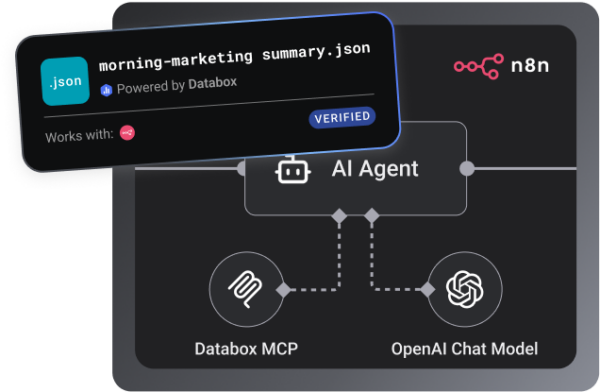
The obvious response is to automate the check. There is a free n8n workflow running on Databox MCP, built by Atidiv for exactly this, which runs against your Databox data every weekday at 7 AM and delivers a brief to Slack and email before you’re at your desk. But installing the workflow isn’t the whole argument. The argument worth making is what shifts when the check runs itself, and where the shift genuinely matters versus where it’s a smaller optimization than it looks.
TL;DR
- The manual morning marketing check isn’t failing because it takes too long. It’s failing because the reviewer arriving at the check under time pressure makes worse triage decisions than a reviewer arriving fresh with someone else’s triage in hand.
- What automation buys is not only time, but more so judgment quality at the moment a decision has to happen.
- An automated brief earns its keep when the AI analysis pass does the pattern-spotting work: ranking channels by movement, flagging anomalies, naming the single most important shift. Without the analysis layer, an automated brief is just a scheduled dashboard.
- The category shift only fires for teams running marketing on three or more channels with active daily anomaly-triage needs on the table. For single-channel operators, or teams whose marketing decisions happen weekly, the workflow is more infrastructure than the job actually needs.
The morning marketing check keeps failing, and time isn’t why
The intuition is that time pressure is the problem. Fifteen minutes per channel, five or six channels, no morning has that room. That framing points at automation as the answer. The answer is directionally right, but the diagnosis is off in a way that matters.
The manual check fails because of what happens to the reviewer running it. Under time pressure, the reviewer opens Meta Ads Manager first, scans spend and ROAS, moves to Google Ads, does the same, jumps to LinkedIn, checks email performance in a separate tool, and lands in the 9 AM standup with one thing to say: “the LinkedIn CPL doubled overnight.” The single flag surfaces, and it’s real. What gets missed is the shape. Meta’s ROAS dropped 30% at the same time LinkedIn’s CPL doubled. The loudest single flag is LinkedIn, but the pattern is that both channels lost efficiency at the same time – a shape that reads as one thing to investigate, not two separate flags. Whether the cause is upstream (a landing page issue, a tracking misfire, a market-wide auction shift) is the reviewer’s next step. The point is arriving at that investigation instead of chasing the loudest single number.
This is not a discipline problem or a talent problem. It’s the predictable outcome of asking a person to hold five or six channels’ worth of daily variance in working memory while the clock counts down to standup. The check doesn’t fail because there wasn’t enough time. It fails because human attention under time pressure has a shape, and that shape is single-channel and loudest-signal. Which is precisely the wrong shape for cross-channel decisions.
The value of automation, in that framing, isn’t the seventy-five minutes back. It’s that the reviewer arrives at the daily decision with someone else’s pattern-recognition already done. What’s on the table is a triage that isn’t distorted by the reader’s own attention constraints in that moment.
What separates a brief from a scheduled data dump
Not every automated morning report is a brief. Most of them are scheduled dashboards: the same numbers you would have pulled by hand, arranged in a message and pushed to Slack on a cron. If the automation stops at the data pull, the reader’s morning is only marginally better. The tab-switching is gone. The pattern-recognition work still isn’t, and it’s still being done against a wall of numbers formatted for a phone screen.
A brief is defined by what comes after the data pull. Whether the analysis layer ranks channels by material movement rather than listing them in the order they appear in the data. Whether it flags anomalies against a baseline the reader didn’t have to set manually. Whether it distinguishes shape of movement from direction (spend up 40% while ROAS drops from 3.2 to 1.8 is a different signal than spend up 5% while ROAS holds). Whether it names one thing to act on today, not a menu.
Without those four moves, an automated morning message is scheduled reporting. With them, it’s a brief. The distinction matters because the reader arriving at the brief at 7 AM should get pattern-recognition work already done, not raw material to do pattern recognition against.
The narrower point: the argument for automating the morning marketing check is only as strong as the analysis layer sitting between the data and the delivery. Teams evaluating whether to switch from manual to automated should measure the analysis, not the delivery.
When the shift is a category shift, and when it isn’t
Automated marketing briefs work best under a specific set of conditions. Three of them worth being explicit about.
Three or more active marketing channels. The linear-labor problem the opener describes is the failure mode automation is built to solve. Below three channels, the manual check doesn’t produce the attention distortion the automation prevents. A single-channel operator reviewing one dashboard every morning isn’t running the diagnostic failure that makes automation categorically better.
Daily anomaly triage with real stakes. Most paid campaigns shouldn’t be touched daily. The algorithm needs runway to optimize, and daily changes work against learning. The daily brief’s value isn’t enabling daily optimization; it’s shortening the gap between a real problem occurring and the reviewer noticing it. On paid channels that means catching a sudden drop in conversions, a CPL spike, or a delivery issue showing up as impressions or spend falling off. Whether the underlying cause is tracking, creative approval, or something further upstream is what the reviewer investigates once the anomaly is flagged.
On organic and email that means catching a post whose reach suddenly collapsed, an email send with an unusually low open rate, or a referral spike worth doubling down on. What caused the collapse: an algorithm shift, a spam classification, a genuine trend, is the reviewer’s read once the anomaly is on the table. Teams whose daily “decisions” are actually campaign tweaks rather than problem catches usually get more value from a weekly cross-channel reconciliation, which is calibrated to a cadence the algorithm can absorb.
A team where the analysis actually gets read. The brief only fires if someone reads it and acts on it. In organizations where the morning marketing check happens because it’s on a checklist but no decisions ride on it, automation removes the check without replacing what the check was supposed to enable. Which just means the checklist gets shorter.
Outside those conditions, an automated brief is a smaller optimization than the pitch suggests. Not a category shift, just a minor time save. The workflow is still free to install, and the analysis layer will still do its work on the data. But the marginal value of automation depends on what job the check was actually doing before, and how much of that job survives once the reader isn’t the one doing the pattern recognition.
Get the workflow
The Morning Marketing Summary is a free n8n workflow that runs the daily marketing performance brief against your Databox data. Auto-discovers every marketing channel connected to your account. Delivers to a Slack channel and email every weekday at 7 AM.
Frequently Asked Questions
Which marketing channels does this cover — paid, organic, email, or all of them?
Whatever’s connected in your Databox account, paid or organic. The workflow auto-discovers each connected source and pulls the metrics that apply to it. Google Ads and Meta Ads Manager pull spend, ROAS, CPC, and the rest of the paid-media surface. LinkedIn Company Pages, YouTube channels, Reddit, Snapchat, Pinterest, and X can pull organic impressions, engagement, and follower signals when the organic source is what’s connected. Email platforms pull sends, opens, clicks, and revenue attribution. What lands in the brief depends on which sources you’ve connected in Databox, not on a fixed metric list the workflow forces onto every channel.
If the AI analysis layer is doing the pattern recognition, how much of the reviewer’s role is left?
The judgment layer. The brief compresses the reader’s first five minutes of triage into ten seconds of scanning: which channels moved, what shifted, one recommended action. But whether that action is the right one for the account, given campaign objectives, seasonality, product roadmap, or client politics, is not something an analysis pass can answer. The brief tells you what surfaced. Deciding what to do about it is still the reviewer’s job, and probably always will be.