

Most agencies compare plans by scanning feature grids. The ones that pick the right plan on the first try do arithmetic instead.
TL;DR
- Agency Growth at $399/month is the recommended plan for most agencies scaling past 10 clients. It’s the first Databox Agency plan that includes Forecasting, full Datasets, 15-minute sync, 4,000 AI credits, and a dedicated CSM. Databox’s 14-day free trial (no credit card required) gives you full Agency Growth access to validate the fit.
- Agency Starter ($79) fits 5-or-fewer-client operations; Agency Pro ($159) fits mid-size agencies without deep analytical needs; Agency Premium ($799) fits enterprise-scale agencies where white-labeling is contract-required.
- Databox charges Agency plans by data source connections, not by user count or client count (both unlimited on paid plans). Features and capabilities vary by plan and determine plan fit; data source count determines what you pay.
- A data source is each individual connected account or property. Three GA4 properties across three clients equals three data sources. Your real source count is almost always higher than your platform count.
- AI credits are a monthly capability allowance, not a bill driver. Higher plans give your team more headroom for Genie usage. When credits run out, Genie pauses until the next month; there is no per-credit overage on your invoice.
- Three inputs determine your plan: data source count across all clients, capability needs (Datasets, Forecasting, AI credit allowance), and white-label requirement plus client account volume.
A 15-client digital agency connects four platforms per client: Google Analytics, Google Ads, HubSpot, LinkedIn Ads. That is 60 individual data sources across the roster. Which of the four Databox Agency plans is right for this agency, and how would you calculate that answer for your own footprint?
Quick answer for most agencies scaling past 10 clients: Agency Growth at $399 per month. It is the first Databox Agency plan that includes Forecasting, full datasets, 15-minute sync, unlimited historical data, 4,000 AI credits per month, and a dedicated Customer Success Manager. Growth is where reporting stops being a dashboard deliverable and becomes an analytical service line. Databox’s 14-day free trial (no credit card required) gives you full Agency Growth access, so you can validate the fit against your actual client footprint before you commit to a paid plan.
The other three plans fit specific agency profiles:
- Agency Starter at $79/month fits agencies with 5 clients or fewer (hard cap on client accounts), moderate source counts, and no need for Forecasting or datasets.
- Agency Pro at $159/month is the entry point for unlimited client accounts, unlimited dashboards, hourly sync, and 1,500 AI credits. Datasets remain limited; white-labeling is add-on.
- Agency Premium at $799/month includes 50 data sources at base, 10,000 AI credits, and white-labeling, SSO, and advanced security bundled by default. For agencies with 50+ client accounts or enterprise contracts that require branded reporting.
Which plan fits your agency depends on three inputs no feature grid surfaces: your data source count across all clients, your capability requirements (Forecasting, Datasets, white-labeling), and your client account volume. The math below arrives at the answer for your specific footprint.
Feature grids show what each Databox Agency plan includes, but hide the variable that determines your bill
The instinct to compare SaaS plans by feature grid is reasonable for most B2B tools. Starter gets fewer seats, Pro unlocks a feature, and Enterprise adds SSO. Pick the column where the checkmarks match what you need.
Databox is not priced that way. Features available on each Agency plan matter for fit, but they are not the primary cost variable. Two agencies on the same plan can have very different bills because their data source counts differ by 30 or 40 sources, and no feature grid surfaces that information.
Every paid Agency plan includes unlimited users. A team of 40 pays the same as a team of 4 if their data footprint matches. The variable that scales your bill is the variable that scales what the platform actually pulls, processes, and analyzes: data source connections.
The standard evaluation approach, comparing columns of checkmarks, fails on its own terms here. You might pick a plan because a specific feature is included, while ignoring that your 72-source footprint pushes you into overage territory the moment you connect the first three clients. The feature grid says you chose well. The invoice says you did not.
The problem compounds because agencies are trained by other tools to think in terms of client count. Per-client pricing models feel intuitive. Ten clients, ten slots, predictable bill. But per-client pricing punishes agencies that scale operational efficiency across clients. An agency that consolidates five clients onto shared reporting workflows pays the same per-client fee as one that builds bespoke dashboards for each. The efficient agency subsidizes the inefficient one.
Databox’s structural pricing inverts this. Your cost is driven by client complexity, not client count. An agency managing three clients with 12 sources each pays more than an agency managing eight clients with two sources each, because the platform is doing more work for the first agency. The bill reflects the work.
Data source count drives the Agency bill; AI credit allowance and included capabilities determine which plan fits the work
Before you calculate anything, you need an unambiguous definition of what counts as a data source, because agencies routinely miscount.
A data source in Databox is each individual connected account or property, not each connector type. If you connect Google Analytics for three clients, each with their own GA4 property, that is three data sources. If one client runs Google Ads across two accounts (US and UK), those are two data sources. The connector is the pipe. The data source is each distinct account flowing through it.
A Head of Reporting who thinks “we use six platforms” might actually be connecting six platforms across 15 clients, each with their own accounts. That is 40, 60, or 90 data sources, depending on how each client’s accounts are structured. The number of platforms is irrelevant to your bill. The number of distinct connected accounts is what matters.
The cost variable is data source connections
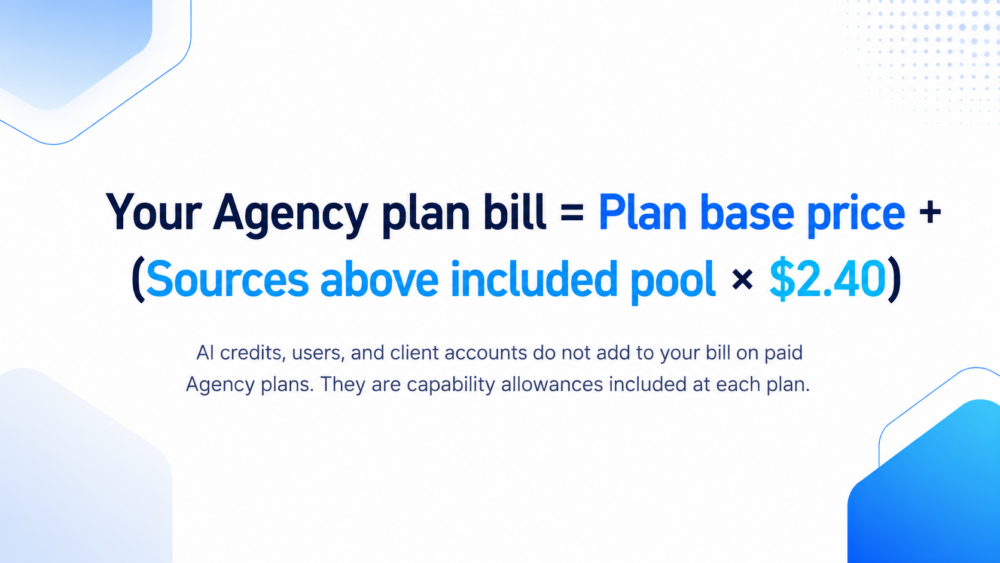
Every Agency plan includes a fixed pool of data sources at the base plan price. Sources beyond that pool cost $2.40 per month on annual billing on the Agency track. That $2.40 is the marginal cost anchor for every plan-sizing decision that follows.
Base plan prices on the Agency track: Agency Starter at $79 per month, Agency Pro at $159, Agency Growth at $399, Agency Premium at $799. Starter, Pro, and Growth each include 3 data sources at base; Premium includes 50. Beyond those included pools, every additional source runs at the same $2.40 monthly rate across all four plans.
The Business track charges $5.60 per month for each additional data source on the same billing terms. For an agency onboarding new clients throughout the year, the Age
ncy track’s lower per-source overage rate compounds meaningfully as client count grows. This is the structural reason the Agency track exists as a separate ladder: agency data source growth is a feature of success, not a planning failure, and the pricing model acknowledges that.
AI credits are a capability allowance
Every paid Agency plan includes a monthly credit pool that powers Genie (Databox’s AI analyst) and the MCP server: Starter includes 500 credits, Pro 1,500, Growth 4,000, Premium 10,000. Credits reset at the start of each month. When your team exhausts the allowance, Genie and MCP pause until the next cycle; your invoice does not change. Higher plans give your team more room to use AI, but no plan charges per query. Your AI credit allowance is a capability sizing question (which plan’s pool fits your usage pattern), not a bill forecasting question.
Included capabilities differentiate the plans
Beyond source count and AI credit allowance, the four Agency plans differ in what they include by default. The pricing ladder from $79 to $799 corresponds to increasing capability depth, not just larger source pools.
- Datasets (raw-data preparation): not on Starter, limited on Pro, full on Growth and Premium.
- Forecasting, OKRs, 15-min sync, unlimited historical, dedicated CSM: Growth and Premium only.
- Client account limit: Starter caps at 5 clients (hard); Pro, Growth, and Premium are unlimited.
- White-labeling and advanced security (SSO, audit logs): add-on on Starter, Pro, and Growth; included by default on Premium.
A Director of Client Services choosing a plan is answering two questions in parallel: how many sources will I connect, and which capabilities does my agency workflow require?
Three inputs map to the correct Agency plan before you sign
You now have the cost variable (data sources), the capability structure, and the pricing math. Convert them into a plan choice.
Step 1: Count your data sources
Open a spreadsheet. List every client. Under each client, list every platform account you will connect to Databox. Not every platform: every account. One client with a GA4 property, a Google Ads account, a HubSpot portal, and a LinkedIn Ads account is four data sources. Multiply that pattern across your roster.
Take a 12-client digital marketing agency. Eight clients connect GA4, Google Ads, and HubSpot (3 sources each = 24 total). Three clients add LinkedIn Ads and Facebook Ads (5 sources each = 15 total). One enterprise client connects GA4, Google Ads, HubSpot, Salesforce, LinkedIn Ads, and Facebook Ads (6 sources). Total: 45 data sources.
That number, 45, is the input. Not “12 clients.” Not “6 platforms.” Forty-five individual connected accounts.
Step 2: Confirm your capability requirements
Answer four questions:
How many client accounts will you manage? Agency Starter caps at 5 client accounts. If you have 6 or more clients needing isolated environments, Starter is off the table regardless of source count.
Do you need datasets, Forecasting, or 15-minute sync? These live on Growth or Premium only. If your agency runs raw-data preparation (custom calculations, filtered views combining multiple sources), builds forecasting scenarios into client reports, or needs near-real-time dashboards for high-cadence campaign monitoring, Growth is the entry point.
How does your team use Genie? Starter’s 500 credit allowance handles occasional AI-assisted queries on a small client roster. Pro’s 1,500 covers regular Genie-assisted reporting across a mid-size client base. Growth’s 4,000 fits agencies where Genie is part of the weekly review workflow across most clients. Premium’s 10,000 accommodates AI-heavy operations at enterprise scale. Size for your team’s actual usage pattern; running out of credits mid-month is a capability constraint, not a cost overrun.
Do your client contracts require white-labeled reporting? White-labeling is an add-on on Starter, Pro, and Growth. If your contracts require it and you land on Starter, Pro, or Growth, factor the add-on into your total. Premium includes it by default.
Step 3: Map to the plan
The four Agency plans align with distinct agency profiles.
- Agency Starter, $79/month. Fits agencies with 5 or fewer clients and moderate source counts. Datasets are not available. White-labeling is add-on. The 5-client cap forces upgrade to Pro at the 6th client regardless of source count.
- Agency Pro, $159/month. Where most scaling agencies sit. Unlimited client accounts, unlimited dashboards, hourly sync, 1,500 AI credits, all integration types (including databases and custom integrations), limited datasets. White-labeling still add-on. An agency running 5–25 clients with 3–5 sources per client (15–125 total sources) is Pro territory.
- Agency Growth, $399/month. Unlocks Forecasting, OKRs, full Datasets, 15-minute sync, unlimited historical data, dedicated CSM, and 4,000 AI credits. The tier for agencies where reporting is a substantive service line: enterprise clients with 6+ sources each, Genie usage across the whole roster, Forecasting used in client-facing reports.
- Agency Premium, $799/month. 50 data sources included at base, 10,000 AI credits, white-labeling and advanced security (SSO, audit logs) included by default, account setup and priority support. For agencies with 50+ clients or enterprise operations where reporting is core to service delivery.
The bill reflects the work
Agencies that grow their client base grow their data source count. That is not a cost problem; it is the natural shape of a reporting tool doing its job as your book of business scales. The Agency track’s pricing model acknowledges that reality: growth costs less per marginal source than on the Business track, AI credits scale as plan-included allowances rather than as consumption charges, and the bill is a line item you can forecast before you sign. Read more about the differences between Agency and Business track here: https://databox.com/databox-business-vs-agency-pricing
You have the math. Confirm current pricing at databox.com/pricing-agency, then run the 14-day Agency Growth trial (no credit card required) against your actual client footprint. If your calculated plan is Growth, the trial IS the plan. If your calculated plan is Starter or Pro, the trial still lets you evaluate the platform against real client data, and you can downgrade at signup. If your calculated plan is Premium, the trial gives you the base analytics experience, while sales conversation covers white-labeling, SSO, and account setup.
Frequently Asked Questions
What counts as a data source on a Databox Agency plan?
A data source is each individual connected account or property, not each connector type. If you connect Google Analytics for five clients, each with their own GA4 property, that is five data sources. Three HubSpot portals across three clients equals three data sources, even though HubSpot is one connector. Your source count is almost always higher than your platform count.
How much does each additional data source cost on the Agency track?
On annual billing, each data source beyond your plan’s included pool costs $2.40 per month on the Agency track. The equivalent rate on the Business track is $5.60 per month. For agencies where source count grows with client roster, the Agency track’s lower rate is a meaningful structural difference across the year.
Do Databox Agency plans charge per client or per user?
Neither. Every paid Agency plan includes unlimited users. Client accounts are unlimited on Pro, Growth, and Premium; Starter caps at 5 client accounts. Neither user count nor client count adds a marginal charge to your bill. Your cost scales with data source connections and the plan’s base price.
Do AI credits create overage charges on Agency plans?
No. AI credits are a monthly allowance included at each Agency plan: Starter 500, Pro 1,500, Growth 4,000, Premium 10,000. Credits reset at the start of each month. When your team exhausts the allowance, Genie and MCP pause until the next cycle. Your invoice does not change. AI credit sizing is a capability decision (which plan’s allowance fits your usage pattern), not a cost forecasting decision.
Is white-labeling included on all Databox Agency plans?
No. White-labeling is an add-on on Agency Starter, Agency Pro, and Agency Growth. It is included by default only on Agency Premium. If your client contracts require branded reporting and you are choosing between Starter, Pro, or Growth, factor the add-on cost into your plan total.
Can I switch between Databox Agency plans after I begin?
Yes. Upgrades and downgrades take effect immediately, with any billing difference handled as a prorated charge or credit. The operational cost of switching is inertia (reconfiguring settings, retraining team), not a fee. Picking the right plan upfront using the three-input calculation avoids the switching cost.
What is the difference between Databox Business and Agency pricing?
Both plan tracks run on the same Databox platform. Business plans are built around one organization’s performance: connect your tools, track your KPIs, share dashboards with your team, run Goals and Forecasting against your own data. Agency plans are built around managing performance for multiple clients: client accounts to isolate each client’s data, a lower per-source overage rate calibrated for agency scale, and (on Premium) white-labeling included by default.