Ask three people in your company to pull the number of active customers this month, and you’ll probably get three different answers, even though each person labeled the metric the same way. One counts everyone who logged in, another counts only paying users, and a third filters down to a single plan tier.
Nobody is wrong here. They’re all working from real data; they just never agreed on a single definition.
Do that enough times, and the data itself becomes the thing everyone argues about. A meeting that was supposed to end in a decision turns into a debate over whose number is right, and every question funnels back to whoever built the reports.
That was already a headache when people were the only ones reading the data. Now AI is in the mix, working off the same data and generating confident answers in seconds, even though no one can see which version it pulled or which definition it used.
What if every person, and every AI tool, worked from the same definitions?
Data governance, built into Databox
Data governance is how your team agrees on what each number means, who’s allowed to access it, and how it gets used, so everyone is working from a trusted source of truth.
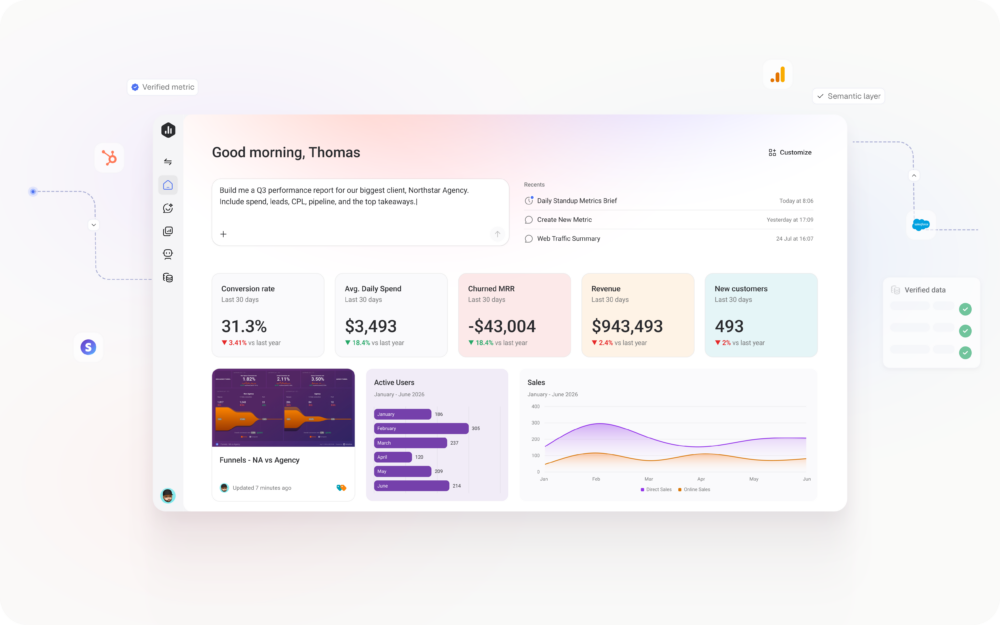
Databox keeps definitions, verification, ownership, and access controls in the same place your team already works, so the person accountable for a metric owns its definition where decisions actually get made.
Define a number once, and have it stay that way
Here’s how that works in Databox:
Define what your data actually means (new)
Semantic metadata lets you attach a description, synonyms, and a default time dimension to your datasets, columns, and metrics. This gives your team and AI Analyst the business context they need to interpret each number consistently. When a teammate sees “MRR” or asks their AI Analyst about “new revenue,” they can rely on the context the owner set, not their own best guess.
Verify the official asset (new)
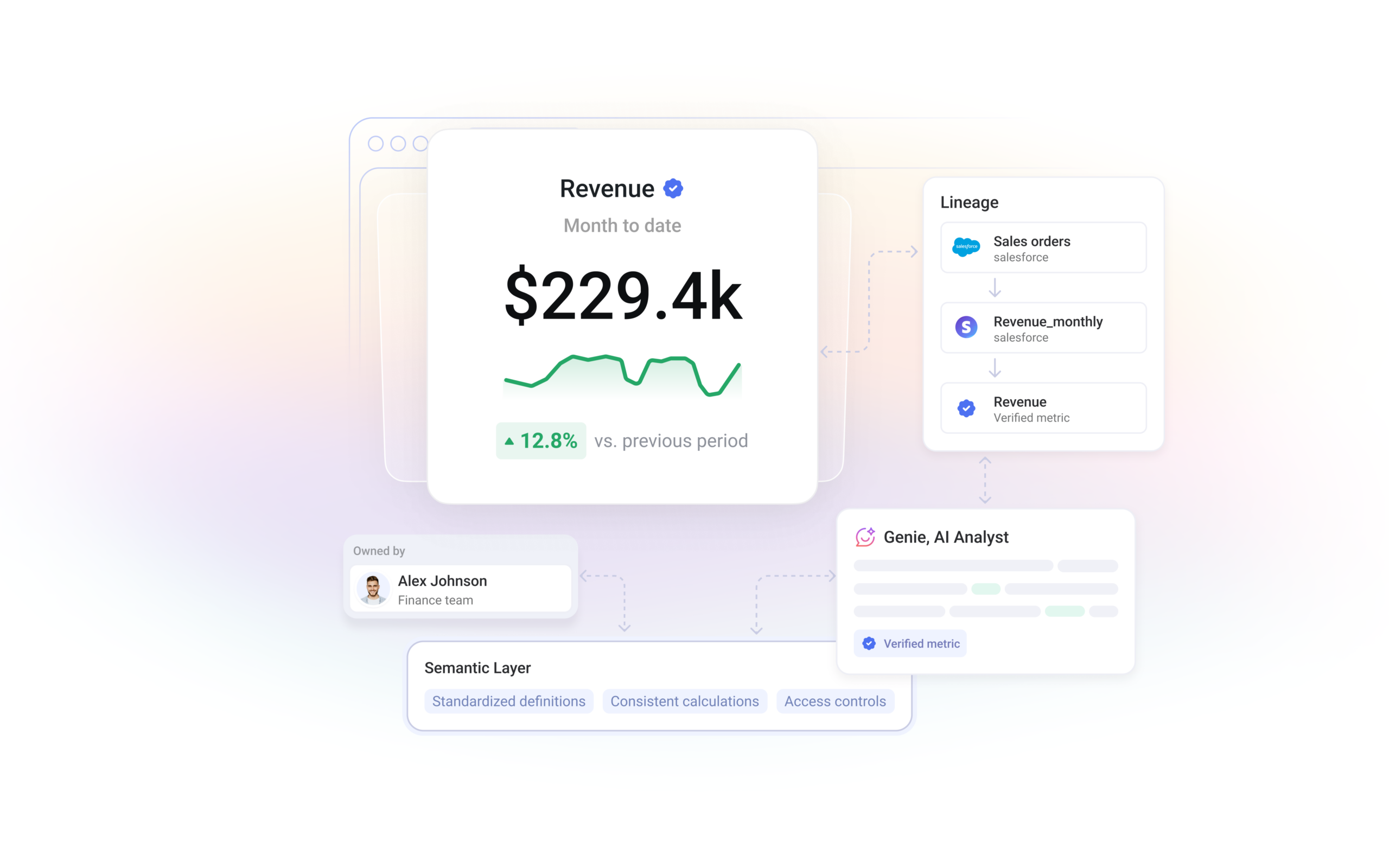
Anyone with edit rights can verify a metric, dashboard, report, or dataset. A verified badge shows up next to its name so the whole team can spot the official version at a glance. Every verification logs who verified it and when, so the record stays attached to the asset itself.
A clear owner on every number
Every metric, dashboard, report, and dataset has an owner on the hook for keeping it accurate, so questions about a number always have somewhere to land.
The right data with the right people
Roles and permissions decide who can create, edit, verify, or view each asset, so sensitive data like compensation stays with the people who should see it.
A full record of every change
The activity log keeps track of every action across your account, so when a number looks off you can see what changed, when, and who did it. A discrepancy turns into something you look into instead of something you argue about.
Trace any number to its source (coming soon)
Lineage will let you follow any number back to where it came from and see what’s riding on it downstream, so you can tell what a change will affect before you make it.
AI answers grounded in data you trust
The governance work your team does shapes every answer your AI Analyst gives. It reads the same governed layer your team does, so the definitions you write and the assets you verify are the ones it works from before it answers.
When you verify a metric or a dashboard, our AI Analyst treats it as the trusted version and reaches for it first. When you add business context through the semantic metadata, the AI Analyst reads a question the way your team would, so “how are active customers tracking this month” returns the number you agreed on rather than a guess.
A confident response you’d still have to go verify becomes one that’s already working from the official version of every number it touches, the kind you’d be fine putting in front of an executive.
How teams put governed data to work
Whether you build the numbers or report on them, governed data changes how your day goes:
- Business analysts and RevOps leads: You’re answering the same “which dashboard should I use” question for the fourth time this week. You verify the official version of each core metric and write its definition into the Semantic Layer once, and the questions stop landing on you. That cleanup you keep pushing to the next sprint turns into the thing that clears your calendar, and the next person who builds a report starts from the version you already signed off on.
- Marketing and Sales Leaders: You walk into your pipeline review with a number, and for once, nobody’s got a competing one. The metric on your team’s dashboard is verified and owned, so the meeting gets to what you’re going to do about the pipeline instead of whether the numbers are even right. When someone asks why it moved, you can answer without looping in the data team first.
- Executives: The numbers you take to the board are only as solid as the trust behind them. With verified assets and clear ownership across your reporting, you can tell at a glance which dashboards are the right ones, and you know the answers your team is acting on are coming from data that’s been checked. You get to report numbers you can stand behind without auditing them yourself.
- Agency owners: Every client defines the same metric a little differently, and one wrong figure in a report can rattle the whole relationship. You verify the right metrics in each client account and set the definitions once, so your deliverables stay consistent even as you pile on accounts. The AI insights you hand clients are reading off clean, governed data, so you can scale the reporting without scaling the odds of a number being wrong.
From arguing about the data to acting on it
For a long time, keeping everyone working from a single source of truth came down to documentation and the hope that people would stick to it. Data governance in Databox keeps the definition, the owner, and the official version right where your team and AI already work, so the trust rides along with the data instead of sitting in a doc next to it.
Ask three people what the number is now, and they all point to the same verified version. Same goes for the reports you send out and the answers your AI Analyst gives on top of them.
See what trusted data looks like across your reporting. Explore data governance in Databox →