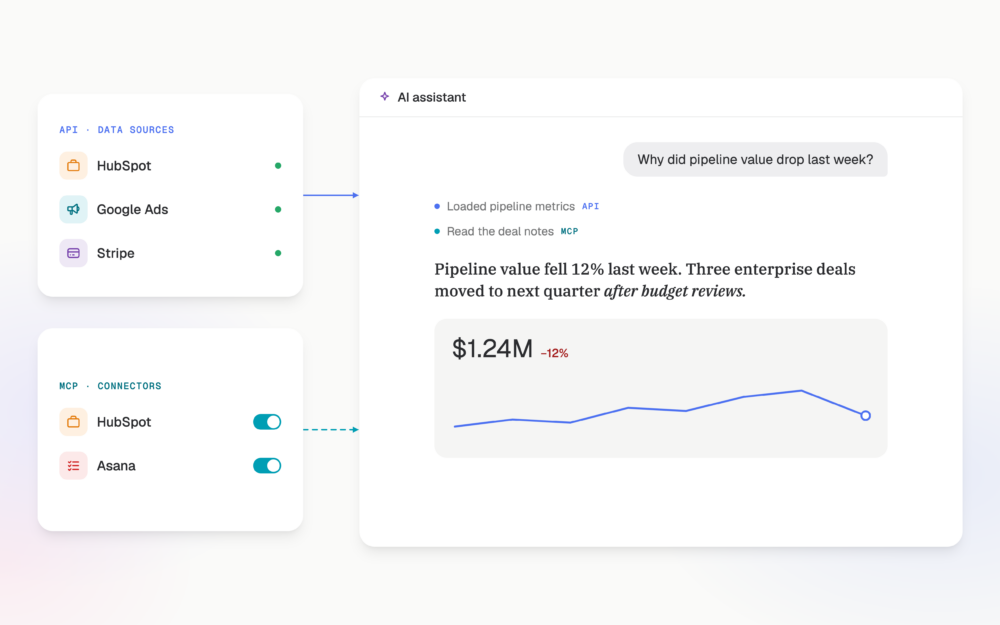

Every tool in your stack now has AI inside it. The questions that move your P&L live between them.
TL;DR
- Almost every tool in the ecommerce stack now ships with AI inside it, and those possibilities are real but bounded: better recommendations in the store, better support in the chat widget, better bids in the ad platform.
- The possibilities that change how you run the business are cross-tool: blended ROAS across every ad platform with the right attribution windows, true profit per channel after fees and COGS, LTV that joins email, store, and ads, forecasts built on full sales velocity.
- Ecommerce truth is more scattered than in any other business model. Store platform, ad platforms, email, marketplaces, accounting: no single tool’s AI can see enough to answer the questions that matter.
- Cross-tool answers are only worth having if they are grounded: computed by a query engine on governed definitions across connected sources. The LLM never touches your calculations. Blended math is exactly where generated numbers fail hardest.
- Three questions reveal whether an AI tool’s blended answers are computed or generated, before it earns access to your revenue data.
Almost every tool in your ecommerce stack now has AI in it. Shopify, Meta, and Klaviyo have AI. So do your support widget, your review platform, and your inventory tool. Each one is a real possibility, and each one is bounded by the same wall: it can only reason about the data inside its own tool.
That wall is why the AI conversation in ecommerce feels smaller than it should. Personalization engines recommend better products, chatbots deflect more tickets, ad platforms optimize their own bids, and so on. They are all useful, incremental, and entirely inside single tools. Meanwhile, the questions an Ecommerce Director actually runs the business on are all cross-tool questions: What is our blended ROAS across every platform, with attribution windows we chose? What did we actually earn per channel after ad spend, fees, and COGS? What is a customer worth across email, store, and ads together? None of your tools’ built-in AI can answer these, because no single tool can see enough.
Here is the thesis: the most valuable thing AI offers ecommerce is not a smarter feature inside any one tool. It is the ability to ask questions across the whole stack and get grounded answers, computed on all of it at once. That possibility is new, it is real, and it comes with one condition that decides whether the answers can be trusted.
Ecommerce truth is more scattered than in any other business model
A typical ecommerce operation runs its truth through six or more systems. Revenue in Shopify (or BigCommerce, or a checkout platform). Spend and platform-reported conversions in Meta, Google, TikTok, sometimes Pinterest and Amazon Ads. Email revenue in Klaviyo. Marketplace numbers in Amazon. Fees and actual costs in QuickBooks. Analytics in GA4, disagreeing politely with all of the above.
Here is how one ecommerce marketer described living in that stack:
“We have data across Shopify, Meta Ads, Google Analytics, Google Ads, Klaviyo, and soon TikTok ads and TikTok shop. We’re struggling, having to go through all these separate dashboards and pull numbers and copy-paste them into an Excel sheet for leadership. It takes a lot of time.”
– An ecommerce marketer describing their reporting stack, in a conversation with Databox
Ecommerce runs on best-of-breed tools because each channel demands one, but the steering questions are between the tools, and between the tools is often nothing but the Excel sheet.
Ask operators what they want from AI, and they do not say “better product recommendations.” They describe the between:
“We want dashboards for each section of ecommerce. The master section would have blended return on ad spend, blended conversion rates, all the platforms together, Amazon, everything, like profit, all that stuff. Another one with Klaviyo metrics for email specifically. Performance ads for Meta. And eventually we’re going to integrate QuickBooks. Sales, marketing, finance, all of it.”
– An ecommerce operator describing what they actually want to see, in a conversation with Databox
Blended ROAS. Blended conversion rates. Profit, all platforms together, finance included. That is the possibility list, in a customer’s own words. AI is what finally makes it conversational instead of a quarter-long BI project.
What cross-tool AI analysis unlocks for an ecommerce team
When the whole stack is connected into one governed data layer, questions that used to be spreadsheet projects become things you ask on a Tuesday. Four families of them, in rough order of impact.
Blended ROAS, on your attribution terms. Not Meta grading its own homework or Google grading its. Revenue from the store platform, spend from every ad platform, divided by the attribution window you chose, comparable across channels because the definition is the same everywhere. This is the number ad budget decisions should run on, and almost nobody has it live. Operators know the platform-reported version is not it:
“The actual conversions on Meta and Google are not really very accurate, and the actual conversions are just reported by our attribution tool. We want to see how the social accounts perform, how much revenue they bring in. The ROAS here is just from Google and Meta, so it’s not really useful for us.”
– An ecommerce operator on ad attribution, in a conversation with Databox
True profit per channel and per order. Revenue minus ad spend minus fees minus COGS, with the fee and cost data coming from the accounting system rather than from a margin assumption typed into a spreadsheet cell last spring. Channel decisions made on blended profit look different from channel decisions made on revenue, and most teams have never seen the profit version live.
Customer economics across the funnel. LTV that joins what a customer bought in the store, what they cost to acquire in the ad platforms, and what email drives afterward. Cohorts by first-touch channel. Payback windows by campaign. Single-tool AI cannot construct any of these, because each tool holds one panel of the triptych.
Forecasts and custom metrics on full data. Demand forecasting from complete sales velocity instead of one platform’s slice. Custom formulas the business actually runs on, like ACOS for the Amazon side, defined once and computed identically forever instead of rebuilt by hand in every report. Pacing against targets that live next to the data.
None of these are exotic. Every one of them is a question an Ecommerce Director already asks, answered today with lag, manual assembly, or not at all. The AI possibility is not the question; it is getting the answer in a sentence, grounded, in the same conversation where you asked.
The condition: blended answers are only worth having if they are grounded
Cross-tool math is precisely where AI-generated numbers fail hardest. Blending ROAS requires structured joins across sources that already disagree with each other, correct attribution windows, and exact arithmetic over large data sets. An LLM handed that job does not reconcile sources; it reads what fits in its context and generates a plausible number. For single-tool questions, that number is sometimes close. For blended questions, the errors multiply, and the output is formatted exactly as confidently either way.
So the condition is architectural. Grounded means the calculation runs on a query engine designed for analytics, against the connected sources, on definitions the team governs, with a traceable path from question to number. The language model does what language models are for: it understands the question, picks the governed metric, and explains the result. The LLM never touches your calculations. Data in, answers out.
Grounding also means respecting decisions your team already made about truth. Ecommerce teams pick sources deliberately:
“We have been comparing Google Analytics with Shopify, and the data that works for us is Shopify. It’s the real one. The correct number is from Shopify if we are thinking about sales.”
– An ecommerce manager on choosing a source of truth, in a conversation with Databox
A grounded system computes sales on Shopify because the team decided Shopify is the truth for sales. An ungrounded one reads both sources and averages the disagreement away. That difference is invisible in the interface and decisive in the P&L.
This is how Databox is built, and it is why cross-tool is where the platform shines rather than strains. The connected stack (store platform, every ad platform, email, marketplaces, accounting) becomes one governed data layer. Metric definitions, custom formulas like ACOS, and targets live in that layer. When an Ecommerce Director asks Databox’s AI Analyst for blended ROAS across Meta and Google, the LLM interprets the question, and the query engine computes the answer against actual source data. In Databox, the LLM has no access to calculations. The platform operates as an intelligence layer for business data, not another dashboard to visit, and the blended answer matches the dashboard leadership already reads because both come from the same computation.
Three questions that tell grounded from generated
Before any AI tool’s blended answers earn a place in your decisions, ask the vendor:
1. “If I ask the same blended question twice, do I get the same number?” A query engine is deterministic; a language model generating the answer is not. Variability in the demo becomes variability in your ROAS reports.
2. “Show me the computation path for one blended result: the query, the sources joined, the operation.” Computed answers have a traceable path. Generated answers have a shrug.
3. “When the calculation spans sources, does a query engine join them, or does the model read summaries and answer?” Cross-source is the stress test. Summaries mean the blend was approximated before the math began.
One scope note. The single-tool AI in your stack is fine where it is: personalization, support, bid optimization are jobs where probabilistic output is appropriate, and errors are cheap. A wrong recommendation costs a click. Hold the AI that produces your blended numbers to a different standard, because a wrong blended ROAS costs a quarter of budget allocation.
What this means for your stack
The possibilities everyone sells you are already inside your tools, and they are fine. The possibility that changes how the business is steered is the one between them: the whole stack as one governed data set, answering blended questions in plain language, with math you can trace.
For the broader reporting foundation, see ecommerce reporting software and the ecommerce analytics guide.
Frequently Asked Questions
What can AI actually do for an ecommerce business?
Two categories, with different ceilings. Inside individual tools, AI improves recommendations, support responses, ad bidding, and content, and those gains are real but bounded to each tool’s data. Across tools, AI can answer the questions the business is steered by: blended ROAS across all ad platforms, true profit per channel after fees and COGS, customer LTV joining store, ads, and email, and demand forecasts on complete sales velocity. The cross-tool category requires a governed data layer connecting the stack; no single tool’s built-in AI can deliver it.
What is blended ROAS and why can't my ad platforms report it?
Blended ROAS is total attributed revenue divided by total ad spend across every platform, computed with one attribution definition. Each ad platform reports its own ROAS using its own attribution model, which both overlaps and disagrees with the others, so adding platform numbers together double-counts and mismeasures. A true blend requires revenue from the store platform and spend from every ad source, joined and computed under a single definition the team chose.
Why does cross-tool AI analysis fail more often than single-tool analysis?
Because blending multiplies the failure points: sources that disagree, attribution windows that must be applied consistently, and arithmetic across data sets too large for a language model’s context. A tool where the LLM generates the answer produces its least reliable numbers on exactly the most valuable questions. Grounded tools route cross-source calculations through a query engine and use the language model only to interpret and explain.
How can I tell if an AI tool's blended numbers are computed or generated?
Ask the same blended question twice in one session; a query engine returns the identical number, while a generating model drifts. Ask the vendor to show the computation path for one result: the query, the sources joined, the operation performed. And ask what happens when a calculation spans sources; if the model reads summaries of each source rather than joining them, the blend was approximated before the math started.
Which data sources should an ecommerce team connect first for cross-tool analysis?
Start with the pair that funds every decision: the store platform (revenue truth) and your largest ad platform (spend truth), which together produce a real blended ROAS. Add remaining ad platforms, then email (Klaviyo or equivalent) for LTV and retention economics, then accounting (QuickBooks or equivalent) to move from revenue to true profit. Each added source upgrades a family of questions from spreadsheet project to conversation.
Does grounded cross-tool AI replace my analytics or reporting tools?
No — grounded cross-tool AI replaces the manual assembly between your tools, not the tools themselves. Source tools keep doing what they do; the governed layer connects them so blended questions are computable and AI answers are traceable. The goal is not another dashboard to visit; it is answers that flow into decisions, with dashboards, targets, and AI responses all drawing on the same computation.