
A debate is running through the data and analytics community: BI is dead. The framing is wrong. The honest version of the argument points to something most of the industry is still avoiding.
TL;DR
- BI as a category is not dying. The dashboard’s monopoly as the primary data interface is, under simultaneous pressure from cloud data platforms, AI assistants, and vibe-coding tools.
- Most BI vendors are bolting premium-priced AI features onto existing dashboards. The strategy fails the moment AI inference costs normalize.
- The dashboard is not the product. The semantic layer, the governance, the metric definitions – those are the fundamentals.
- Per-seat pricing for dashboards structurally mismatches the consumption-based pricing models cloud data platforms use for the same data.
- The vendors that build the trusted infrastructure beneath every interface own the intelligence layer for the next decade. That’s the bet Databox is making.
Introduction: the moment the analyst bottleneck becomes visible
A debate has been running through the data and analytics community lately. The claim, made seriously by people who build in this space, is that BI is dead. Or at least dying.
I don’t think that’s right. But I understand why people are saying it. And the more honest version of the argument points at something real that most of the industry is still avoiding.
BI is not dying, but its monopoly is.
Those are very different problems, and they require very different responses.
The Squeeze Is Real
We’ve been building in the analytics space for over a decade. I’ve seen plenty of “BI is dead” cycles come and go.
For most of that time, the dashboard was the primary interface between data and the people who needed it. You hired analysts. They built dashboards. Executives looked at them in Monday morning meetings. The more dashboards, the more mature your data culture. That was the story.
What makes this moment different is that the pressure isn’t coming from one direction. It’s coming from three simultaneously.
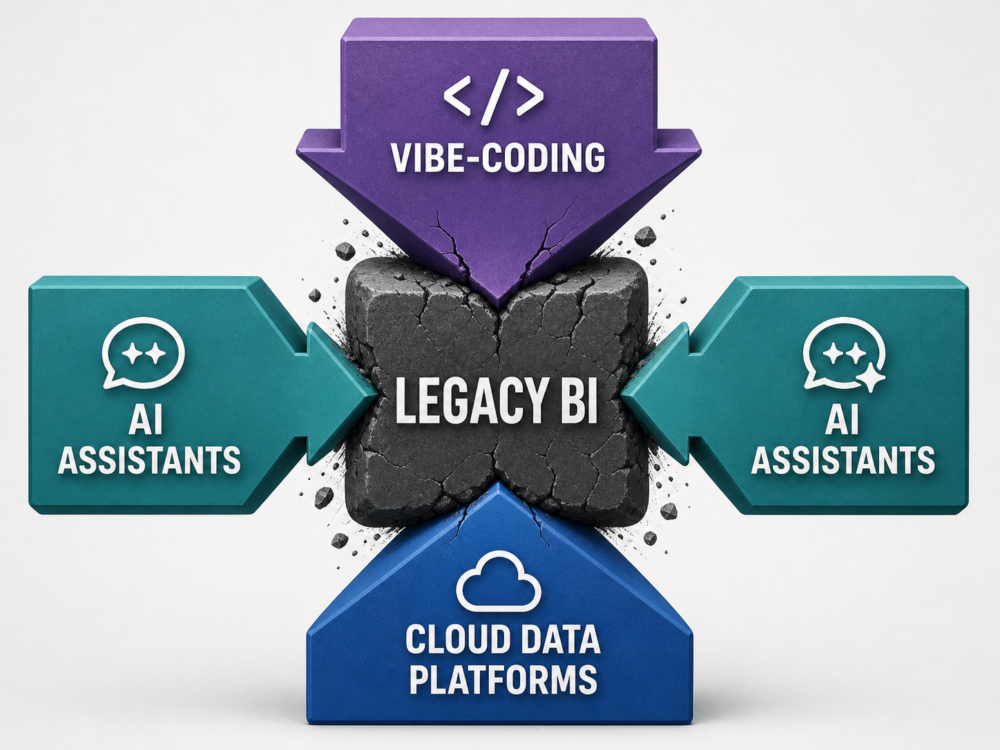
From below: Cloud data platforms like Snowflake, Databricks, BigQuery, are building native analytics capabilities directly into the data warehouse. Snowflake has Cortex. Databricks has Genie. They already own your data. Why would they let a separate BI vendor sit on top and charge per seat? They don’t need to. The vertical integration play is obvious and underway.
From the middle: AI assistants like Claude are genuinely good at ad-hoc data analysis now. Analysts who used to spend forty-five minutes building a dashboard for a one-off question are asking Claude to write the SQL, interpret the output, and draft the memo. The exploratory analysis use case, a major growth driver for self-service BI over the last decade, is being absorbed quietly into general-purpose AI workflows.
From above: Vibe-coding platforms like Lovable and Replit are targeting enterprise use cases. A slide deck showing revenue by region is functionally the same as a dashboard showing revenue by region. Both are point-in-time snapshots. If a business user can generate that slide in Lovable, inside a natural language interface with no BI license, why are they paying for Tableau Creator seats?
This is the squeeze. It’s not theoretical. It’s operational today.
The Trap Being Set Right Now
The rational response to competitive pressure is to ship AI features. Every BI vendor is doing exactly that. I understand the instinct. You can’t show up to a renewal conversation without an AI story in 2026.
But there’s a trap embedded in how most of them are executing it.
AI features are being priced at a premium. The logic makes sense internally: protect margins, justify R&D spend, give the sales team something to sell upmarket. The problem is that AI inference costs are collapsing. The major labs are in an aggressive land grab that will normalize those costs to a fraction of what they are today. Charging a premium for AI on top of a dashboard is a bet on outrunning that pricing curve. Most won’t.
Inference costs for frontier-tier capability have dropped roughly 10x annually since 2023, with cumulative declines exceeding 100x over three years (a16z, “LLMflation”). Gartner projects another 90% reduction in inference costs for trillion-parameter models by 2030.
There’s a deeper issue. BI vendors can’t afford to contract. They can’t have negative NDR. So they bolt AI features onto the existing business to protect it, when what the moment actually requires is repositioning the entire company around a different layer of the stack. That’s a much harder conversation to have internally. Most aren’t having it.
What The Market Actually Shows
Here’s the uncomfortable market context that most of these industry debates dance around but don’t fully surface.
The global BI software market is currently around $42 billion. Analysts project it continues growing, but that number increasingly includes things that don’t look like traditional BI. Headless BI, embedded analytics, streaming analytics, AI-native platforms. The TAM is expanding, but the traditional dashboard-centric slice is being competed away from multiple directions simultaneously.
Per-seat pricing is structurally under threat. Consumption-based and outcome-based pricing are rewiring enterprise expectations. Any vendor charging per viewer seat for a dashboard now faces a comparison to compute-based models where distribution has no marginal cost. That’s a pricing architecture mismatch that gets harder to defend every year.
The adoption data tells the real story beneath the hype. Salesforce surveyed 3,800 data and analytics leaders and found that 84% say their data strategies need a complete overhaul before their AI ambitions can succeed. Those same leaders estimate that over a quarter of their organizational data is untrustworthy.
Most organizations bought into the AI dashboard narrative without addressing the underlying governance and data quality foundations. The result: expensive implementations, low adoption, and frustrated CFOs.
That failure mode is good news for vendors who lead with infrastructure. When the AI layer fails, it almost always fails because the data underneath it is inconsistent, ungoverned, or poorly defined. The semantic layer — the place where “revenue,” “active user,” or “churn” is defined once so every query trusts the same number — becomes the difference between an ROI story and an adoption embarrassment.
What We’re Building At Databox
I want to be direct about where we stand. Founders who write about industry disruption while dancing around their own company’s bet are doing readers a disservice.
We are not a legacy BI vendor trying to protect a dashboard-first revenue model. We’re in the business of helping companies track, understand, and act on their metrics — so this structural shift is not abstract to us. It’s the market we’re building in.
The bet we’re making: trusted, governed metric definitions as the foundation, but not the whole asset. The real leverage comes from combining:
- A semantic metric layer with definitions, governance, and lineage
- An analytical query engine that computes truth accurately
- An agentic intelligence layer that turns results into insight and action
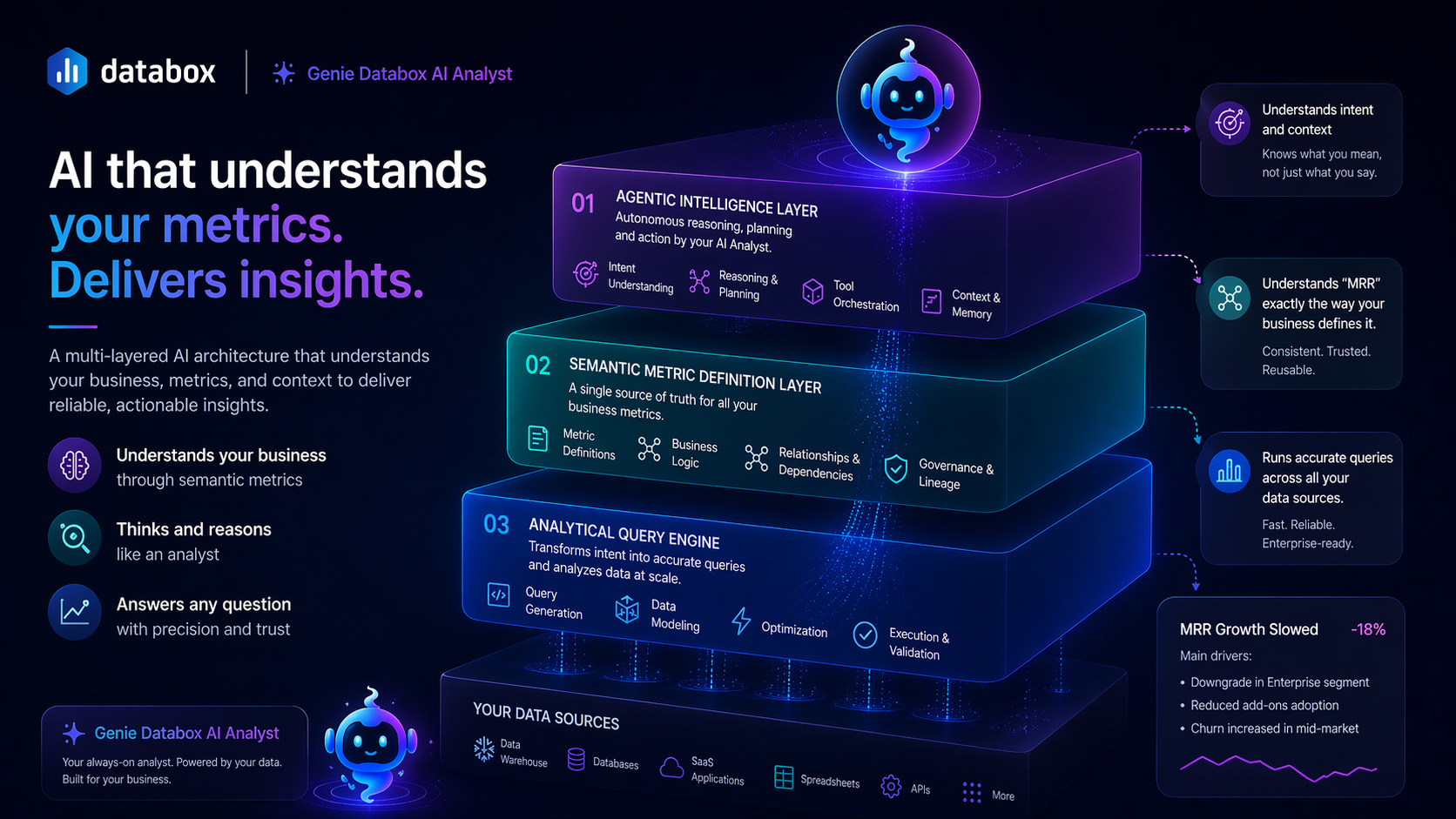
Whoever owns this system owns the intelligence layer, regardless of what interface sits on top.
That means a few concrete things for how we build.
1. Building the decision infrastructure. The dashboard is not the product. The semantic model, the governance layer, the metric definitions — those are the fundamentals. Dashboards are one rendering of that infrastructure. So are AI agents. So are API calls from a product team’s embedded analytics.
2. Opening the semantic layer to agents. Every AI agent that touches your data needs a governed source of truth underneath it. If your semantic layer can’t be queried by an AI agent — if it only serves dashboards — you’re about to become irrelevant in the agentic workflow layer. Open APIs, MCP, CLIs, clearly defined data models. These are not nice-to-haves. They’re architectural prerequisites for survival.
3. Moving away from per-seat pricing for everything except power users. Consumption-based models, outcome-based models, embedded analytics that scale without per-user licensing friction — these unlock the distribution that traditional BI pricing has always throttled. You cannot claim to democratize data while charging $70 per month per person to see a chart.
4. Building for the intelligence layer, not the reporting layer. The UI is commoditizing. The backend — orchestration, reliability, recovery, governance — is becoming the only place to capture real enterprise value. Products that live in the intelligence layer, that power AI-driven decisions across products, workflows, and teams, have a durable business. Products that exist purely to render charts do not.
5. Don’t fight Lovable and Replit. Vibe-coded dashboards break on governance, access controls, auditability, and version control. They work for demos. They fall apart in production — especially in regulated industries, multi-team environments, and any scenario where a number needs to be defensible. That’s not an argument for complacency. It’s a design brief: build the infrastructure layer that governs what happens when the vibe-coded apps inevitably connect to enterprise data.
The product proof for this bet is concrete. A Head of Revenue asks Databox’s AI analyst “what is driving churn this quarter?” The query routes against governed metric definitions in the Metric Library — the same definitions powering every Databoard, the same definitions Claude or n8n query via MCP. The answer reconciles across interfaces. AI dashboard adoption follows when the answers hold up in the next board meeting, because the underlying definitions are governed in one place.
What 2027 Looks Like
BI is not dead. But companies that built their businesses on dashboards for analysts will struggle if they don’t evolve.
Most business users won’t live in dashboards anymore. They’ll ask questions of an AI analyst, an agent in their CRM, or via MCP in Claude. The dashboard becomes one output among many, not the destination.
What replaces it isn’t a single thing. It’s agents, natural-language queries, embedded analytics, agentic workflows — and yes, still a dashboard sometimes. The vendors who build the trusted infrastructure beneath all of those interfaces have a real business.
That layer is not glamorous. It won’t be announced on stage at a conference. But whoever builds it, and earns the trust of enterprises around it, owns the intelligence layer for the next decade.
That’s the bet we’re making.
Note: This article is based on a SubStack article.
Frequently Asked Questions
Is BI dead?
No. The 2026 BI software market is approximately $42 billion globally and growing. What is dying is the dashboard’s monopoly as the default data interface for enterprises, under simultaneous pressure from cloud data platforms, AI assistants, and vibe-coding tools. BI vendors that reposition around the intelligence layer beneath the interface will see continued growth; vendors that bolt AI features onto dashboards will not.
Why are BI vendors pricing AI features at a premium?
The internal logic is straightforward: protect margins, justify R&D spend, give the sales team a renewal story. The risk is that AI inference costs are collapsing as the major labs compete for enterprise budget — which means premium-priced AI on dashboards faces a pricing curve that has already broken the wrong way. Most premium-priced AI BI products will lose pricing power inside two renewal cycles.
What is the intelligence layer in BI?
The intelligence layer is the stack beneath the data interface — comprising a governed semantic metric layer with definitions and lineage, an analytical query engine that computes truth at enterprise scale, and an agentic intelligence layer that turns results into recommended actions. The vendor that owns this stack owns the data layer regardless of what interface — dashboard, AI agent, embedded analytics, or MCP-queried agent — sits on top.
Why are AI dashboard rollouts failing on adoption?
Adoption fails when the answers AI features produce are not defensible in the next exec meeting. The Salesforce 2025 State of Data and Analytics survey of 3,800 data leaders found 84% say their data strategies need a complete overhaul before AI ambitions can succeed. Over a quarter of organizational data is untrustworthy. The bottleneck sits below the interface, in the metric definitions that AI agents and dashboards both depend on.
Should BI vendors avoid building AI features?
No. AI features have become table stakes for renewals. The mistake is building AI on top of an existing dashboard business priced per seat, while declining to reposition around the layer where durable enterprise value sits. AI features are necessary for renewal in 2026; they are not sufficient for the next decade.
What does the intelligence layer mean for per-seat BI pricing?
Per-seat dashboard pricing structurally mismatches the consumption-based and outcome-based pricing models cloud data platforms use for the same data. A CFO comparing $70/month/viewer for a chart against compute-based pricing on the same warehouse data sees the math without explanation. Vendors that succeed in the intelligence layer price by outcome or consumption, with per-seat reserved for power users.