
The Model Context Protocol (MCP) has given AI assistants something they’ve never had before: a standardized way to pull live data from external systems. Instead of just generating text, an AI agent can now query your CRM, check ad performance, or pull revenue numbers in real time.
The industry’s response has been predictable. Every major platform is racing to build their own MCP server. There’s one for Google Analytics, one for HubSpot, one for Stripe, one for Meta Ads, and the list keeps growing.
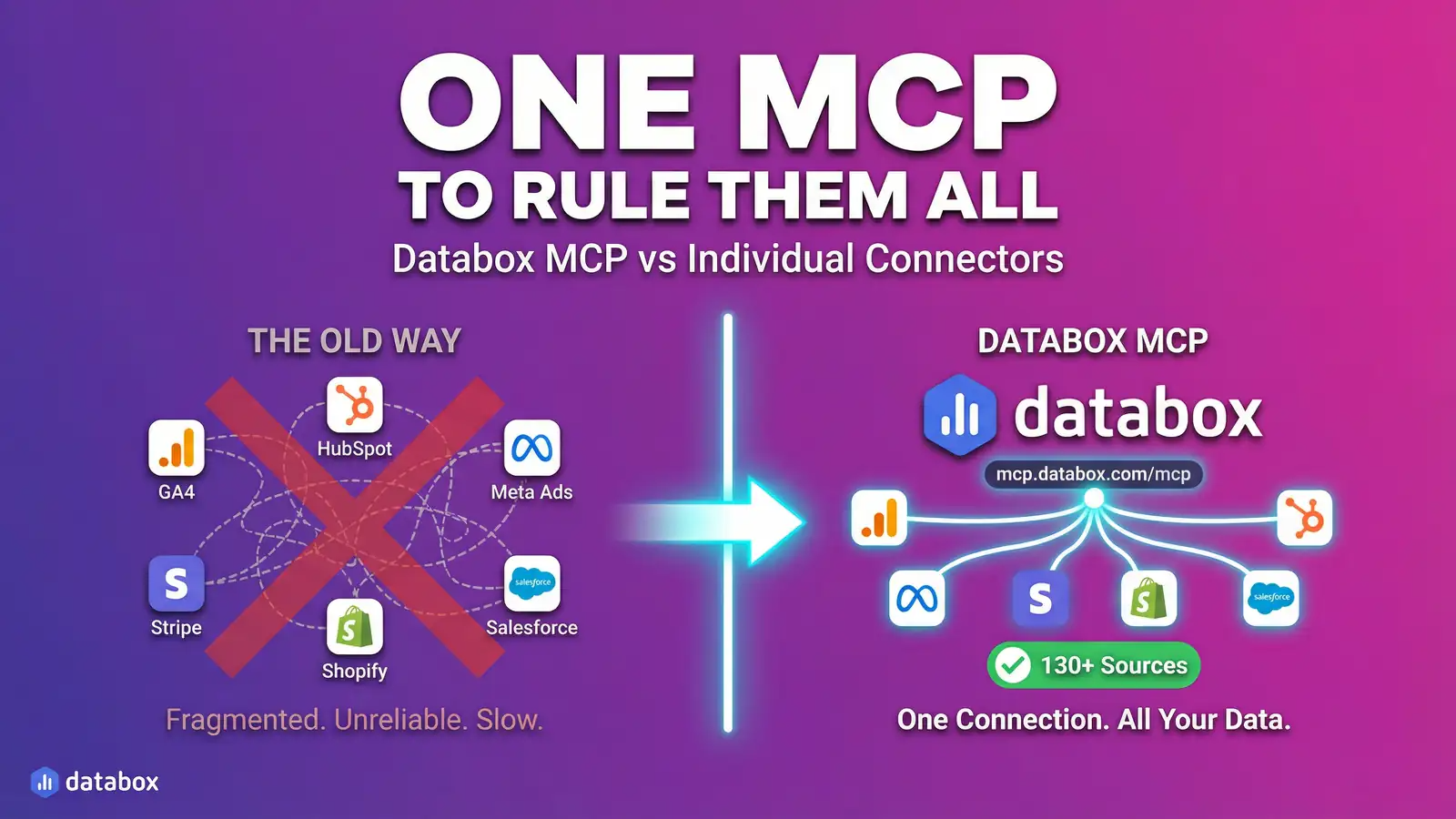
The logic seems obvious: if you want AI to analyze your full marketing funnel, just connect it to the GA4 MCP, the HubSpot MCP, and the Stripe MCP. But as we’ll show, a unified approach works far better than stitching together individual connectors.
TL;DR: Connecting AI to multiple individual MCPs creates three problems: different systems use different names for the same things (leads vs. users vs. customers), the AI wastes most of its working memory just loading tool definitions, and accuracy drops fast. Databox MCP solves this with one connection to 130+ data sources, pre-defined metrics, and an AI analyst that returns answers instead of raw data.
The Problem with Connecting to Everything
Imagine asking your AI assistant a simple question: “Did our latest Facebook campaign produce profitable customers?”
To answer that, an AI connected to individual MCPs would need to:
- Pull ad spend from the Meta Ads MCP
- Pull conversion data from the GA4 MCP
- Pull customer revenue from the Stripe MCP
- Figure out how to match users across all three systems
- Calculate the actual profitability
The problem? Most software platform structure and label data differenlty. Meta MCP may store “leads.” GA4 tracks “users.” Stripe calls them “customers.”
A human analyst understands that these records often represent the same person moving through a funnel. Someone clicks an ad, visits a website, submits a form, and eventually becomes a paying customer.
An AI model does not automatically recognize that relationship.
And because individual MCPs can’t perform joins across systems, the AI is forced to pull massive amounts of raw data from all three sources to try and stitch it together itself. This is data engineering work, and AI models are notoriously bad at it. The result: hallucinated numbers, skewed calculations, and answers you can’t trust.
This is the digital version of the swivel chair problem that plagued analysts for years: exporting CSVs from five different tools and manually stitching them together in Excel. Connecting individual MCPs just hands that same messy job to the AI.
Every Connector Is Built Differently
You might think the solution is just picking better connectors. But look at what’s actually available:
| Platform | Who Built It | What It Actually Does |
|---|---|---|
| Google Analytics 4 | Google (Official) | Read-only web analytics |
| HubSpot | HubSpot (Official) | CRM data only, still in beta |
| Meta Ads | Community | Requires complex app setup |
| Stripe | Stripe (Official) | Needs human approval for actions |
| Shopify | Shopify (Official) | Two MCPs—neither for store analytics |
| Ahrefs | Ahrefs (Official) | Strict API limits on paid plans |
Some are read-only. Some require elaborate authentication setups. Some are in beta. None of them talk to each other.
More importantly, none of them include a semantic layer—a shared understanding of what your metrics actually mean. When you’ve defined “Marketing Qualified Lead” as a specific combination of HubSpot properties and engagement scores, that definition lives in your head (or maybe a spreadsheet somewhere). It doesn’t exist in any of these individual MCPs.
This isn’t a problem you can solve by choosing different connectors. It’s built into the architecture.
More Connections, Worse Results
Even if you could solve the business logic problem, there’s a technical ceiling, and it comes down to how AI models actually work.
Every AI has a “context window”, essentially its working memory. Think of it like a whiteboard. Everything the AI needs to work with has to fit on that whiteboard: your conversation history, any documents you’ve shared, and crucially, the instructions for every tool it has access to.
Here’s the problem: MCP tool definitions are verbose. Each connection comes with detailed schemas describing every available action, every parameter, and every data type. And all of this gets loaded onto the whiteboard before the AI even reads your question.
Anthropic’s engineering team measured what happens when you connect multiple MCP servers:
| MCP Servers Connected | Tools Loaded | Tokens Consumed |
|---|---|---|
| 1 (just GitHub) | 35 | ~26,000 |
| 3 (+ Slack, Sentry) | 51 | ~50,000 |
| 5 (+ Grafana, Splunk) | 58 | ~55,000 |
| 6 (+ Jira) | 85 | ~72,000 |
Most AI models have context windows between 128,000 and 200,000 tokens. With six MCP connections, you’ve already used up 35-50% of the whiteboard just listing available tools, leaving less room for actual analysis, conversation history, and the data you’re trying to examine.
The consequences are predictable: accuracy drops, responses slow down, and the AI starts picking the wrong tool for the job. One study found that tool selection accuracy fell to just 42% when agents had access to multiple overlapping MCP servers.
What this means in practice: You ask about ad performance and the AI pulls data from the wrong source. You ask about revenue and it returns session counts instead. The more connections you add, the worse this gets.
How Databox MCP Solves This
There’s an alternative to stringing together a dozen separate connections.
Instead of forcing AI to manage multiple MCPs and guess at how data relates across systems, a unified data plane handles all of that complexity in one place. Your AI connects to a single endpoint and gets access to pre-joined, semantically consistent data from every source you use.
This is the approach behind Databox MCP. Here’s how it differs:
One connection replaces many. Your AI connects to https://mcp.databox.com/mcp and immediately has access to data from 130+ integrations, whatever you’ve connected to Databox. No juggling authentication methods or managing separate API keys.
Metrics are defined once. When you build a metric in Databox, say, “Cost Per Qualified Lead” combining Meta spend with HubSpot qualification data, that definition becomes canonical. The AI doesn’t have to guess how to calculate it. It just asks for the metric and gets the right number.
Cross-source queries work out of the box. Ask “correlate our LinkedIn ad spend with demo requests from HubSpot” and the query actually runs. The joins happen inside Databox, not in the AI’s head.
The AI works with answers, not raw data. This is the key architectural difference. When your AI queries individual MCPs, it receives thousands of rows of raw JSON that it has to parse and process. With Databox, Genie—our AI analyst—does the heavy lifting internally. Your AI gets a synthesized answer: “Your CAC across those channels is $47.50.” Clean. Accurate. Ready to use.
When Separate Connectors Still Make Sense
Individual MCPs aren’t useless. They’re valuable for single-system actions, creating a HubSpot contact, sending a Stripe invoice, updating a Shopify product.
But for analysis across sources? For answering the questions that actually drive business decisions? That’s where the multi-MCP approach falls apart.
The pattern we’re seeing across the industry: use specialized MCPs for actions, use a unified data plane for analytics.
Getting Started
The MCP ecosystem is still young, and individual connectors will continue to improve. But the fundamental limitation won’t change: separate systems don’t share context, and AI can’t manufacture that context on its own.
If you’re building AI workflows that need to analyze data across marketing, sales, and revenue systems, the architecture matters. A unified approach means your AI spends its capacity on analysis, not on wrestling with fragmented tools and inconsistent data models.
Ready to try a different approach? Connect your data sources to Databox and add the MCP server to Claude Desktop or your preferred AI tool. One connection. All your data. Actually useful answers.