




Table of contents
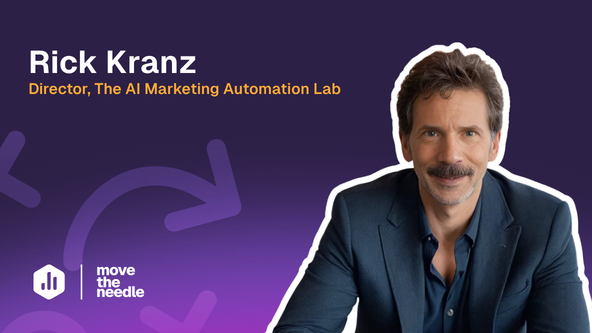
“Why can’t you do this without the Databox MCP? Because you’re not going to get it. I tried it. It doesn’t work.” — Rick Kranz, Director, The AI Marketing Labs
Everyone’s connecting AI to their business data right now. Fewer people are asking whether the AI actually understands what it’s looking at.
In the latest episode of Move the Needle, Rick Kranz, who’s built over 100 AI automations for his own business and the members of his AI Marketing Labs, breaks down why he couldn’t get reliable AI analysis without a standardized data layer, and what that means for anyone trying to get real answers out of Claude, ChatGPT, or any other AI tool pointed at business data.
Watch the interview
The Problem: AI Will Always Give You a Confident Answer
Here’s what makes this tricky: a general AI tool connected to raw data doesn’t fail loudly. It doesn’t say “I don’t have enough context to answer that.”
It just answers, and the answer sounds right.
Rick found this out the hard way. He tried building AI analysis skills without a standardized data layer underneath them, and while he couldn’t fully explain the mechanics, the pattern was unmistakable:
“There’s something going on. It works with Databox, and it matches when I check it. But it doesn’t work if I don’t use Databox.”
The Fix: Three Things AI Needs Before You Can Trust Its Answer
Rick broke this down into three specific requirements that most people skip when they wire an AI up to raw data:
1. A Semantic Layer
Your data isn’t just numbers in tables; it’s relationships, like deals connect to salespeople, salespeople connect to accounts, and accounts connect to contacts. If the AI doesn’t understand how these things relate to each other, it can’t reason about your business correctly, no matter how capable the underlying model is.
2. Metric Definitions
Raw data is stored in a way that makes sense to a database, not to a human trying to make a decision. Turning rows into a meaningful KPI requires math, and that math has rules that aren’t obvious from the data itself. As a simple example: you can’t average five daily conversion ratios and expect the same number you’d get from calculating the ratio off the full week’s raw totals. Those are two different numbers, and an AI that doesn’t know which one you need will confidently hand you the wrong one.
3. Consistent Statistical Math
Correlation, trend detection, anomaly detection: all of this requires a standard, repeatable way of comparing metrics to each other. Without it, an AI might tell you your outbound calls “correlate” with closed deals when the sample size doesn’t actually support that claim.
What This Unlocks
The bigger shift Rick pointed to: most people are still thinking about AI as a way to speed up tasks they already do, content creation, follow-ups, prospecting. What they’re missing is that AI can now do work that used to require a data analyst, a developer, and someone senior enough to know which questions to even ask.
That’s expensive, specialized work. It’s now available on demand, but only if the data feeding the AI is structured well enough to trust.
If you’ve ever connected Claude to a handful of data sources and felt like it was “guessing and checking” its way to an answer, burning through tokens in the process, that’s the reason why. A standardized data layer skips that step entirely: the AI already knows what to check and how to interpret it once it finds it.
Put This Into Practice
Here is how you can act on this without building any of it yourself:try out one of the Claude skills that Rick Kranz has built to ease analytics for others.
Each one is a pre-built analysis workflow that runs through Claude on your live, standardized Databox data, meaning the semantic layer, metric definitions, and consistent math Rick described aren’t something you have to set up yourself. They’re already baked into the skill.
Four of Rick’s own skills, live on the marketplace now:
- Weekly Growth Dashboard: a Monday-morning growth read across GA4, Search Console, and CRM, with a rolling 4-week comparison and recommendations.
- Sales Pulse: pipeline analysis before charts. Reads your CRM through Databox and flags what’s healthy, what’s slipping, and where to act.
- Content Performance Partner: sorts every published page into keep, refresh, or retire, delivered as a prioritized monthly editorial queue from GA4 and Search Console.
- Newsletter Email Analyzer: reads your email data, matches it to subject lines, shows which patterns actually drive opens, and suggests what to write next.
Each one is free, editable, and runs on your own connected data instead of a generic sample, which is the whole point.