
AI has plenty of promise.
We make it deliver.
Buying AI tools is easy. Making them useful across your business is harder. We connect your data, give AI the context it needs, and build practical workflows that turn information into better decisions and action.
No deck, no pitch. A plain answer on whether this fits your business.
Trusted by 20,000+ businesses








Most AI spend doesn’t buy results.
It buys the feeling of progress.
Your business already generates valuable data, across sales, marketing, finance and operations. But AI can summarize a document in seconds, and still have no idea why revenue slowed, which customers need attention, or what your team should do next. It needs a reliable picture of your business, and most companies don’t have one to give it.
The problem isn’t a shortage of AI tools. It’s the missing connection between your data, the way your business runs, and the work AI could actually do.
Scattered data
Your CRM, marketing tools, accounting system and spreadsheets each hold part of the answer, in formats and definitions that were never built to be combined automatically.
Conflicting numbers
If sales and finance define revenue differently, or two tools round the same metric differently, AI cannot know which definition to trust, so it has to guess.
Missing context
AI doesn’t automatically know your goals, customers, priorities, processes or approval rules, unless someone takes the time to teach it, and most teams never do.
Disconnected execution
Even a useful answer has limited value if someone must manually chase the next steps across several different tools before anything actually changes.
80% say AI has improved their productivity, but only 37% can point to any actual earnings impact. McKinsey, 2026 →
95% of organizations saw no measurable return from their generative AI pilots. MIT NANDA, 2025 →
6.4 hrs a week spent “botsitting” AI: the unseen work of making it usable. Glean, 2026 →
Gartner expects more than 40% of agentic AI projects started without this kind of foundation to be abandoned by 2027, mostly over cost and unclear value. Source: Gartner, “Gartner Predicts Over 40% of Agentic AI Projects Will Be Canceled by End of 2027,” June 2025 →
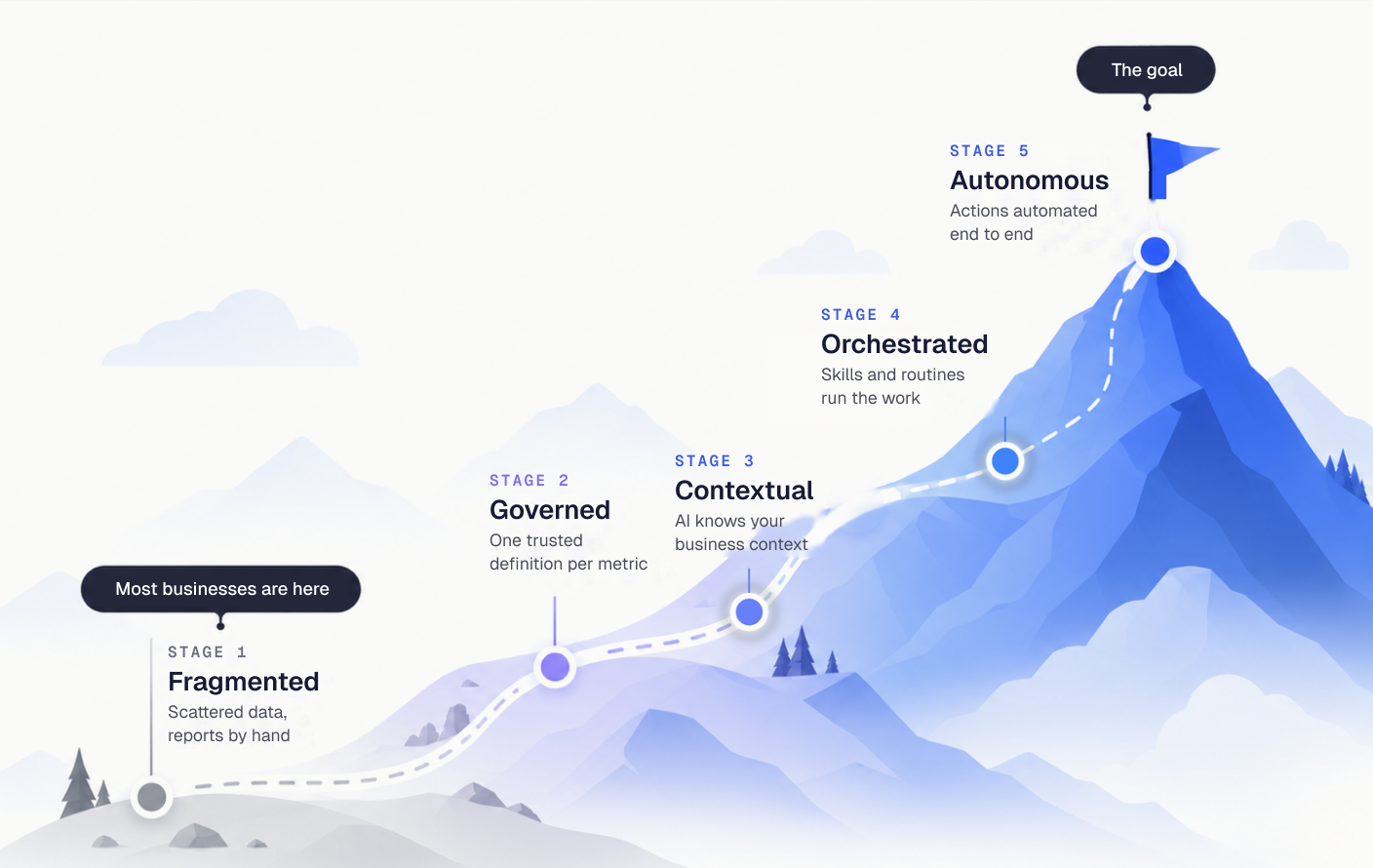
You’re somewhere on this ladder.
Most are lower than they think.
It usually starts with data scattered across apps, warehouses and spreadsheets, pulled together by hand for every answer. That’s a long way from what AI makes possible today, and each step up depends on the one below it. We take you all the way up.
Fragmented
Data sits across tools and spreadsheets. Every answer is pulled together and checked by hand.
Governed
Every source connected, every metric defined once. Sales and finance finally report the same revenue.
Contextual
AI knows what you sell, who you sell to, what you’re aiming for and who owns what.
Orchestrated
Recurring work runs on its own. Reports and alerts land before anyone asks.
Autonomous
Agents spot what needs doing and do it. People approve the calls that matter.
Find out how far your business is from running on AI.
30 minutes, with whoever can answer for the whole business. Nothing to prepare beforehand, and you walk away with a finished report, not a follow-up email.
-
1
Your stage and score
Where you are on the five-stage ladder, and how far through it.
-
2
What AI can take on today
Function by function, based on how you actually work.
-
3
Your next steps
What to build first, and what has to happen before it.
Fragmented
Stage 1 of 5 · 50% of the way to Governed
Each rung needs 75% (the tick) before the next one counts.
Your ceiling is the data. Until your numbers live in one place with one definition each, AI has to guess which one is right.
What could an AI-ready business do differently?
Imagine your teams spending less time finding answers and more time acting on them. That’s the difference between having AI tools and having an AI-ready business.
Manual. Reactive. Fragmented.
- ×Reports must be requested, exported, and reconciled.
- ×Decisions depend on someone spotting the issue.
- ×Each team has a different version of the numbers.
- ×AI pilots remain isolated from day-to-day operations.
Connected. Proactive. AI-ready.
- Trusted answers are available when teams need them.
- Important changes are detected and surfaced earlier.
- AI understands the metrics and context behind decisions.
- Useful workflows are automated, with people approving what matters.
What this looks like, team by team
Here’s what changes once AI has something real to work with.
Spot risks before deals are lost.
Track pipeline health, identify stalled opportunities, and prepare follow-up recommendations using your actual sales data.
Value: More focus on the opportunities that need attention.
Turn spend into clearer decisions.
Connect campaigns to business outcomes, flag performance changes, and recommend adjustments for human review.
Value: Faster optimization and better visibility into impact.
Know which customers need help.
Detect changes in customer activity, surface potential churn signals, and prompt timely outreach.
Value: Proactive relationships instead of late reactions.
Spend less time assembling reports.
Automate recurring updates, explain variances against targets, and prepare management summaries for review.
Value: More time to make decisions, less time collecting numbers.
Illustrative use cases. Available workflows, permissions, and outcomes depend on your systems, data quality, and implementation scope.
The software is the easy part.
The work around it is what holds teams back.
Three ways companies can become AI-ready. Only one doesn’t slow everything else down.
Do it yourself
Est. cost: $20–200+/mo in LLM subscriptions, plus 3 to 6 months of a senior analyst’s time
- You connect and clean the data
- You define metrics and context
- Pre-built skills, you customize
- You deploy and maintain agents
- Fast to vibe-code, fragile to maintain
- Speed depends on your bandwidth
Best for: hands-on analysts who enjoy building.
Databox does it for you
From $15k
- AI and data engineers connect every source
- Metrics governed with your business’ context
- Skills and routines built for your workflows
- Agents deployed, monitored, improved
- Live in weeks, with an embedded engineer
- Stays current as your processes change
Best for: teams that want the outcome.
Book a strategy callHire an in-house team
Est. cost: $300k–450k/yr in loaded salaries, before tooling
- Months to hire and ramp
- Several salaries, every year
- Still needs a platform underneath
- Agentic expertise is scarce
- Knowledge leaves when people do
- You own the maintenance burden indefinitely
Best for: companies building a large data function.
From talking about AI to putting it to work for you.
A practical, phased approach with clear deliverables at every step.
Understand your business
We discuss your objectives, workflows, and where time or opportunities are being lost.
You get: clear priorities
Assess AI readiness
We map your systems, data, metrics, processes, and any security constraints.
You get: a readiness assessment
Design the roadmap
We choose the highest-value use cases and define the data and workflows required.
You get: an implementation plan
Build and launch
We connect the tools, establish business context, and deploy tested AI workflows.
You get: a working solution
Improve continuously
We help your team adopt it, track value, and refine the system as needs change.
You get: sustainable progress
From disconnected systems to AI you can rely on.
Strategy, data, implementation, and continuous improvement. One experienced team takes you from disconnected systems to practical, production-ready AI workflows, scoped and priced for your business.
Starting from
Unlimited users · Unlimited data sources · Unlimited agents
Everything we do for you
01Unify your data
- Audit of your data, tools and reporting
- Every source connected, including custom ones
- Security and compliance review
03Train your agents
- Business context: goals, ICP, seasonality, unit economics
- AI stack designed around how you work
- Genie tuned to answer like your best analyst
02Govern your metrics
- Semantic layer and governed datasets
- One trusted definition per metric
- Databoards for every team
04Automate and deploy
- Custom skills and Routines for recurring work
- Agents deployed in Slack, email and your AI tools
- Team enablement and handover
Plus an embedded AI engineer who keeps optimizing your agents as your business changes.
You can ask any AI about your business.
Without the right context, it has nothing to act on.
ChatGPT, Claude and other LLMs are just as capable in both cases. What changes is the data they reason over. Databox doesn’t replace your AI tools, it gives them a business they can actually read.


“Based on the usage data you shared, accounts with declining logins over the last 30 days may be at higher risk. Without more context I can’t say which ones specifically. You’d need to export your CRM and usage data and go through it manually for a closer look.”
- ×Generic advice, not a list of actual accounts.
- ×No access to real usage, billing or support data, only what’s pasted in.
- ×Can’t tell a high-value account from a low-usage trial.
- ×Produces a different shortlist each time you ask.
“Three accounts dropped product usage by 40%+ over the last two weeks: Meridian Labs, Harbor & Vale, and Nordisk Retail. All three are on annual plans renewing within 60 days, and two have a support ticket that’s gone unanswered for 5+ days. Recommend CS outreach today, starting with Meridian Labs, your highest-ARR account of the three.”
- Named accounts, not a category.
- Reads usage, billing and support data together.
- Weighs ARR and renewal date to prioritize outreach.
- Flags the specific signal behind each account, not just a score.
Where Databox makes the difference
One definition per metric
Revenue, pipeline and CAC mean the same thing in every tool, every team and every answer.
Traceable numbers
Each figure links back to a source and a definition, so finance can check it.
Business context built in
Goals, targets, ICP and seasonality sit next to the data, so answers come with judgment.
Maintained, not vibe-coded
Our engineers keep connectors and MCP access working when APIs change.
From AI experiments to work that gets done.
Not pilots. Not demos. Work that’s actually running, every day.
“We run 55 agents and 51 skills across 25 brands in 30 markets.” The system opens a task for a person whenever it spots a risk or an opportunity, then checks whether finishing it actually moved the metric.
László Fazakas
Arcanian Consulting

“Our content system pulls context from our own knowledge base and performance data from Databox.” Changes go live, then get measured over a fixed window before the next decision.
Keith Gutierrez
Modgility

“Our first-party data told us to target a different region than the analytics platform did.” Two sources, one model, opposite recommendations, which is why FunnelView grounds its analysis in Databox.
Nian Wetsteijn
FunnelView

“We built a financial health check on our accounting data through the Databox MCP server.” When data is missing, the report says so instead of guessing.
Manav Mehra
Wagman Digital

Find out what AI can do for your business.
Whether you want us to build it for you, get a quick read on where you stand, or start exploring on your own, there’s a way in.
Book a strategy call
Talk to our team about where you stand, what’s holding you back, and where to start.
- 01Fit check: does this fit your business
- 02AI readiness: where you stand today
- 03Opportunities: what AI could improve first
Get an AI readiness assessment
30 minutes, with whoever can answer for the whole business.
- 01Your stage and score
- 02What AI can take on today
- 03Your next steps
Try it yourself
No call required.
- 01Connect your data in minutes
- 02Set up your governed semantic layer
- 03Ask Genie, your AI analyst, anything