
Your dispatch system knows
your labour ratio.
It just won’t tell you.
It has the jobs, the timesheets, the invoices and who was on which crew. What comes back is a report per job, at a tier that runs $250 to $500 per technician a month.
Thirty minutes with someone who has pulled numbers out of these systems before. Or work out your own gap first.
From 13 field-service companies we studied in depth: roofing, HVAC, plumbing, electrical, pool and drainage.
Everything you’re trying to fix runs through one number you can’t get out.
It also decides what the business is worth the day you sell it. Buyers open by asking for revenue per technician, how many of your people stayed, and gross margin, and they want all three on demand. An owner who can produce them gets paid a different multiple to one who can’t. On a business making $2m a year that difference is four to seven million dollars, and it comes down to whether the numbers come out of your systems cleanly.
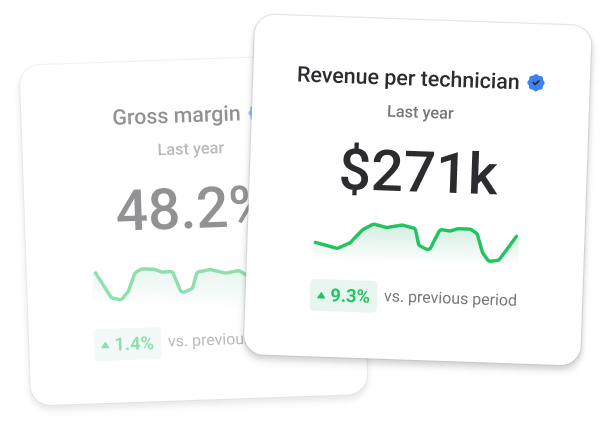
The trade is short around 110,000 technicians and the advice is always to recruit harder. You can’t tell whether you need another one or whether two of yours run at 61% while a third runs at 92%. ServiceTitan’s own account of what the industry is fighting names both stretching capacity too thin and leaning too hard on your best people as what follows.
An agent watches how full each crew actually runs and tells you on the Tuesday which ones are carrying the week and which ones aren’t. The hiring conversation starts from a number instead of a feeling, and you can ask it why in plain English.
What it looks like when the number turns up in time.
One of them runs ServiceTitan. None of them bought a dashboard.
“We have a ton of data in the system. But right now, I have to run individual reports to track that. Right now, it’s just a whole bunch of Excel spreadsheets.”
Elizabeth Kuerth, Marketing Director, Quality Comfort Home Services
Heating, air conditioning, plumbing and duct cleaning in Cincinnati, running on ServiceTitan. Revenue by ZIP code, by job type, campaign spend, campaign revenue, all of it in there. She was rebuilding it by hand every month. “It takes a long time … I just don’t have the capacity.”
- 8+ hours a month of hand assembly gone
- ~15 campaigns with a return attached to each
- Underperforming service areas found, and budget moved off them
That was their marketing. The crew and labour side, the part costing you $0 a year, sits in the same ServiceTitan account and nobody has pulled it out yet.
I needed something that could give us the KPI data we need across the business, that can communicate with the main systems producing data.Tim Peterson, Director. First Response.
I firmly believe that if you can’t measure it, you can’t manage it.Martin Saunders, Managing Director. Rivertrace.
Small errors in estimating and tracking add up job by job, and they only surface at month end. By then you’ve priced the same job the same way forty more times.
Actual hours and materials get checked against the estimate as each job closes. An agent flags the job types drifting over while there are still twenty more to quote, rather than after the quarter has been priced on a bad assumption.
What is your unsold crew time worth?
Three numbers you already know. We’ll do the arithmetic.
Built from the numbers on the left, and it moves with them. Claiming the whole gap would be dishonest, since some of it you would never have caught. This is the share you would.
Long shifts, high stress and no visible progress is the standard account of why a good technician leaves. Pay, coaching and commission all rest on a number nobody can produce on a Tuesday.
Every technician’s number against their own target, on the warehouse screen each morning without anyone assembling it. An agent flags the ones trending the wrong way while there is still time to coach rather than count.
Find out while you can still
do something about it.
Half an hour with an engineer who has done this build. You’ll leave knowing whether your dispatch system can be read, what it would take, and what it costs. If it doesn’t add up on your figures, we’ll say so.
Book your assessment Every week you wait costs about $0, on the numbers above.