
At a glance
- Intera had years of performance data, dashboards, metrics, goals, and definitions already in Databox.
- Its weekly business performance review became one of the first recurring processes Intera turned into an AI workflow.
- Performance questions that require deeper analysis can now often be investigated in about 15 minutes.
- Review preparation dropped from two to three hours to an automatically prepared analysis Peter can review in about 15–20 minutes.
- The leadership team can access the same metrics and reports and use the AI Analyst to investigate performance before and during reviews.
Getting from data to insight required too much back-and-forth
Intera had been using Databox for several years to combine data from Intrix with marketing, product, financial, and spreadsheet data. Teams had dashboards for their own areas, while Peter kept a smaller set of company-level dashboards that he checked regularly to understand how the business was tracking against its goals across markets.
The problem came when something looked off. If a market was falling behind target or a metric changed unexpectedly, Peter needed to understand what was driving the change and whether Intera should respond.
Peter could look into the data quickly, but deeper analysis often meant involving the relevant team. If the answer raised another question, the cycle started again. That back-and-forth made it harder to move from a number to a decision as quickly as he wanted.
The dashboard was usually the beginning of the question. I could see that a number was below target, but as CEO, that is not enough for me to make a decision. I want to know why it is below target and whether we need to change something.
 Peter Ladič
CEO, Intera
Peter Ladič
CEO, Intera
From one-off AI analysis to recurring performance reviews
When Databox introduced the AI Analyst and its agentic capabilities, Peter started testing it with questions he would normally send to someone on his team. He could ask why a market was behind target, follow the answer with another question, and get to the underlying cause in minutes.
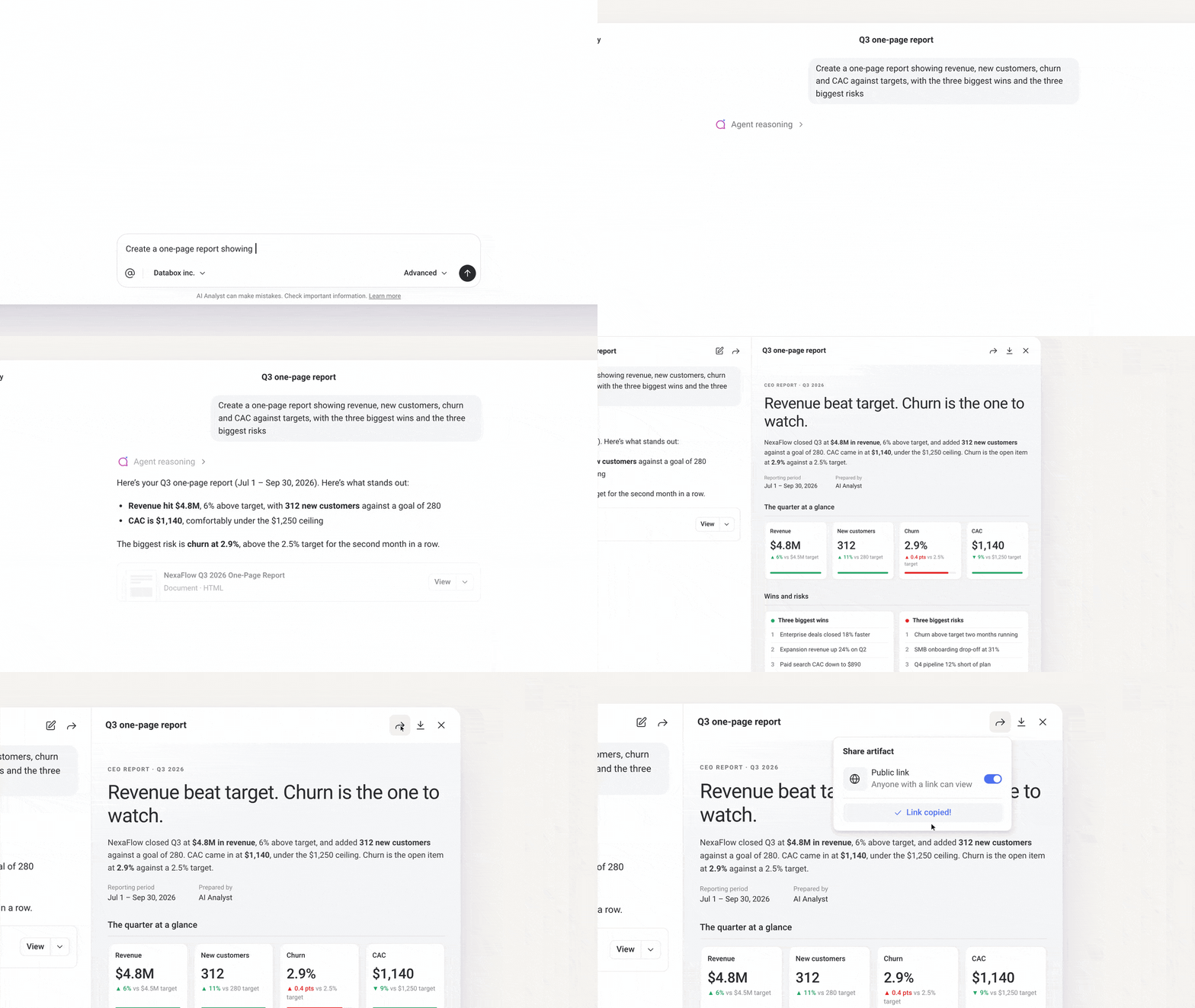
At first, Peter mainly used the AI Analyst for one-off questions. As Intera explored the broader agentic capabilities in Databox, the team started looking at its existing analysis and reporting processes to see where AI could improve, automate, or partially delegate the work.
Its weekly business performance review became one of the first recurring workflows they chose to build out fully.
The first few times I used AI Analyst, I remember thinking, wow. These were questions I would normally send to the team and wait a day or two to get answered, and now I was getting there in minutes. It immediately made me wonder what else we could do with it.
Peter Ladič
CEO, Intera
Building the weekly performance review
Much of what Intera needed was already in Databox. Over several years, the team had connected its core data sources and built the dashboards, goals, metrics, datasets, and definitions it relied on.
To build the workflow quickly, Peter worked with the Databox team to map how Intera already reviewed the business: which markets and metrics the team looked at, the questions they asked when something changed, and the context they needed before making a decision.
That process became a Skill that captured how the review should be run, what context to consider, and how the final analysis should be structured. They also connected Monday.com and other business tools through MCP connectors, giving the AI Analyst access to project, pipeline, and other operational context beyond the metrics already in Databox. The result was saved as an Artifact the team could review, refine, and use in the weekly business review.
Once the process was defined, they added a Routine to run it automatically before each review, so the analysis was ready when the team needed it.
The workflow did not stop with the finished Artifact. Depending on what it surfaced, Peter could continue the investigation with the AI Analyst, ask for recommendations, and move the follow-up action into the tool where the team would actually carry it out.
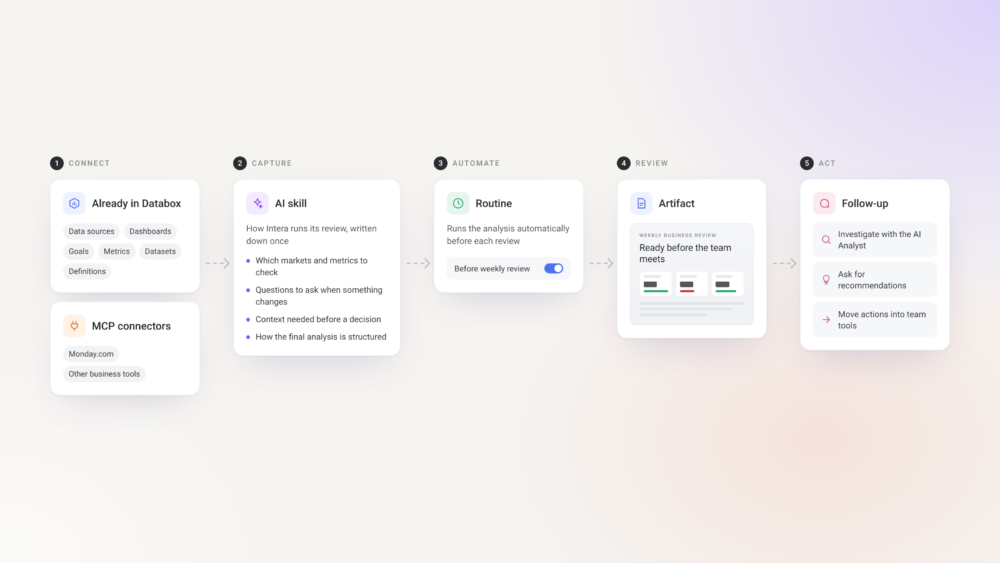
If the analysis points to something we need to follow up on, I can ask the AI Analyst for a recommendation, decide what we want to do, and have it create a task in Monday.com for the right person to review and act on.
Peter Ladič
CEO, Intera
Review preparation dropped from hours to minutes
Performance questions that previously required additional investigation or follow-up can now often be worked through in about 15 minutes.
The weekly business review has changed too. Instead of spending two to three hours preparing the analysis and presentation, Peter now opens Databox with that work already completed. He spends around 15–20 minutes reviewing the Artifact, asking follow-up questions, and deciding what to bring into the leadership discussion.
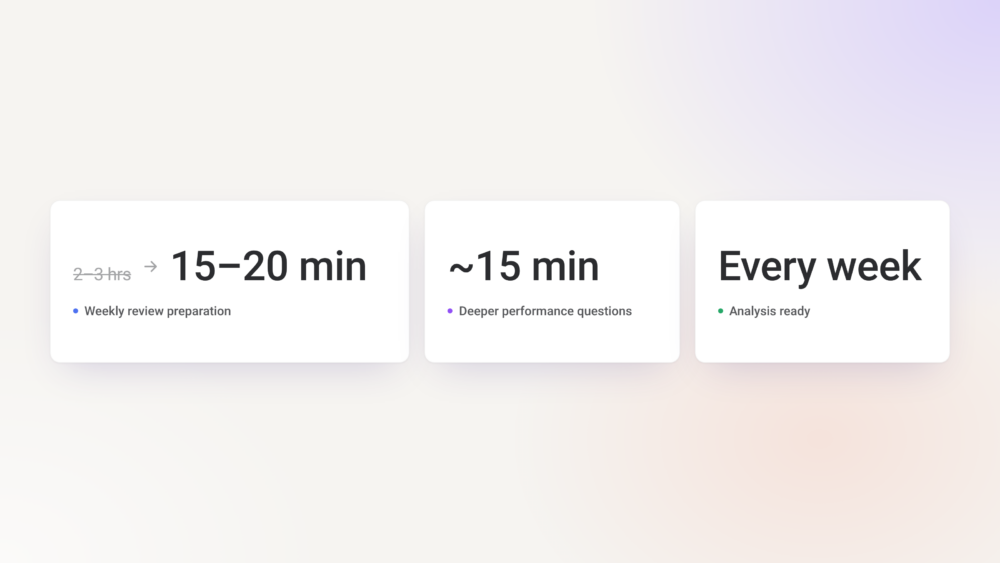
The change also affects the people around him. Teams spend less time preparing additional cuts of the data, while the leadership team comes into the review with access to the same metrics, reports, and analysis.
If a new question comes up during the meeting, the team can investigate it with the AI Analyst while the discussion is still happening.
The team spends less time pulling together extra analysis for me, so we can use the meeting to discuss what the results mean and what we want to do next. If a new question comes up during that discussion, we can ask the AI Analyst right there and keep the discussion moving instead of turning it into another follow-up for later.
Peter Ladič
CEO, Intera
Expanding the same approach across Intera
With the weekly business review running as a repeatable workflow, Intera now has a model for evaluating other recurring analysis across the company.
The team is starting with processes it already understands well, including deeper market reviews and quarterly planning, then looking at where the same combination of connected data, business context, and defined analytical methods could reduce manual work.
Peter’s advice is to start with an existing process rather than trying to introduce AI everywhere at once.
Pick a review you already run regularly and write down how you actually do it. What do you look at, what questions do you ask when something changes, and what do you need before you can make a decision? Once we did that, it became much clearer where AI could help.
Peter Ladič
CEO, Intera
See where AI can improve your performance workflows
Book an assessment call with our team to identify the recurring analysis and reporting processes you could automate, improve, or delegate with Databox.