
Results at a glance
Preparing every client report by hand
Brian runs Kellcat on his own and wants to serve more clients without hiring, so the hours that go into reporting decide how far the firm can grow. Before Databox, that reporting was spread across several tools. Once the books were done, he pulled numbers from QuickBooks or Xero, built charts in spreadsheets, and wrote each client’s report in Google Docs.
Most of the effort went into explaining what the numbers meant for that particular business and what the owner should do next. Every new client added another report to prepare each month.
“Writing every client’s story by hand in Google Docs, every month, would put a hard cap on how many clients I can serve on my own,” Brian explains.
The reports also focused primarily on financial data and reflected the business at the time they were prepared. Brian wanted to give owners a more useful view of performance, with numbers they could keep checking between monthly reviews and eventually a broader picture of how activity across the business affected cash flow and profitability.
Seeing how the AI Analyst could help with reporting
Databox appealed to Brian because it could bring client data together and help turn those numbers into a report.
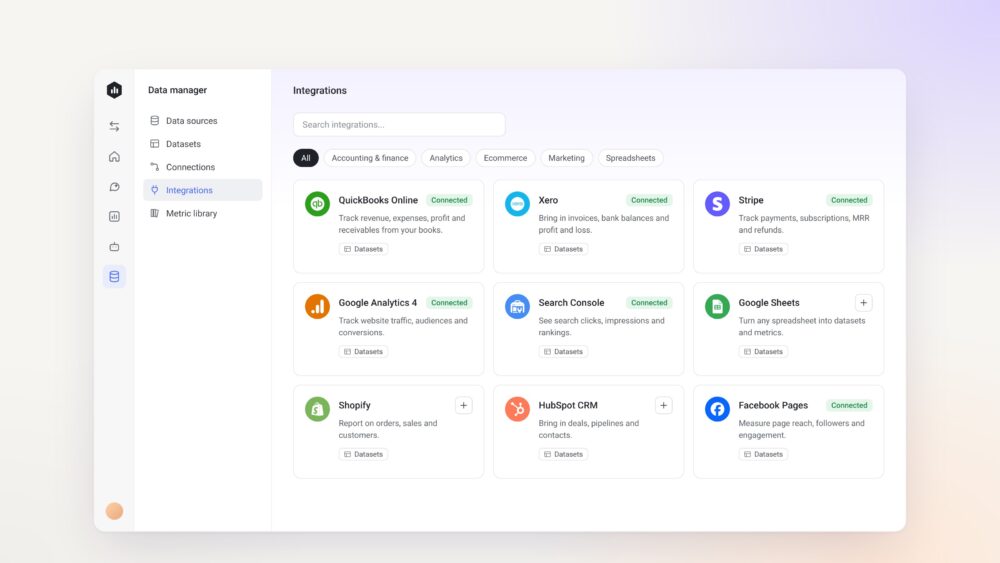
Its native integrations supported the wider view of the business he wanted to give clients, while the AI Analyst could help build reports, explain performance in plain language, and answer questions using the data, metrics, and business context available in the account.
Brian saw an opportunity to hand off more of the reporting preparation while keeping his own judgment at the center of the service.
“It explains the data in plain language and answers questions about the numbers, which is exactly the advisory piece I used to write by hand,” Brian says.
Building a consistent reporting process for each client
To make the process repeatable across clients, Brian uses Databox’s client accounts to manage their reporting under Kellcat.
“Clients sit under my account, so I can connect their books and share dashboards without each client having to buy a subscription,” Brian explains.
Within each account, he connects financial data through Databox’s native accounting integrations and uses the AI Analyst to help build the relevant metrics and dashboards.
Each client gets a version of Brian’s master dashboard built from their own financial data. It covers core measures including revenue, net profit and margin, gross margin by offer, cash on hand, accounts receivable aging, and operating expenses.
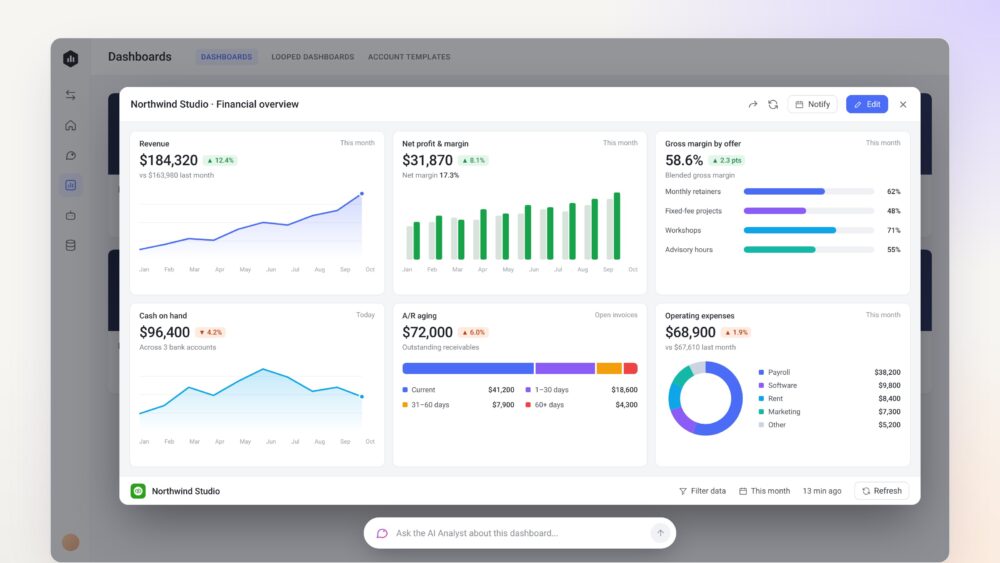
The AI Analyst also helps Brian work through those numbers, using historical data for comparisons and taking the client’s goals and business context into account so the analysis reflects what matters to that business.
As Brian launches Kellcat’s broader advisory service, he is bringing marketing and operational data into the same view. Connections such as Google Analytics will give him and the AI Analyst more context when exploring what is driving performance across the business.
Using the AI Analyst to deliver the Books & Numbers Review
One workflow Brian now handles with the AI Analyst is Kellcat’s Books & Numbers Review, a no-cost first step for prospective clients.
The review lets prospects see what working with Kellcat looks like using their own books. It also helps Brian understand the condition of the books and the work a new client would need, so he can price the service more accurately.
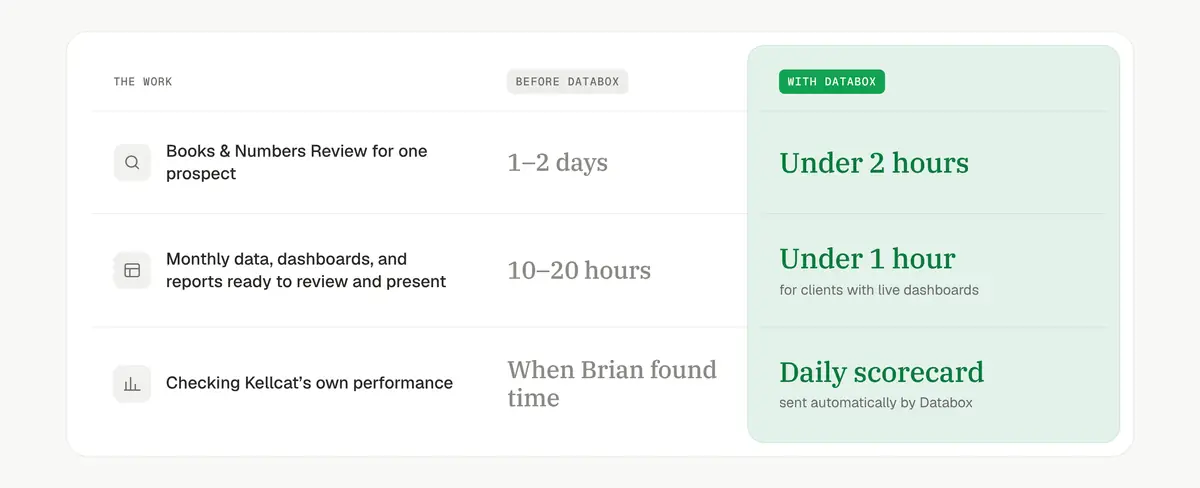
Before Databox, preparing that level of personalized review required Brian to do the work by hand. He estimates that the process took one to two days, which made it difficult to offer as a no-cost first step to every prospect.
Today, Brian hands off much of the preparation to Databox and the AI Analyst. After connecting the prospect’s accounting data and running his own accounting checks, the AI Analyst helps build the financial metrics and dashboard and drafts the written review. For each measure, it identifies a win, a watchout, and explains what the numbers mean for the business.
Brian can then ask follow-up questions as he works through the findings. He reviews the analysis, checks it against the books, and makes the final decision about what to recommend.
“I review, make changes, and approve every report before a client sees it,” Brian says.
Once the report is ready, Brian walks the prospect through it on a 30-minute results call and prepares a proposal based on what the review uncovered. By that point, the prospect has seen their own numbers explained and has a clear idea of the type of advice Kellcat provides.
A review used to take me 1 to 2 days. Now it takes under 2 hours, which is what makes it practical to offer every prospect as a no-cost first step.
 Brian Kelly
Founder, Kellcat
More capacity to deliver personalized advice
Making the Books & Numbers Review faster has allowed Brian to turn it into Kellcat’s standard first step with new prospects. The impact also carries into his ongoing client work.
- Monthly reporting preparation fell from 10–20 hours to under one hour for clients with live dashboards. Brian spends less time pulling together data and writing reports, leaving more time to review the findings and decide what each client should do next.
- Questions about client performance can be answered in minutes. Brian can investigate the numbers with the AI Analyst instead of building another spreadsheet whenever a new question comes up.
- Kellcat’s own performance is reviewed more consistently. Brian now receives an automatic daily Databox scorecard on his business metrics instead of checking them whenever he finds time.
The time Brian gets back goes into advisory work and improving Kellcat’s systems. For a founder who still handles sales, delivery, systems, and client advice himself, that gives him more capacity to support clients without adding the same amount of manual reporting work.
“I spend far less time per client, so I can serve a lot more clients in the same hours,” Brian says.
Brian’s advice for other business leaders
Brian recommends starting with a process you understand well and building it in a way that can be repeated.
“Fix the data first. AI can only explain the numbers you give it, so for a business, that starts with clean books. Then build once and duplicate: create one great dashboard and template, and reuse it everywhere,” Brian says.