

Single-platform MCP servers solve the data-fetching problem. They don’t solve the problem that actually matters: computing the cross-tool metrics your decisions depend on.
TL;DR
- Every meaningful revenue metric is cross-tool. Blended ROAS lives across ad platforms. Marketing-sourced pipeline lives across CRM and marketing automation. Forecast accuracy lives across CRM and sales engagement. NRR lives across billing and CRM. Single-platform MCP servers cannot compute any of these, no matter how well they connect.
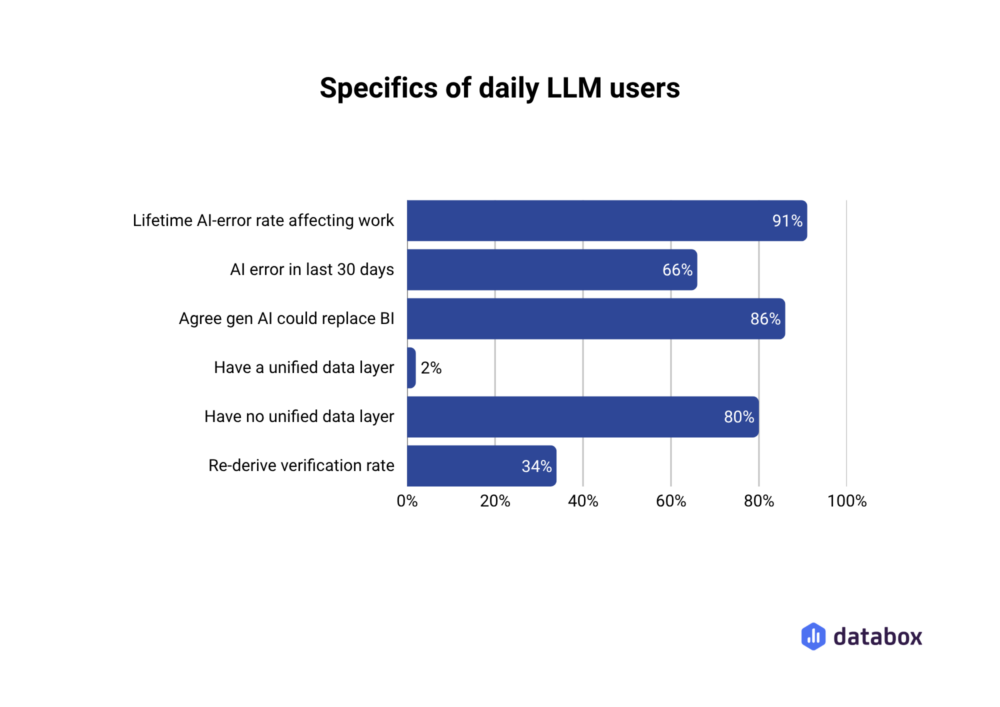
- 74% of business users have shipped a decision, report, or shared output based on a generative AI number that later turned out to be wrong. Among daily gen AI users, that lifetime rate is 91%. (Databox, Using AI You Don’t Trust: How Business Users Actually Run Analytics in 2026.)
- Two architectures can compute cross-tool metrics reliably: a data warehouse plus semantic layer (Snowflake, BigQuery, Cube; data team required), or a pre-modeled cross-platform metrics service (Databox; no data team required).
- Every other MCP server on the standard “best of” lists is a data pipe. Useful for records and single-platform answers, useless for the metrics revenue leaders actually put in front of a CFO.
- Start building your MCP stack from your highest-stakes cross-tool metric, not from whichever server has the easiest setup guide.
Every MCP server list published this year tells you the same thing: connect your CRM, connect your ad platforms, connect your analytics, and let the AI answer your questions.
None of them ask the question that actually determines whether you can act on the answer: once the AI has data from four different sources, what’s computing the metric that spans them?
A VP of Marketing reallocating $150K in paid spend needs blended ROAS across Google and Meta computed correctly. A VP of Sales reviewing a quarter needs forecast accuracy computed across CRM stages, rep activity, and engagement signal. A Head of RevOps modeling capital efficiency needs LTV, CAC, and payback period computed from data that lives in six different SaaS tools. A CS leader defending renewals needs NRR computed across billing, product usage, and CRM.
Not one of those metrics lives in a single platform. Not one of them can be answered by a single-platform MCP server, no matter how cleanly it connects.
That’s the layer most “best MCP servers” lists skip entirely. This article puts the cross-tool problem at the center: evaluating each server on whether it can compute the blended metrics revenue and operations leaders actually make decisions with, and naming the two architectures that can, plus the one designed for functional leaders who don’t have a data team.
Every meaningful revenue and operations metric is cross-tool
The Model Context Protocol (MCP) is a standard that lets AI assistants (Claude, ChatGPT, Cursor, and others) pull live data from external tools. An MCP server for HubSpot lets your AI agent access deal records without you exporting a CSV. An MCP server for Google Ads lets it pull campaign performance without you writing an API call. That’s genuinely useful. It eliminates the data-fetching bottleneck that used to sit between a leader and an answer.
But fetching is not computing. And single-platform is not cross-platform.
Consider what a real decision actually requires:
- Blended ROAS across paid channels. Requires spend and revenue from Google Ads, Meta, LinkedIn, TikTok, weighted by spend, with consistent attribution windows. No single ad platform MCP can answer this.
- Marketing-sourced pipeline. Requires deal data from the CRM, campaign attribution from the marketing automation platform, and a shared definition of “marketing-sourced.” Neither the CRM MCP nor the marketing automation MCP has the other side.
- Forecast accuracy. Requires historical deal outcomes from CRM plus rep activity from sales engagement plus engagement signal from conversation intelligence. Three tools, three MCP servers, one metric none of them can compute alone.
- NRR by cohort. Requires MRR from billing, expansion and downgrade events from CRM, and churn signal from product usage. Same problem.
- LTV to CAC ratio. Requires customer lifetime revenue from billing plus fully-loaded acquisition cost from ad platforms, plus sales compensation from HRIS. Four sources, one number.
When an AI agent has to compute any of these, one of two things happens under the hood. In one architecture, the agent pulls raw data from each MCP server and the LLM attempts to combine and calculate. It reads numbers from different contexts, weights them (or forgets to weight them), and returns a result that looks confident regardless of whether it is correct. In the other, the agent routes the question to a query engine that has the data pre-modeled, executes the calculation on real infrastructure, and returns a computed result the LLM merely presents.
The output looks the same in a chat window, but the reliability is not the same at all.
The data on how often the difference matters is worse than most leaders assume. Databox’s Using AI You Don’t Trust research found that 74% of business users have shipped a decision, report, or shared output based on a generative AI number that later turned out to be wrong. Among daily generative AI users (the population most revenue leaders are becoming), the lifetime rate hits 91%, and 66% have done it in the last 30 days. Yet 69% of those same users lean on generative AI often or always for analysis they share with leadership, boards, or clients. In an error-detection test the same survey ran, only 5% caught all three real errors planted in AI output. That is the baseline reality of AI-assisted analytics right now: high usage, low catch rate, decisions shipped on numbers nobody verified.
The evaluation framework for the rest of this article applies two criteria to every server: what it connects to (table stakes) and whether it can actually compute across sources (the criterion that determines whether a revenue leader can act on the answer).
The most-recommended MCP servers for CRM, paid media, sales engagement, analytics, and SEO are useful data pipes, but they cannot compute the cross-tool metrics revenue leaders own
Every marketing and sales MCP list covers roughly the same categories. The servers below are the ones that appear most frequently, evaluated against both criteria: what they connect to and what they can compute.
CRM: HubSpot and Salesforce MCP servers
What they connect to: HubSpot’s MCP server exposes contacts, deals, companies, tickets, and pipeline stages. Salesforce MCP servers (multiple community-built options exist alongside Salesforce’s Agentforce ecosystem) expose objects, reports, and SOQL queries.
What a revenue leader actually asks: “How many marketing-sourced deals closed this quarter, and what’s the average deal size by campaign?” or “What’s our forecast accuracy by rep for the last two quarters?”
What the server can and cannot compute: Both servers are strong at record retrieval and single-object aggregation: count of deals in a stage, sum of deal values, deals by owner. Any question that requires data from the CRM plus data from another system (marketing automation for source attribution, sales engagement for rep activity, billing for realized revenue) puts the calculation in the LLM’s hands. For a raw count, that’s fine. For a weighted, filtered, or joined calculation, it’s not.
Read/write capability: HubSpot’s MCP server supports both reads and writes: creating contacts, updating deal stages. That’s useful for workflow automation but orthogonal to the computation question.
Verdict on cross-tool trust: Trustworthy for single-object CRM questions. Not equipped to answer any cross-tool metric a revenue leader owns.
Paid media: Google Ads and Meta Ads MCP servers
What they connect to: Campaign performance data: spend, impressions, clicks, conversions, and cost metrics across campaigns, ad groups, and creatives.
What a marketing or RevOps leader actually asks: “What’s our blended ROAS across Google and Meta for Q2, weighted by spend?”
What the server can and cannot compute: Single-platform metrics (ROAS on Google alone, CPA on Meta alone) are pre-computed by the ad platform itself and returned reliably. Any cross-platform blend (ROAS across all paid channels, blended CAC including LinkedIn and TikTok, cost per pipeline dollar) requires combining outputs from multiple servers. The LLM ends up doing the arithmetic, and blended ROAS specifically requires weighting by spend rather than averaging the two figures. Language models frequently miss that.
Read/write capability: Mostly read-only. Some implementations allow campaign creation or bid adjustments, but the primary use for revenue leaders is performance retrieval.
Verdict on cross-tool trust: Reliable for single-platform, pre-computed metrics. Unreliable the moment the question crosses platforms, which is exactly the moment the metric starts to matter for budget allocation.
Sales engagement and conversation intelligence: Gong, Avoma, Outreach, and Salesloft MCP servers
What they connect to: Meeting transcripts, call outcomes, deal-level engagement signal, rep activity metrics, sequence performance.
What a sales or RevOps leader actually asks: “Which deals stalled in the last 30 days despite high engagement signal, and what’s the pattern in the calls?”
What the server can and cannot compute: Activity retrieval, transcript search, and single-tool aggregation (calls per rep, sequences per deal) are the strong use. Anything that joins engagement data to CRM outcomes (the actual work of forecast accuracy, deal-risk scoring, or rep effectiveness) routes the join and the calculation through the LLM.
Read/write capability: Read-oriented for intelligence retrieval. Some servers support scheduling or sequence enrollment.
Verdict on cross-tool trust: Strong for conversation and activity intelligence within the tool. Not built to compute the CRM-plus-engagement metrics that actually predict pipeline outcomes.
SEO and competitive intelligence: Ahrefs and Semrush MCP servers
What they connect to: Keyword rankings, backlink profiles, domain authority, traffic estimates, and competitive gap data.
What a marketing leader actually asks: “Which of our target keywords dropped more than 5 positions in the last 30 days, and what’s the estimated traffic and pipeline impact?”
What the server can and cannot compute: Ahrefs and Semrush pull pre-indexed data from their own databases. Ranking positions and traffic estimates arrive pre-computed by the SEO platform. The cross-tool problem shows up the moment a marketing leader asks the AI to tie SEO performance to pipeline or revenue data from another source. That correlation is LLM-computed.
Read/write capability: Primarily read-only.
Verdict on cross-tool trust: Strong for platform-native metrics. Weak for tying SEO into any downstream revenue metric.
Analytics, BI, and warehouse: Google Analytics, Amplitude, BigQuery, Snowflake, and Cube MCP servers
What they connect to: GA4 surfaces web analytics. Amplitude and Mixpanel surface product analytics: funnels, retention, cohorts. BigQuery and Snowflake expose warehouse-level data via SQL. Cube’s MCP exposes the semantic layer sitting on top of a warehouse.
What a leader actually asks: “What’s the conversion rate from landing page to closed-won for our top 5 traffic sources, and how does it compare to last quarter?”
What the server can and cannot compute: This category splits into two tiers.
The application-analytics tier (GA4, Amplitude, Mixpanel) mostly pulls event or report data and hands the LLM the job of filtering, grouping, and joining. Multi-step funnel questions get LLM interpretations of raw events, not computed funnels.
The warehouse tier (BigQuery, Snowflake, Cube) is genuinely computation-capable: the LLM generates SQL or a semantic-layer query, the engine executes it, and a computed result comes back. Cross-tool metrics work here, assuming the warehouse is modeled correctly. The practical constraint is exactly that assumption: someone has to model the warehouse. A data team has to build the pipelines, agree on definitions, and maintain the SQL. For a functional leader without that infrastructure, the warehouse tier is architecturally right but operationally out of reach.
Read/write capability: Mostly read-only.
Verdict on cross-tool trust: Application-analytics servers fall into the LLM-computed category for anything beyond pre-built reports. Warehouse and semantic-layer servers are computation-trustworthy, but they solve the problem for teams with data engineering, not for functional leaders with a metric to defend.
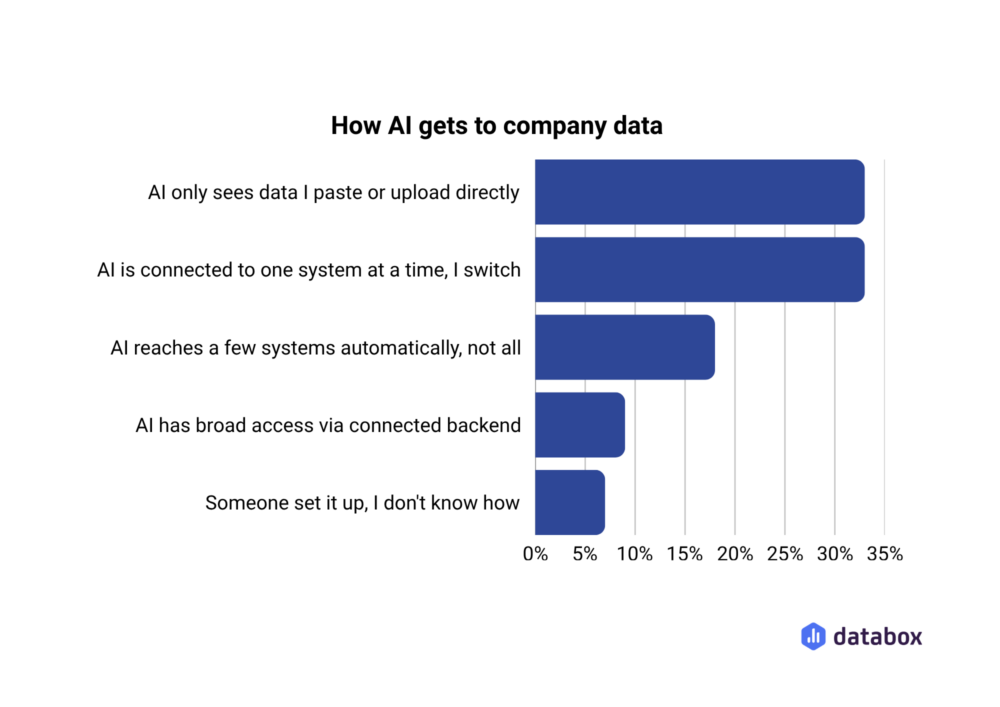
The pattern across these categories is consistent: connectivity is strong, cross-tool computation is either impossible (single-platform servers) or expensive to enable (warehouse tier). It also explains a finding buried in Using AI You Don’t Trust: only 9% of business users have a unified data layer their AI can query freely. 66% still feed AI by paste-and-upload or one-tool-at-a-time connections. That is the exact shape of a stack built from single-platform MCP servers without a cross-tool layer underneath.
A unified business metrics MCP (pre-modeled, pre-integrated, no data team required) is the layer most revenue and operations stacks are missing, and the only one where cross-tool decisions are safe to act on
The servers above solve connectivity category by category. What none of them solve is the cross-tool computation problem for the metrics revenue leaders actually own.
Two architectures can solve it. Both keep the LLM out of the math.
The warehouse + semantic layer architecture (Snowflake with Cortex Analyst, BigQuery with LookML, dbt Semantic Layer, Cube) routes questions to a real query engine that executes calculations on pre-modeled data. The LLM interprets the question and presents the answer, but the math happens in the database. This works. It requires a data team to build and maintain the model.
The pre-modeled cross-platform metrics service (where a vendor has already normalized data from 130+ SaaS sources into a metrics layer any client can query) is the same architecture aimed at functional leaders. Same computation trust. Different prerequisites for using it.
Databox’s Agentic Platform is that second architecture. All analytics run on a real data infrastructure stack: a query engine designed for analytics, not a language model guessing at arithmetic. Where Databox differs from Snowflake or BigQuery is the setup. The 130+ marketing, sales, product, billing, and finance integrations arrive pre-modeled, cross-source metrics are already standardized, and the MCP server exposes those computed metrics to any AI client. There is no warehouse to provision, no SQL to write, no data team to hire. The LLM’s role is the intelligence layer for business data: understanding the question, routing it to the right computation, and presenting the answer. The math itself is executed by an engine built for math. Data in, answers out.
In practice, a Director of RevOps at a mid-sized SaaS company connects Databox’s MCP to Claude and asks: “What’s our blended ROAS across Google Ads and Meta for Q2, weighted by spend?” The question goes through the LLM. The LLM does not calculate the answer. Databox’s query engine pulls the standardized metrics from the connected platforms, executes the weighted calculation, and returns a computed result. The LLM presents it. The number is correct because a query engine produced it.
The same pattern extends across every cross-tool metric revenue leaders own:
- A VP of Sales asks: “What’s our forecast accuracy by rep for the last two quarters, weighted by deal size?” The unified metrics MCP joins CRM outcomes to forecast history, weights correctly, and returns a computed number. Single-tool servers can’t answer this at all.
- A Head of Customer Success asks: “What’s our NRR by cohort, split by acquisition channel?” Requires billing data, CRM cohort data, and channel attribution. Three sources, one computed number.
- A CMO asks: “What’s our fully-loaded CAC by channel, and how does it compare to LTV by segment?” Ad spend from four platforms, sales compensation from HRIS, revenue from billing. One question, five sources.
The experience a practitioner gets from this architecture is distinct from adding an AI chatbot to a dashboard. Databox’s MCP connects to any AI agent already in use (Claude, ChatGPT, Cursor, custom workflows in n8n) and gives that agent access to correctly computed cross-tool metrics. It is not a new interface to learn. It is the computation layer that makes every existing AI interface trustworthy for revenue data. (Claude is currently the client that interacts most reliably with servers like Databox’s, though the MCP protocol is client-agnostic.)
Frequently Asked Questions
What is an MCP server, and how is it different from a regular API integration?
An MCP server implements the Model Context Protocol (MCP), an open standard that lets AI assistants like Claude, ChatGPT, and Cursor pull live data from external tools during a conversation. Unlike a traditional API integration, which requires a developer to write and maintain code to fetch and process data, an MCP server exposes data directly to the AI agent through a standardized interface. The practical result: a revenue leader can ask about ROAS or forecast accuracy in a chat window, and the AI retrieves the numbers without an engineering ticket in between.
Why can't single-platform MCP servers compute cross-tool metrics like blended ROAS or forecast accuracy?
Single-platform MCP servers can’t compute cross-tool metrics because the required data lives in different systems. Blended ROAS needs spend and revenue from every ad platform, weighted correctly. Forecast accuracy needs CRM outcomes plus sales engagement data plus historical forecasts. A single-platform MCP exposes one source, so the join and the arithmetic land in the LLM’s context window, and language models are pattern-matching systems, not calculators. Databox’s Using AI You Don’t Trust survey found that 74% of business users have shipped a decision, report, or shared output based on a generative AI number that later turned out to be wrong, and cross-tool calculations are where those errors concentrate.
How do I tell whether an MCP server routes calculations through the LLM or a real query engine?
Ask a question that requires computation across two data sources (like blended ROAS across Google Ads and Meta), then compare the result to a manual calculation. If the number matches your spreadsheet, a query engine likely handled it; if the number is off, the LLM did the arithmetic. You can also check the server’s documentation for terms like “query engine,” “semantic layer,” or “data infrastructure.” Servers that describe themselves purely in terms of “accessing” or “reading” data are typically LLM-dependent for anything beyond record retrieval.
How is Databox's MCP different from BigQuery, Snowflake, or Cube MCP servers?
Databox’s MCP is architecturally the same category as BigQuery, Snowflake, and Cube: a query engine handles the math instead of the LLM. The difference is the prerequisite. BigQuery, Snowflake, and Cube require a data team to model the warehouse, agree on metric definitions, and maintain the SQL. Databox arrives with the modeling done: 130+ marketing, sales, product, billing, and finance integrations pre-integrated, cross-source metrics pre-standardized, and the MCP server exposes them to any AI client. Computation trust is equivalent. Prerequisite to use is not.
Which AI clients work with MCP servers for revenue and operations data?
Claude, ChatGPT, Cursor, and workflow automation tools like n8n all support MCP connections. Databox’s MCP server connects to any MCP-compatible client, meaning a VP of Sales or Director of Marketing Ops can use their preferred AI tool and get correctly computed cross-tool metrics without switching interfaces. Claude currently interacts most reliably with servers like Databox’s, though the MCP protocol itself is client-agnostic. Computation quality depends on the server, not the client.
Do I need a data team to use an MCP server for cross-tool business metrics?
Not with Databox. Warehouse-tier MCP servers like BigQuery, Snowflake, and Cube compute cross-tool metrics correctly but require a data team to model the warehouse and maintain the SQL. Databox’s MCP delivers the same computation trust with none of the modeling overhead: 130+ SaaS integrations arrive pre-modeled, cross-source metrics are already standardized, and any MCP-compatible AI client (Claude, ChatGPT, Cursor) can query them directly. Functional leaders in marketing, sales, RevOps, and CS get computed cross-tool answers without warehouse infrastructure.
Should I replace my existing dashboard with MCP-connected AI agents?
No. MCP servers and dashboards solve different problems: MCP gives AI agents live access to your data on demand, while dashboards give your team a persistent visual of performance nobody has to ask a question to see. The value of a unified business metrics MCP like Databox is that the same computation engine powering your Databoards also powers the AI agent’s answers. A VP of Sales who reviews pipeline coverage on a dashboard Monday and asks Claude about forecast trends Wednesday gets the same number from the same engine, computed the same way.