
AI & agentic analytics implementation services
Know what’s working. Act on it without waiting.
We put AI to work for companies that want to move faster but don’t have the skills or people to build the systems behind it.
From numbers your whole team trusts to a function that runs without you
What AI systems we’d build for you depends on where you are today. All three of these are running in production now.
Ask your data
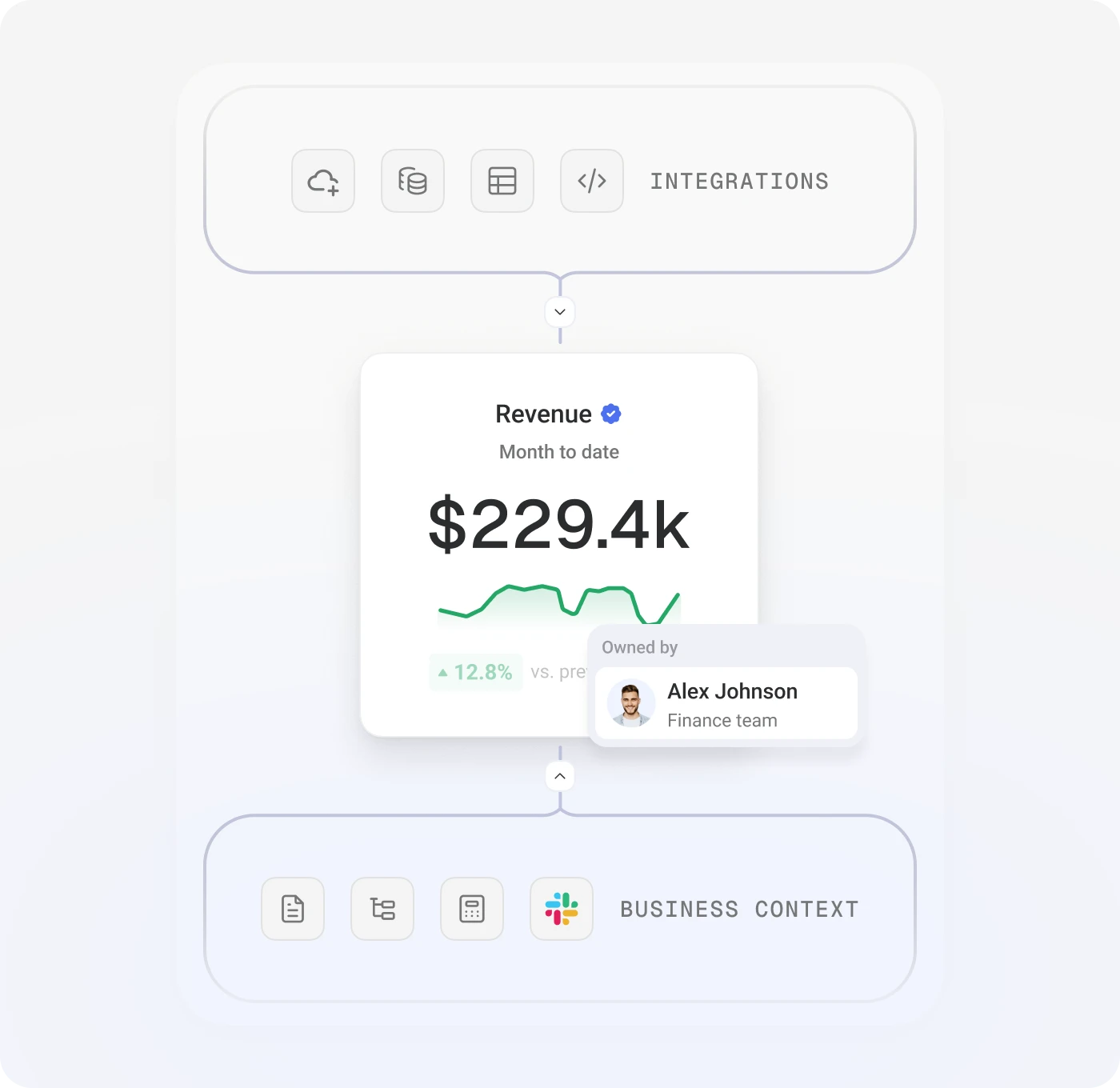
Your whole business in one view, and numbers you can trust
Performance data from every system your business runs on, plus the context that explains it, from Slack to your docs to call transcripts. Every metric across every part of the business, defined once with an owner behind it, so anyone on your team can ask anything and get an answer that holds up.
Act on insights
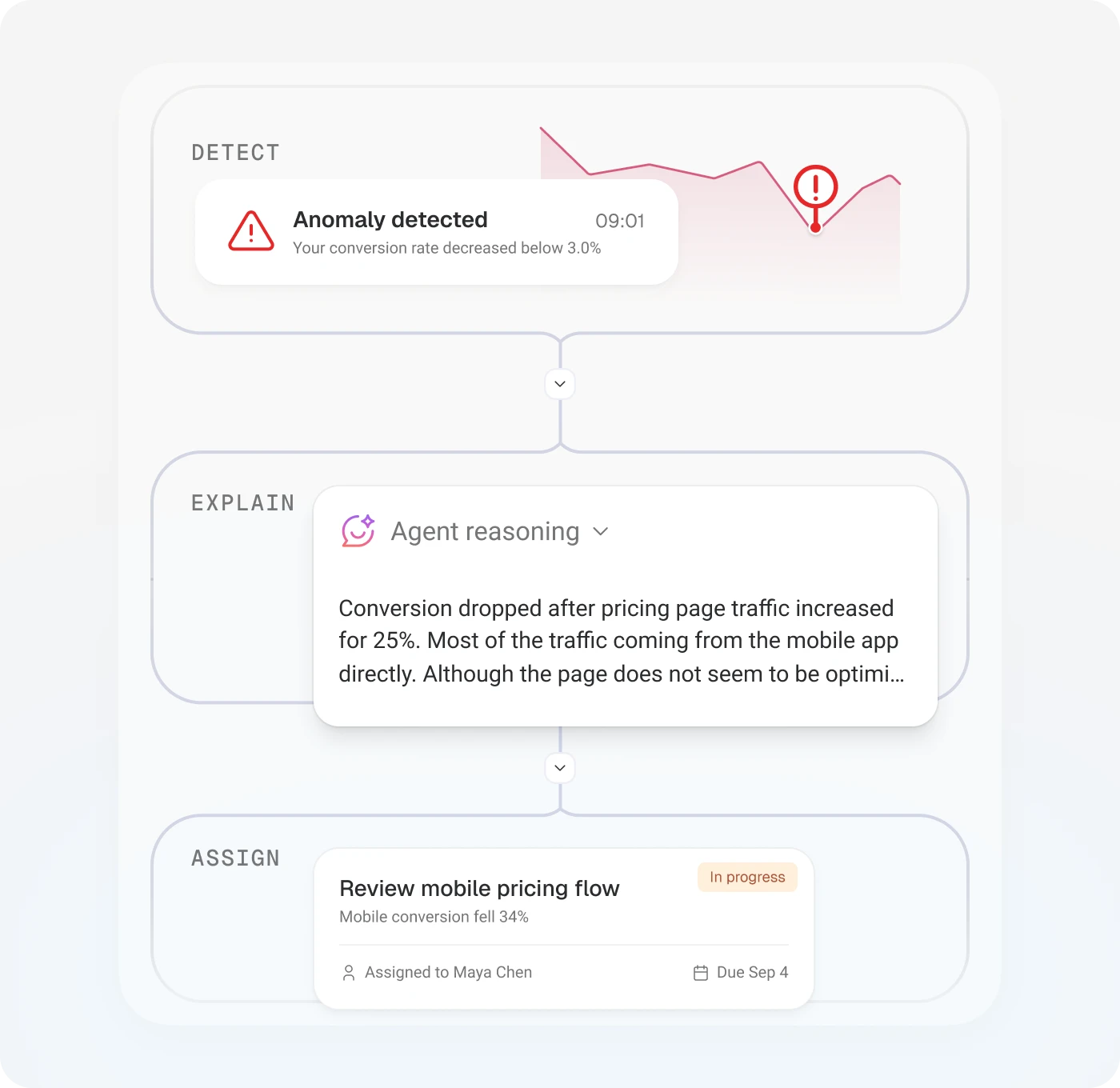
Find out while you can still do something about it
No person can watch every metric across every team and project at once. An agentic analytics system can. It runs constantly, explains what changed, and assigns the fix before a bad week turns into a bad quarter.
Bring data in
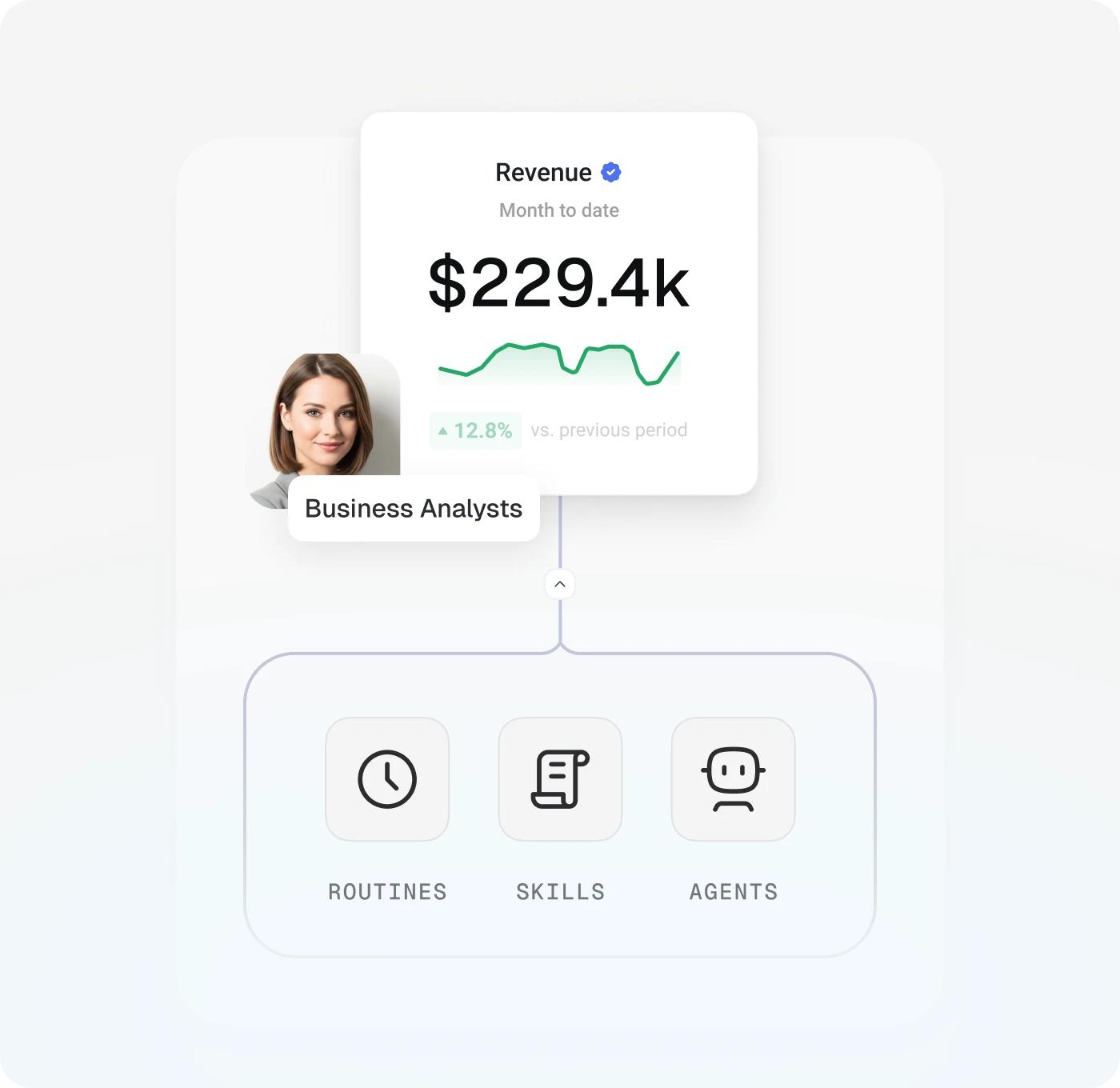
A whole system doing work that used to need your best people
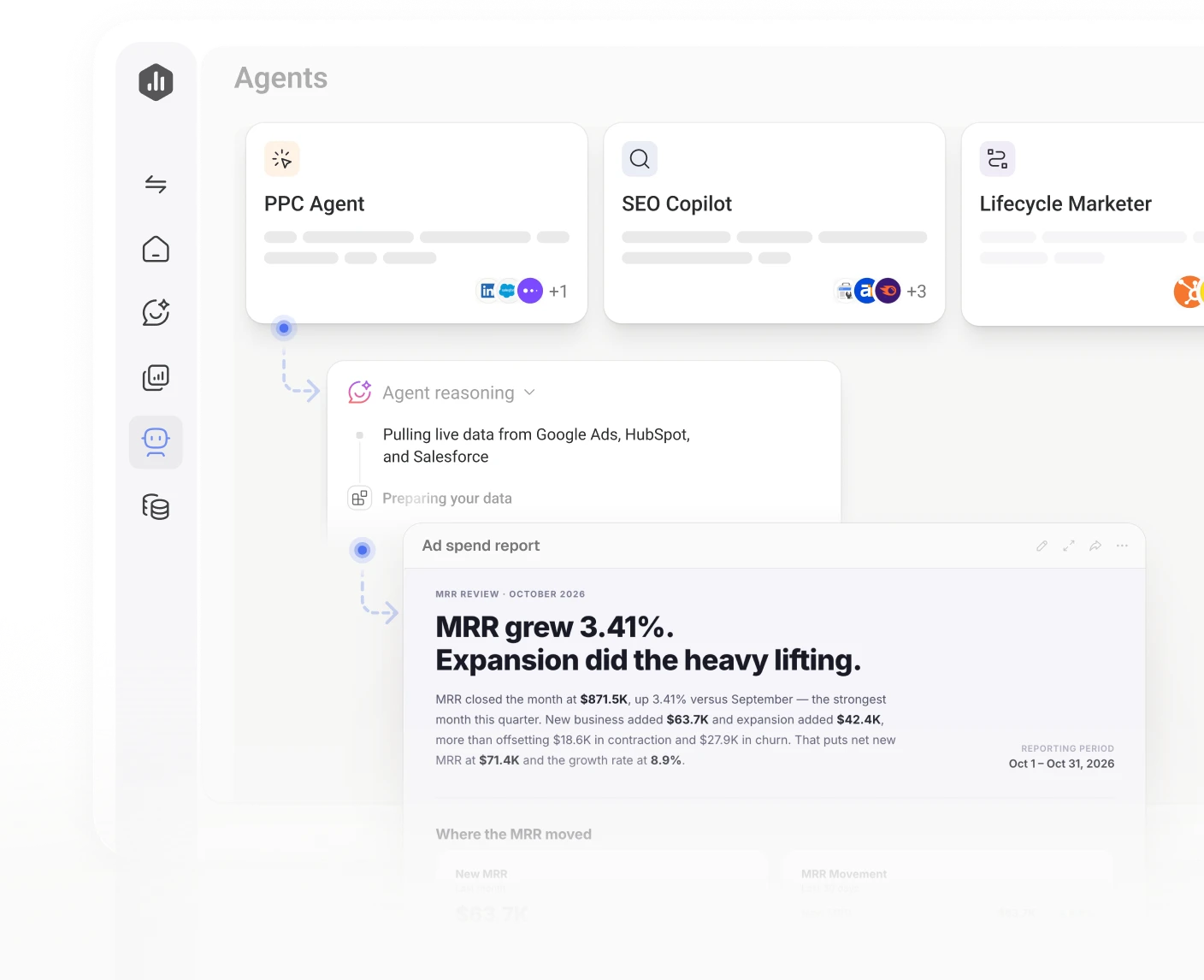
Content production, executive reporting, account management. Dozens of routines, skills, and agents working together, with a person approving what matters, and every action checked against the metric it was meant to move.
Every tool you run, connected into something that runs itself
AI that acts on your data, not just describes it. Built with Genie, our AI Analyst, and the same integrations your team already uses.
Everything in.
130+ one-click integrations, any spreadsheet, database, or API, plus context from your systems through MCP: Slack, Asana, your docs, call transcripts.
Work built anywhere.
Databox, Claude, n8n, Make, or wherever your team wants it built.
Actions out.
Tasks, messages, execution, and updates in the tools you’re already using.
Three ways to get started, based on how far you want to go
Each package builds on the one before it. All three start with your data, connected and governed the same way, then add more of what runs on top of it.
Package 1
Governed Reporting
Your data connected, governed, and built into reporting your whole team can trust.
Best for:
Teams that need a trusted foundation for consistent, reliable reporting.
- Account and workspace structure, user access and permissions
- Datasets, metrics, and a governed semantic layer for consistent reporting
- Goals, Databoards, and reports
- Custom integrations for data sources without a native connector
- Automatic delivery of reports to email, Slack, and other channels
- Team training and operational handoff
Package 2
AI-Powered Analysis
Genie configured and validated to deliver answers grounded in your metrics and business context.
Best for:
Teams that want AI answers grounded in how their business actually operates.
- Everything in Governed Reporting, plus:
- Genie business context setup
- Skills configured for your specific workflows
- External tool connections via MCP
- Routine configuration for scheduled checks and recurring tasks
- Genie accuracy validation against your metrics
- Post-launch AI tuning pass
Package 3
Company OS
Agents that run recurring work, act on insights, and continuously improve based on results.
Best for:
Companies that want AI to operate parts of the business, not just analyze them.
- Everything in AI-Powered Analysis, plus:
- Knowledge grounding across your docs, Slack, and call transcripts
- Forward-deployed engineer for continuous AI and integration improvements
- Agent configuration for defined, recurring tasks
- Past actions and outcomes inform future analysis and recommendations
- Continuous measurement and tuning against target metrics
- Quarterly business reviews and strategic tuning
Already running on Databox,
in their words
-
“We run 55 agents and 51 skills across 25 brands in 30 markets. When the system spots a risk or an opportunity it creates a task for a person, and then it checks back to see whether finishing that task moved the metric it was supposed to move.”
László Fazakas Arcanian Consulting
-
“Our content system pulls context from our own knowledge base and performance data from Databox to decide what to publish, what to optimize, and what to promote. Changes go live, and we measure the result on a fixed window before deciding what to do next.”
Keith Gutierrez Modgility
-
“Our first-party data told us to target a different region than the analytics platform did. Same model, different context, opposite recommendation. That’s the whole reason we grounded everything in Databox.”
Nian Wetsteijn FunnelView
-
“We built a financial health check on our accounting data through the Databox MCP server. When the data isn’t there, the report says so instead of guessing.”
Manav Mehra Wagman Digital
Built by people who already run these systems
4,500+
Pieces of content produced and optimized
Used to scale content operations while keeping teams focused on what performs and what to improve next.
1.2M+
Customer questions resolved
Support teams use structured insights to answer faster, reduce repeat work, and understand what customers need most.
1.2k+
Product improvements shipped
Product improvements shipped from analysis of tens of thousands of calls.
3.4M+
Conversations analyzed
Reviewed to uncover objections, trends, and revenue opportunities.
Get a free assessment
We’ll go through your data, your tools, and the work your team still does by hand. You’ll leave knowing what’s worth automating, what performance you could be improving, and which to start with.
Learn more
Frequently asked questions
Why not just connect Claude or ChatGPT to our data?
You can, through our MCP server. An MCP moves data and a prompt tells the model how you think about the business. Neither one decides what a metric actually is. Databox handles the APIs, working around the pagination and rate limits that cap what a source returns in one request, so the model isn’t analyzing a fraction of your data without knowing it. Metrics get calculated from definitions someone owns. Statistical analysis runs in a query engine rather than being approximated by the model. Without that, the same question can return two different numbers and nothing in the answer says which one you got. Gartner expects 60% of projects built that way to fail by 2028.
How much does this cost?
A Databox software subscription is required and priced separately. Build fees start in the low thousands and scale into the tens of thousands, depending on how many systems and how much data get connected, whether anything needs a custom integration, how many skills, routines, and agents get built, and how much of the work runs outside Databox. Governed Reporting starts lowest, the AI-Powered Analysis and Company OS packages scale up from there as more gets built. What happens after is up to you, whether that’s running it yourselves or keeping us on for maintenance and new work.
What’s your process for scoping and quoting?
The free assessment finds where this would pay off most for you: work your team is doing by hand, and performance you could be improving. If it looks like a fit, we run a longer session to work the scope out in detail, talk through budget, and send a quote.
How long does it take?
Simple things can be live in days. Larger builds get a timeline and a price during scoping.
Who owns the systems when you’re done?
You do. Everything gets built in your Databox account and the tools you already run, and we train your team on it. Keeping us on afterward is optional.
What do you need from us?
Access to your tools and data. If they’re already connected in Databox we can do a fuller assessment, though it isn’t required to have the conversation. Beyond that, time with the people running the business, since the system has to reflect how the business actually works.
How do you handle our data during the engagement?
Anything you share with us is treated as confidential and used only for the work we do with you. We’re also happy to sign an NDA before any work begins.
Do you work with tools outside Databox?
Yes. Databox holds the numbers and the context, and the work gets built wherever it makes sense, including Claude, n8n, and Make. Actions land in the tools your team already uses.