
Messaging Audit
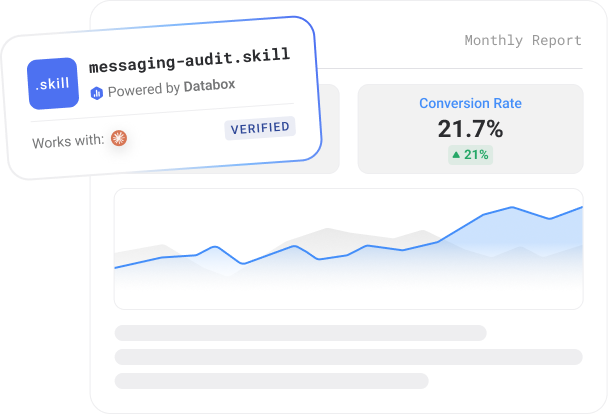
A Claude skill that pulls nine funnel signals live from Databox (GA4 required; HubSpot and Ads optional) and diagnoses which stage — Traffic→MQL, MQL→SQL, or SQL→Opportunity — is losing buyers, as one HTML report with a prioritized next step.
~5 minutes setup
Runs on demand
Claude + Databox MCP

Built by
The Write Way
For 15+ years, I've helped mid-market B2B tech and automotive companies break through the noise with GTM messaging and competitive positioning that actually converts. The typical result? 40% higher engagement and MQLs that show up for sales calls instead of ghosting.
How to use it
Step 1
Download the skill
Click Get it free above. The skill file downloads to your machine.
Step 2
Install in Claude
Open Claude Desktop → Settings → Skills → Install from file. Select the downloaded file.
Step 3
Connect Databox
The skill prompts you to connect your Databox account using the connector. This takes less than a minute, and you'll need a free Databox account.
Step 4
Trigger on demand
Type the trigger phrase in Claude — listed in the setup guide. The skill runs against your live Databox data and returns the output.
Built on Databox
No AI hallucinations. Analysis built on a real context layer.
Ask a generic AI to analyse your business performance and it will give you a confident answer. It will also be working from assumptions.
Generic AI doesn't know how your business defines a qualified lead, what your MRR calculation includes, or how you attribute revenue. It fills those gaps with the most plausible interpretation it can find — which is different from the correct one.
The products here run on Databox's data layer — if you choose so. Your metric definitions, your reporting logic, and your live numbers are what the AI reads, pulled straight through Databox MCP instead of uploaded by hand. That's the difference between an output you can share with your team and one you have to verify before you trust it.
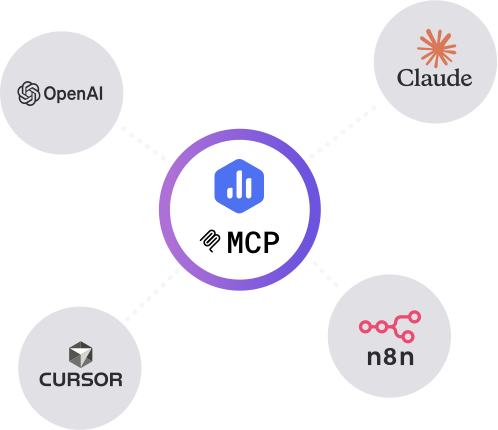
Connect any AI tool to your Databox data with Databox MCP.
Databox MCP is the bridge between your live metrics and any AI — Claude, ChatGPT, Cursor, or any client that speaks MCP. One auth, every workspace, no scraping.
Stay updated with new AI products
New skills, prompts, agents, and bundles ship every few weeks. Get them in your inbox.
More like this
AEO Report
Maps your brand's visibility across ChatGPT, Gemini, Perplexity, Copilot, and others - built from live GSC and GA4 data.


Works with
Claude
GA4 Website Traffic & Performance Report
Your weekly GA4 brief - sessions, channels, top pages, conversions, and anomaly flags - written from live Databox data.
Works with
Claude
SEO Performance & Visibility Report
GSC, GA4, and your SEO platform in one report - rankings, backlinks, conversions, and CTR opportunities from live data.


Works with
Claude
Built by
Executive Decision Brief
Turn your connected metrics into a one-page leadership briefing in minutes.
Works with
Claude
Common questions
What does the Messaging Audit do?
It runs a nine-signal diagnostic across your funnel — Traffic→MQL, MQL→SQL, SQL→Opportunity — and produces an HTML report that names which stage is where your messaging is losing buyers, with a prioritized next step. Every number is pulled live via the Databox MCP; nothing is estimated.
What data sources do I need?
Google Analytics 4 is required. HubSpot CRM is optional and unlocks the MQL→SQL and SQL→Opportunity stages; LinkedIn Ads or Google Ads is optional and unlocks the channel CTR signal. Whatever you don't have connected is simply left out of the report — no placeholder sections.
Is this a dashboard or a diagnosis?
A diagnosis. It doesn't dump metrics — it verifies the signals live, drops anything it can't stand behind (including a data-quality check on the lost-deal-reason field), and delivers a prioritized point of view on where to focus, in a report you can read in minutes.
Do I need a Databox account to use this skill?
Yes, ideally — and here's why it matters. Point a generic AI at a raw data export and it has to guess what your numbers mean: which conversions count, how you define an engaged session, what a "normal" week looks like. It fills those gaps with the most plausible interpretation it can find, which is often not the correct one. The skill avoids that by reading your data live from Databox through MCP, where your metrics are already standardized — one consistent definition for sessions, engagement, and conversions across your setup. The AI reads what's actually true for your business instead of inferring it, so the report is one you can trust rather than verify. You can technically run it against data you've pasted in by hand, but you lose that context layer and the output is only as reliable as the export. If you don't have an account or data source connected yet, the skill walks you through the setup.
Do I need a paid Databox plan to run this skill?
The skill is free to download. Running it requires the Databox MCP connection, which isn't included on the forever free plan. Every new Databox account starts with a 14-day free trial that includes everything the skill needs — after that, any paid plan covers it, including the Analyst plan.
Does this use live data from my connected source?
Yes — every run reads your live data directly from Databox through the MCP connection. The report reflects your current data at the moment you run it, not a cached or uploaded snapshot.
Do I need to export data manually?
No — there are no CSV exports and no copy-paste. The skill pulls your data straight from Databox through MCP each time it runs, so the report is always built from your live source.
Can agencies run this for multiple clients?
Yes — run it against each client's data connected in Databox, one account at a time, and you get the same structured weekly brief for every client. It's built to give a consistent report you can take to each client review.
Can I customize the report?
Yes. Before it runs, the skill asks a few onboarding questions — what you want to measure, the time frame, and any context that matters for the analysis — so the report is shaped to your goals from the start. After a run, you can give it feedback to adjust focus, sections, or anomaly thresholds, and reinstall the updated version so your changes carry into future runs.